Bonaire One Month and Counting

As I am sitting at the computer killing time, a pastime even for old people, I type one of our future destinations into the search bar and see what comes up. I use a different tag, like Bonaire or Bonaire diving or Bonaire tourism, each time so I do not end up with the same 24 sites. I peruse the stuff that is listed and save the sites that are interesting, or may be of some use, to a file in my favorites. Some time closer to the trip I will go through the websites one by one and glean the information that will be of use to us. The information may be of things to do or places to visit, sometimes it is of a more practical nature, like how to acquire a visa or how much the departure tax is and how it is to be paid. We keep a “real” file folder for each of our future destinations. It gathers the piles of paper that accumulates. I write down each of the pieces of info. I have gather on the outside of the file folder. Then if I think the electronic file could be of some future use or I want to discuss something it contains with Debbie I keep it, otherwise I delete it and get rid of the clutter.

Our trip to Bonaire is one month out and I have spent the last couple of days going through my Bonaire file. Here’s what I found. The order is random as that is the way it comes up and the information I keep isn’t necessarily connected in any way.

Bonaire, the boring stuff. The main ‘city’ has a Dutch name, not easy for us English speakers to imagine how it is pronounced. So, Kralendijk, is pronounced Crawl-en-dike. The tap water is potable and “is some of the best water in the world”, this is good as we will drink it and do our part by not contributing to the plastic bottle island that is developing in  the middle of our oceans. We carry travelers cheques instead of a credit card. The reason’s we will discuss in another blog, but what it means we have to know the banks that will cash American Express travelers cheques without a fee. The only bank in Kralendijk should do so and it is open between 8:30 and 4:00. We should be able to make it. Stores are generally open 8:00 to noon and 2:00 to 6:00. The island uses Atlantic Standard Time, which is the same as EDT. Tipping is 10 to 15% but review the bill as some restaurants add a “service charge” so no tip is necessary. The departure tax is $20 US so if you have to leave keep some cash on hand. Further to that, the web site said that if your plane ticket was purchased after Oct. 01, 2010 the departure tax should be included in the price of the ticket. We did purchase our tickets after Oct. 01, but I cannot find evidence that the departure tax has been paid so I think we will keep $20 each on hand, unless of course we need an excuse to stay. All jokes aside, I was once short cash to pay the departure tax while trying to get on a plane out of Mexico,  the lady took what cash I had and gave me the all important piece of paper. I don’t think any country really wants to keep a bunch of cash short tourists.

Bonaire, the good stuff. About a year ago several of our friend’s expressed an interest in learning to dive, they had the idea that we should go south and go on a diving trip. It sounded like fun so Debbie and I, being the experienced divers, started to research possible destinations. After sometime on the net and discussions with the crew at Subsea Experience, the dive shop we utilize, we thought that Bonaire would be ideal. It offers excellent diving and is does not require a vast amount of expertise to dive, great for our novice ensemble. Our preliminary searches indicated that people do not go to Bonaire unless they dive. In other words, there is not that much else to do and fortunately it does not attract the Caribbean holiday crowd. BUT, by spending a couple of hours on the web I found there are a few other diversions that should keep us occupied. Two of our traveling companions windsurf and kiteboard so they will be spending some time on the windward side of the island pursuing those activities. We all ride bikes. There are bikes for rent and a few miles of road that can be explored which qualifies as another diversion. Bonaire is one of the places where flamingos gather and they can be viewed in vast numbers at several spots. It is also possible to rent kayaks and paddle thru the mangroves for an afternoon. The thing that interests me the most is a once per month market that takes place, on the day we arrive, in the town called Rincon. We will not be able to dive that day anyway, we are taking the red eye from Houston and I don’t want to dive on minimal sleep, so I will definitely be attendance at the market. I was also able to find a few reviews on some of the shore diving sites. I will look for more but I think we should be able to determine a few ‘must see’ sites that we will take in. I got the names of a few restaurants to try and a few of the local dishes to try; maybe, iguana soup doesn’t really appeal to my senses but they say it is good.

It should be a busy 10 days. Who said, you go on holidays to relax????

Posted in Bonaire, Planning and Packing | Tagged , | Leave a comment

Scuba Diving List

Bonaire is a scuba diving trip.  Makes packing the scuba gear easy.  Everything goes!  Well, almost.

I crossed off the following items as they will not go to Bonaire – Panty hose (used to help get on a 7 mil or thicker wetsuit), warm dry clothes (used when diving in cold water), swim nose plug (won’t need it – no chlorine in the big pool).  Everything else goes.

You are probably asking how we take all this gear AND go carry on. We do it by pushing the weight limit and by sacrificing the amount of clothing we take.  How many clothes do you really need to take on a scuba dive/beach holiday to a hot climate?

Certification Cards and Dive Logs

It is important to take all your certification cards – dive and nitrox.  The dive shop will ask to see the cards to verify that you are qualified to dive.  Our dive logs are getting fat, so we have taken out the first 70 or so pages.  Other divers have told us that they have been asked to show their whole dive logs to verify the number of dives.  We have never come across this.  We need to watch the weight of our bags, so we have opted not to take the whole dive log. We take enough blank pages to write up all the dives we will be doing.

Wetsuits, Hoodie and Booties

We used to dive with rented shorty wetsuits and then one year, in Cozumel, I got touched by a long tendril of (we think) a jellyfish across my calf.  Stung nicely, so we asked for some vinegar at our favorite lunch stop to relieve the pain.  After that, we bought 2 – 3 mil wetsuits.  They are mostly for protection from the underwater environment and also for warmth.   Then Mur bought me a hoodie to wear under my wetsuit for warmth because I was getting cold on the second dive. When we bought our fins, we decided to buy ones that we could wear in cold water.  For cold water, we have booties for warmth, and the fins fit over the booties.

Safety Measures

We have slowly been adding safety items to our gear.  Dive computers for more accurate dive profiles, a compass, safety sausages.  Our dive computers are”Gekko”s made by Suunto. Fairly basic computers that handle oxygen and nitrox. We went on a “live aboard” dive trip around Tobago one year.  Everyone had to carry a safety sausage when diving in case we got separated from the group as the currents were quite strong. Murray and I thought the sausages were a good idea to carry all the time.  We each have one with about 15 ft of line and a tiny reel made out of a film canister.  They go in the pocket of our BCD in case we need them.

Snorkel and Swim Gear

We always carry our snorkels, swim shirts, caps and goggles as we love to snorkel and swim when we are not diving.  If we are going to the ocean, we want to spend as much time in the ocean as we can. Murray wears a do-rag as he is bald and the reflection off the water makes for a really red pate.

Camera Gear

A few years ago, we bought an underwater housing for my small Canon camera.  We have just loved taking pictures.  Then we bought a strobe flash so we could get better colour underwater.  That was an excellent buy and I recommend to anyone interested in underwater photography to invest in a strobe flash.

Batteries

One issue with going carry on is the weight of the batteries for the camera, strobe and the dive lights.  The camera and flash each take 4 AA batteries.  We take rechargeable AA batteries, a small charger and an extra set of regular AA batteries. The dive lights take 4 C batteries.We take Alkaline C batteries, but after reading another travel blog, we are going to investigate which type of battery weighs less.

Decongestants

When taking our open water certification, my daughter had trouble clearing her ears, so the dive master suggested we buy some Sudafed.  It comes in both children and adult doses.  We always carry some in case someone has ear issues.

Spare Glasses

I wear glasses. One dive trip, I realized I was destroying my favorite glasses by wearing them on the dive boat – they were getting salty and they were rusting! Since then, I have an old pair of glasses that I wear on the dive boat.

Fish Books

We have two small (5″ x 6″) booklets that we take for fish identification.  They are by Paul Humann and Ned Deloach.  They are “Reef Creature” and “Reef Fish”.  These are specifically for Florida, the Caribbean and the Bahamas. It is advertised that they are waterproof and fit in a BCD pocket, but we keep ours dry and on land. We also have the 3 volume Reef Set that we look at before we leave – it stays home.

Corks

Lion fish are invading the Caribbean and eating their way through all the fish.  There is a concerted effort to control this invasion, so the Bonaire National Marine Park asks divers to place a marker where lion fish are spotted. Dive operators supply markers, but have asked that divers bring wine corks to help with the supply of markers.  We have gathered a small sandwich bag of corks to take to aid in the cause.

The Rest

The rest of the items on the list are pretty normal. We have a box in the closet that holds all our dive gear.  I pulled the box down and we will go through it and divide up the stuff.  We will also double check the camera housing, strobe flash, batteries, dive computers etc to make sure they work properly.

Posted in Planning and Packing | Tagged , , , , | Leave a comment

Packing for a Quick Trip

I am flying to Abbotstford tomorrow to visit my daughter, who is going to school in Langley. I just finished packing for the two day trip.  Took me about a 1/2 hour. I am ready to go except my purse.  Here is what I did.

Got my bag out.  Laid it on living room floor (where there was good light for pictures!).


Gathered my running stuff as I plan to run on Saturday morning. It looks like rain in Langley all weekend, so I have to take a running jacket and hat. Taking my Garmin, so I don’t get lost! Grabbed some PJs, underwear and a pair of warm socks.


What to wear….It is not much warmer there than it is here, so I had better take some pants.  Jeans, long sleeved t-shirt, socks and underwear for the plane.  Shorts, 2 tops and 1 wool tee.  The wool tee is extra just in case it is colder than I expect. A warm layer – Fuzzy. All mix and match for optimum wearablitiy. Picked up my rain jacket on the way to the living room.


The jeans etc go on the sofa with my rain jacket in the “on the plane” pile.  The shorts, tees and fuzzy go on the floor in the “to be packed” pile. Threw in a scarf. Added some odds and ends to give to my daughter.


Grabbed a 1 litre ziploc and off to the bathroom.  Pulled out my travel cosmetic bag.  Shampoo and conditioner, moisturizers, toothpaste and hair goop into ziploc. Deodorant, floss, toothbrush, face soap, earrings and prescriptions into travel bag. On the way to the living room, grabbed my travel purse and eReader. The travel purse is bigger than  the one I normally carry. I will take it so my eReader will fit inside.

Packing…..Running shoes at the end of the bag.  Layered the clothes with the small cosmetic bag and Garmin bag so the pile extends across the tie down straps.  This will make the bundle tight and secure.  The 1 liter ziploc went at the top end as it will have to be pulled out to go through airport security.     DONE!           READY TO GO!

I am taking more than I really need for 2 days of casual visiting. If I forgot something, I can always borrow from my daughter and Langley does have stores! All that is left is to transfer my wallet, glasses etc from my everyday purse to my travel purse.  I will do this before I go to bed and double check and close my suitcase so I am ready to go in the morning.

See you in a few days!

Posted in Planning and Packing, Western Canada | Tagged , | Leave a comment

Important Documents List

The most important items that you take on a trip are a passport and some means of paying for stuff.  When you think about it, that’s all you really need.  You can buy clothes and toothbrushes and bandaids and cameras – you can buy it all.  Without proper identification and a credit card (or cash or travelers cheques), you can’t go far. We have created a list of documents, just so we don’t forget something important. It is now posted on the page called “Important Documents” under the Packing Lists menu item. Let me explain a few of the items.

Credit Cards

Murray and I both carry different credit cards.  We usually only use one – the Visa with Avion Points, but we both have cards as backups.  Murray also carries an AMEX credit card as it allows him to cash personal cheques if needed. Murray will talk about credit cards vs cash vs travelers cheques in a later post.

Copies of Important Documents

We each carry photocopies of birth certificates and passports hidden inside our luggage somewhere.  In case our passports go missing, we have these copies to help get replacements.  It also is a good idea to have photocopies of prescriptions, credit cards, entry visas and driver’s licenses.  I usually carry these copies inside a bag of various bags I have in my suitcase.  Instead of carrying photocopies, scan and email the copies to your gmail email account (or other web accessible sites).

Extra Passport Photos

Depending on where we travel, we take extra passport photos with us.  Researching entry requirements for each country will tell you if you are going to need photos when you arrive.

Words to Learn in the Local Language

After being in Vietnam and China, we put together a list of words to learn in the local language.  This list is on its own page also. It’s amazing the reaction you get when you say “Waitress, the bill please”  in Mandarin.  As I have some food “issues”, our list contains food items that are specific to me.  If you use this list, it should be modified.

Travel/Medical Insurance and IAMAT Cards

Always carry your Travel/Medical Insurance Cards.  These cards will supply phone numbers to call for information on where to find English speaking doctors.  We required a doctor in Belize once, and our Travel Insurance provider was able to provide us with one. IAMAT has a list of doctors available that are western trained.

Plane Tickets/eTickets/Hotel Reservations

We carry paper copies of all eTickets and hotel reservation confirmations.  We also keep all these in my gmail email account, in case we loose the paper copies.  This sounds like lots of backups of backups, but planning for the unexpected will help greatly in keeping the stress down if the unexpected happens.

Copies of City Maps

We added this item to our list last year after our trip to China.  We were carrying around the very thick Lonely Planet book just to use the map. For the Bhutan trip, we will photocopy, and perhaps laminate the maps of the cities where we will be going. These will fit into a pants pocket when we want them out of sight.


Posted in Planning and Packing | Tagged , , | Leave a comment

First Aid Kit Packing List

We always take a first aid kit with us when we travel.  The size of the kit varies greatly, depending on where we are going and how long we are away.  We could probably count on one hand how many times we really needed it, but those times makes it worthwhile to have it along.

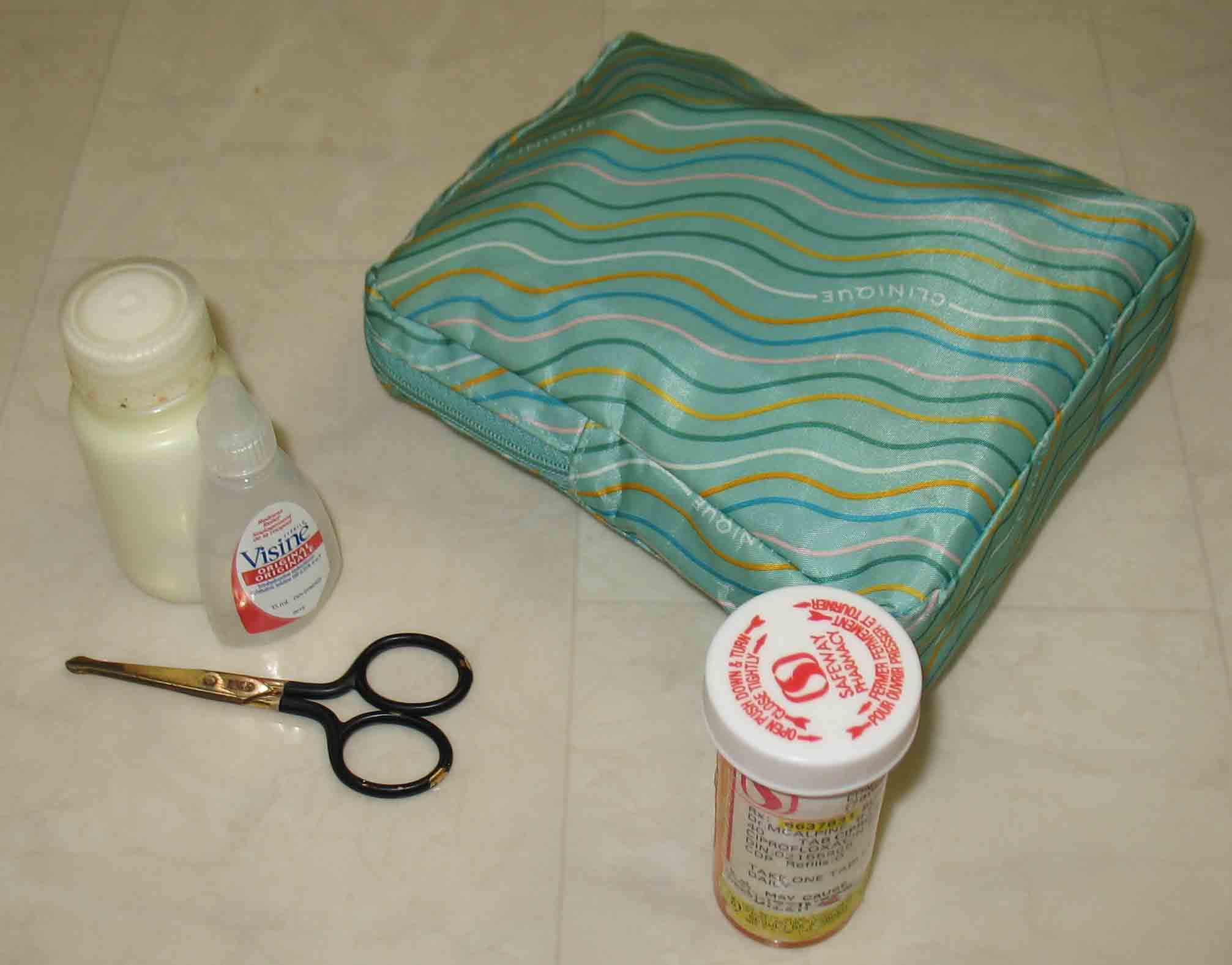
I have been collecting Clinique cosmetic bags for years and these small bags are ideal for this purpose. For larger kits, we use the clear bag, which is cylindrical.  It, amazingly, holds a lot.  For smaller kits, we use the green rectangular bag.


The complete First Aid List is posted on the First Aid Page now. All the items are the generic terms, but if you use the list, I would change the generic terms to what you actually use.  So, instead of Antacid, change it to Maalox, or Tums or Rolaids – whatever you typically use.

We buy small containers/tubes of Polysporin, Tylenol etc to take traveling. We only take 8 to 10 bandaids, antiseptic wipes etc.  These quantities will get us through a few days of a minor injury.  If we need more, then we just go buy more. We want to make sure we can deal with a minor injury right away.  When we were in Australia years ago, my daughter tripped on a curb and scraped her knee badly.  We had enough supplies with us to clean and bandage it and to keep clean bandages on it for a few days.

Ciproflaxin, a common antibiotic, is on the list as it is recommended by doctors to have  when traveling. It will treat urinary infections and bacterial diarrhea. Talk to your doctor about when to take Cipro and a prescription.

I used to have a horrible time with blisters on my toes in hot humid climates.  A friend told me he puts Vaseline between his toes when he runs in hot weather, so I tried this when we went to China.  Everyday I put a thin layer of Vaseline all over and around my toes.  My feet were the happiest they had been for decades and not one blister.  If you suffer from blisters, try Vaseline. The Vaseline is not coming to Bonaire, though, as Bonaire is a water holiday and we won’t be doing that much walking (plus I am taking only sandals!).

Whenever traveling to hot climates, take cream to combat heat rash. You never know when you might need it.  Same with oral hydration salts – if you get ill and your electrolytes get depleted, you will need to replenish them.

Knowing what to take, takes some practice, but remember that you can always go buy what you need.  R&D were in Japan, and they needed something for heat rash.  With a phrase book and some pantomime, they managed to explain to the Japanese pharmacist what they were looking for.

After printing off a copy of the list, Murray and I cross off all the items that we think we will NOT need for Bonaire.  This first aid kit will have items to take care of cuts, scrapes, heat rash, dehydration, fever, mild stomach aches – fairly basic stuff.

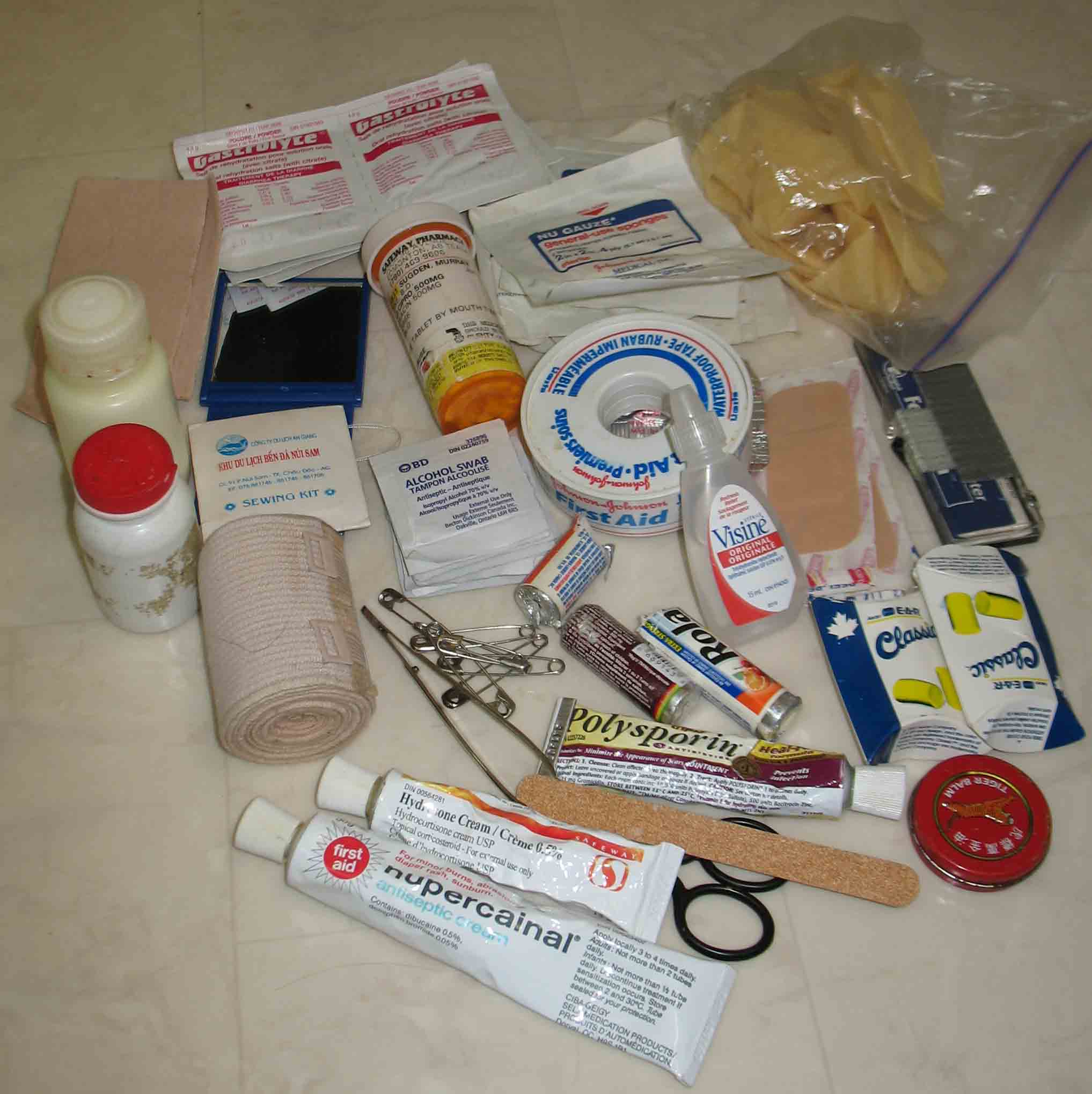
Next, I sit on the bathroom floor and dump everything out of the kits and the cupboard.  It looks like this…..

I start gathering the items from the list and separate them until it looks like this……..

And the list looks like this………

Crossed out stuff is staying home, yellow highlighted stuff is gathered, stuff with notes is yet to be packed.

I pack all the items into the green bag.  I leave out liquids – sunscreen and eye drops – as these must go in our 1 litre ziploc bags for airport security. I will put the scissors in the 1 litre bag also.  Even though snub nosed scissors are allowed in carry on luggage, airport security will check them, so it is easier to make them accessible.  The bottle of Cipro will go in Murray’s shaving kit.  So, the first aid kit is ready to go to Bonaire and here is what it looks like now……..


Posted in Planning and Packing | Tagged , , , | Leave a comment

Intro to Our Packing Lists

Over the next while, we are going to share with you our various packing lists.  The lists can be found on their own pages under the Packing Lists menu item.  If you would like to use them, they can be copied and pasted into a Word document.  If you are really good, you can copy them into Excel. We actually have six lists crammed onto one Excel sheet.  Also,  if you plan on using the list, you should personalize it by listing your own medications, cosmetics etc.

There are no quantities on the lists as the quantity depends on the length and type of trip.  For example, our “first aid kit” we take to Bhutan will be more extensive than the one going to Bonaire – more moleskin, more Maalox.

We do not take everything on the lists.  When we start packing for a trip, we go over the lists and decide what we should take and cross off the items that we don’t think are necessary. For Bonaire, we won’t take items such as Calamine Lotion and Liquid Bandaid. For Bhutan, we will make sure we take a clothesline. ear plugs and a flashlight.

Every time we travel, we seem to add items to the lists. We hand write it on the paper list we use for packing and then when we return, I add the item to the digital list.  We often create other lists, such as a “High Altitude” list – what symptoms were experienced, what worked, what didn’t work.

We have lists for EVERYTHING! Scuba diving, first aid, clothing, toiletries, important documents, camping, riding with and without panniers, folk festivals and what to do before we leave on a trip.  Since Bonaire is coming up, we will start with what we need for a scuba diving trip to the Caribbean.

Posted in Planning and Packing | Tagged | Leave a comment

Daypacks and Wallets

We take one daypack with us on trips where we think we will be walking or hiking and will need to carry extra items such as jackets, food, water and umbrellas.  When we fly, this pack is packed into a suitcase. On day excursions, I will carry the daypack and Murray will carry his courier bag, due to his camera gear. We have used the same style and make of daypack for many years.

The pack is a “Serratus”, which unfortunately is no longer available. As the picture shows, the pack can be packed up into a small bundle.  The pack is the right size for a couple of jackets, a large water bottle and snacks. The pack is easy to carry providing it is not too heavy.  I rue the day when we have to replace this pack.  In looking for a day pack, consider what will go in it, how easy is it to pack into your suitcase and how does it feel on you when you carry it.

A quick note on travel wallets.  Both Murray and I leave our normal wallets at home when we travel and take smaller, thinner wallets.  Mine is actually a kid wallet – bright purple! Both wallets hold fewer credit cards etc, but we find that we leave most cards at home.  Don’t really need the Save-On Member Card in Greece or China!  Most foreign currency fits in the paper bill section of the wallets . Both wallets are thin enough to lay hidden in the zippered/velcro pockets of our purses. When Murray carries his wallet in his pants pocket, he puts two wide elastics around the wallet, which makes it harder for a pickpocket to remove the wallet.

Posted in Planning and Packing | Tagged , , | 2 Comments

Jig Saw Complete

We need to purchase tickets for the intervening three legs of travel. After a night in Kolkata we plan to go to Darjeeling and after our trip into Bhutan we want to go, to and from, the Andaman and Nicobar Islands. All ‘local flights’ but I am concerned there are a limited number of seats each day and, what to us seems like, an unlimited number of people that could fill those flights. So, if we want to fly on specific days we should be diligent and book the flights early.

As soon as the long flights from Canada to Kolkata were booked we let our credit card cool down and got back on the internet to see how we could fit in the last pieces to our transportation puzzle.

It was simple. Typed ‘Kolkata to Darjeeling flights’ into the Google search bar and landed on mapsofindia.com. All the possible flights and airlines were listed. We picked the one wanted and bingo we got our flight. Repeated the process for the return tickets to Point Blair, ease the last piece into place and the transportation picture is complete.

Posted in Bhutan and India, Planning and Packing | Tagged , , | Leave a comment

Bags Bags and more Bags

Let’s talk “purses”.  Most airlines allow guests to carry a purse, or a personal article with dimensions of 16cm x 33cm x 43cm (6″ x 13″ x 17″) and a maximum weight of 10 kg (22 lbs).

Both Murray and I carry what we call purses.  Murray’s purse is actually a courier bag.  The dimensions of the bag are approximately 36cm x 30cm x 10cm (14″ x 12″ x 4′).  Murray usually carries a large camera, a zoom lens, a book, snacks, travel docs and wallet inside. It has both velcro and snap buckles to close the bag, making the interior pocket very secure.  It has one outside pocket, a large open interior with several smaller pockets, one of which has a long piece of velcro to close the pocket.  This pocket is quite secure so this is where the important things go. The interior is plasticized. The bag has a long shoulder strap.  Murray usually carries the bag over his shoulder and across his body for security and it also helps distribute the weight as it tends to be heavy.

The courier bag is made by CourierWare at http://courierbags.com/.  They have a huge selection of styles, sizes and colours.

I have a selection of purses that I use, depending on the type of trip and where we are going. We recently bought a note book to take with us traveling, so I had to find a bag that I could carry it discreetly.  I wanted to be able to carry the notebook but not have my bag scream “She has a laptop with her!!”.

Tom Bihn has a great bag called the Ristretto.  There are two sizes, one designed for an iPad, and one designed for a 13″ MacBook Air.  We could use it for our notebook and I like the design and the colours, but it’s expensive.  Maybe it will show up under the Christmas tree.

For now, I decided to use a purse that we had in the closet.  It is an older Eagle Creek over the shoulder (across the body) bag.  The notebook fits into it with room for other stuff too. Its dimensions are about 30cm x 25cm x 8 cm (12″ x 10″ x 3″). It has an exterior flap with a pocket (shown). Under the flap are a couple of small zippered pockets for pens, floss, breathe mints etc. And hidden under the flap is another larger zippered pocket that I put my important documents in. There is a large interior zippered pocket accessible from the top of the bag.  I would carry my notebook, e reader, glasses, camera and snacks etc in here.

Until we bought the notebook, I carried a small over the shoulder bag that I purchased in Hawaii.  It is made by LeSportSac, has bicycles on it and is my favorite purse.  This bag is big enough (26cm x 21cm x 3cm) to carry my book or e reader, camera, wallet, snacks and important docs.  It has a zippered exterior pocket for pens, lip chap etc., a large interior zippered pocket and a smaller interior zippered pocket for the important stuff.  I cannot stress the importance of keeping those valuable docs (passport, tickets, wallet) hidden, secure and hard to access by a pickpocket.

If we are going on a dive holiday, I sometimes take a very small purse for evenings that holds my camera and wallet.  The one I have was purchased in Vietnam, is cloth and measures about 21cm x 16cm x 2cm.  I consider this an extravagant item to take on holidays.

These are the purses that we carry.  Here are some ideas for you to think about when choosing a travel purse.  Happy shopping!

  • Where are you traveling?
  • What do you want to carry in your purse? Camera? Notebook? Book? E Reader? Water bottle? Wallet? Travel docs? Cosmetics? Kitchen sink?
  • What size of purse do you need to carry all that stuff?
  • What is comfortable?
  • Does the purse you are considering have a secure hidden pocket for important docs?
Posted in Planning and Packing | Tagged , , | Leave a comment

Old Bags and New Bags

I got waylaid for about a week prepping, running and recuperating from running a marathon.  Phew!  It’s done and now down to bags.

Carry on luggage, on most airlines, is limited to one standard article (suitcase, backpack, roller bag) and one personal article (purse).  The size of the standard article has a maximum size of 55cm x 40cm x 23cm (21.5″ x 15.5″ x 9″).  The personal article size is a maximum of 16cm x 33cm x 43cm (6″ x 13″ x 17″).  The bags must be a maximum of 10 kg (22 lbs) each.  I picked this off the Air Canada website and if you check other airlines websites, the requirements are similar, but do have slight variations.  For instance, Lufthansa’s weight restriction is 8 kg (17.5 lbs) and they only allow one carry on bag.  Continental Airlines’ weight restriction is a whopping 18 kg (40 lbs). It is best to check the airlines that you will be flying with to see what the restrictions are. We generally go with the Air Canada weight restrictions as anything heavier gets hard to carry.

There are more and more bags out there that fit the size requirements.  Murray and I have used bags for more than 10 years from a Canadian store called Mountain Equipment Co-op.  The bags finally saw their final trip last summer to China.  My son had a similar bag that he no longer uses, so I have adopted it.The bag is a previous version of the “Walkabout Travel Pack” that they sell now.  The dimensions of the older styles are within the requirements, but the newer bags are not.  This bag can be carried as a shoulder bag, or as a backpack.  Murray carried his bag as a shoulder bag.  I use it as a backpack as it is easier on my body as I have a tendency to lift up my shoulder that is carrying the load and throw my back into an odd shape. OUCH!  The bag has interior stays and can be bent to fit the shape of your back. The backpack straps are well padded and the waist belt is designed to distribute the load onto the hips. The backpack straps can be hidden in a zippered pocket when you don’t want them. The interior of the bag has tie down straps and an interior zippered pouch in the lid.  There are also exterior tie down straps.  The bag came with a small day pack that attaches to the outside.  We found this daypack wasn’t that useful as it was small and not the right shape to stuff jackets etc into.  We have left the daypack in the closet and use a different one when we need one.We are in the process of buying Murray a new bag.  There are a number of websites that have carry on specific bags that fit the dimensions needed.  I like the MEI Voyager Backpack –  http://www.meivoyageur.com/.  A few other websites are TOM BIHN, RED OXX, Rick Steves Europe and Osprey Packs.  Check them out and search for a bag that you like, keeping in mind the dimension requirements.  We are going to go look at Osprey Packs first – we are hoping to buy one locally and not have to order it on line. If that doesn’t pan out we will go for a MEI one.

We like soft sided bags rather than the roller bags.  Having the option of converting your bag into a backpack comes in handy.  We went to France with 2 bike boxes, 2 carry-on MEC bags and 2 “purses”.  We arrived in Toulouse by train and had to walk to our hotel.  We both put our purses over our shoulders across our bodies, our carry on bags on as backpacks, and then, handled our bike boxes with free hands.  It worked very well.  While in the train station, we saw two fellows, each with a bike box in one hand and a large roller suitcase in the other hand, trying to maneuver around people and then down the stairs.  It was quite amusing to watch because they weren’t doing a very good job of it.  It was much easier to throw our bags on our backs so our hands were free.

I will talk about “purses” and daypacks next time!

Posted in Planning and Packing | Tagged , , , | Leave a comment