Our Morocco journey is winding down. We have a day in Casablanca and then we fly home.
Here are my random thoughts from our travels:
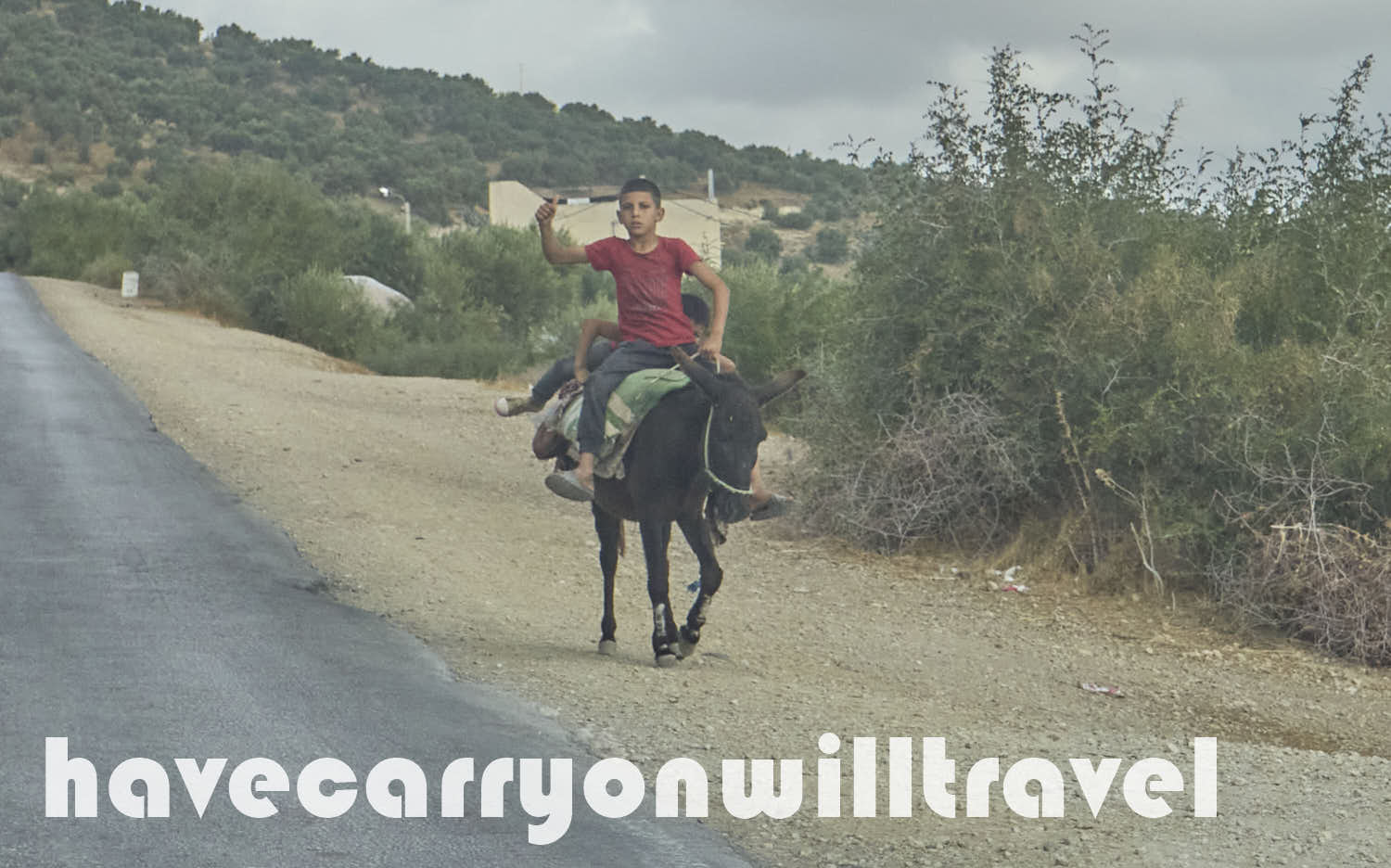
How much weight can a donkey carry? I saw a rather large man riding a rather small donkey. Was the donkey overloaded? A quick query from Co-Pilot indicates that the donkey was, indeed, overloaded. Poor thing.
Murray and I have decided that Chicken Pastilla is the yummiest supper. Tonight we shared one and it had chicken and almonds and cinnamon inside and icing sugar and more cinnamon on top. A sweet and savoury taste. So yummy!
On our road trip through the Atlas Mountains, we stop at a gas station so I can pee. Other tourists are also stopped there. I go into the woman’s toilet and notice a lady sitting near the entrance.Unfortunately, I have no change in my pocket today, so do not pay on the way out. Plus, I get my back up about paying for toilet use. The lady yells something at me loudly and all the tourists stare. Oh boy.
Storks build nests on the top on minarets. Huge nests! It’s an engineering feat that they stay up there.
I wish Morocco would do something about how they handle their garbage. It is everywhere. In the cities, there is a system to collect it every night, but the countryside and small towns are buried in it. It’s upsetting to me to see such disregard for the environment.
The Moroccan people are very friendly and helpful. We have had so many interactions with folks helping us or just asking where we are from. These interactions are what make traveling so much fun.
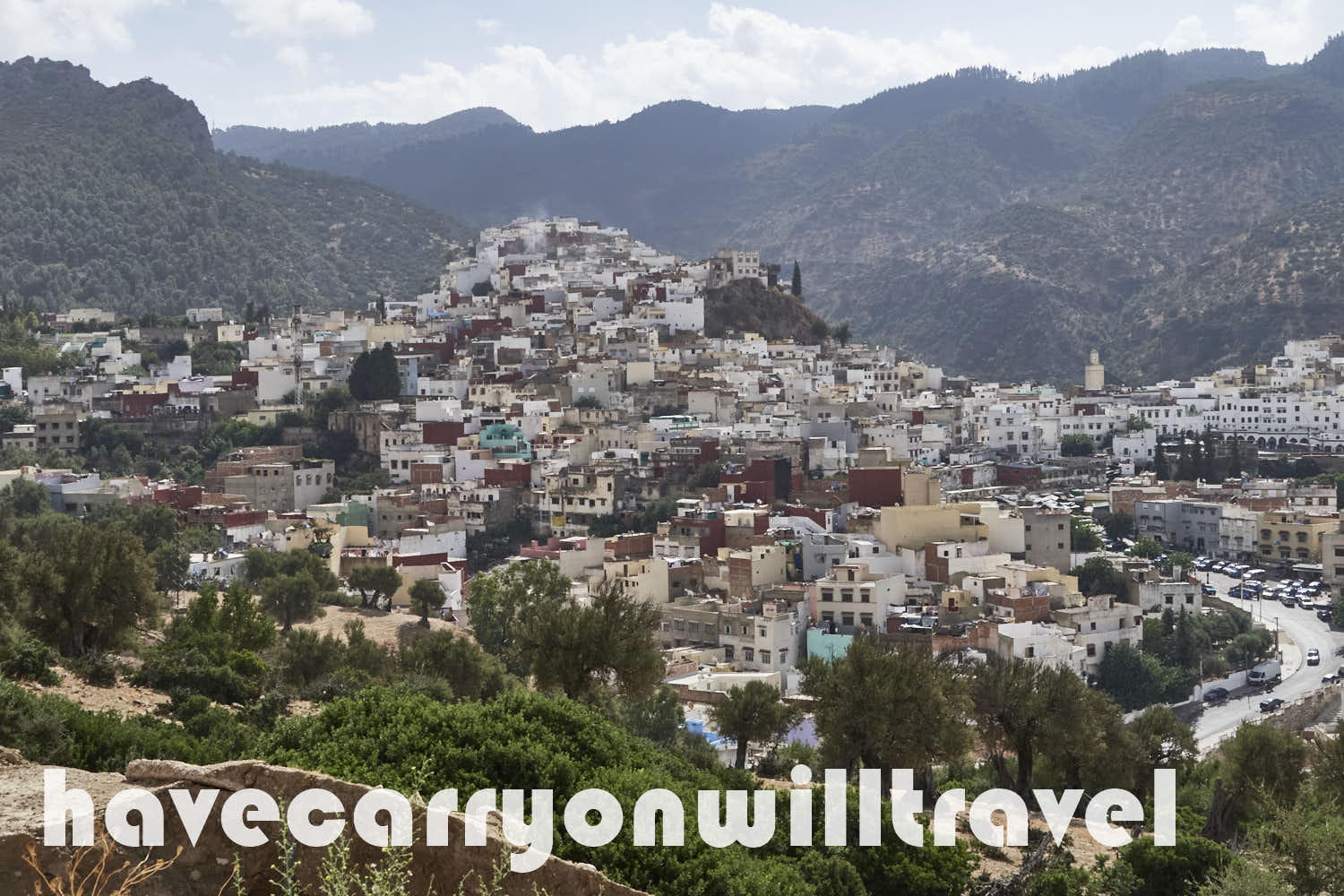
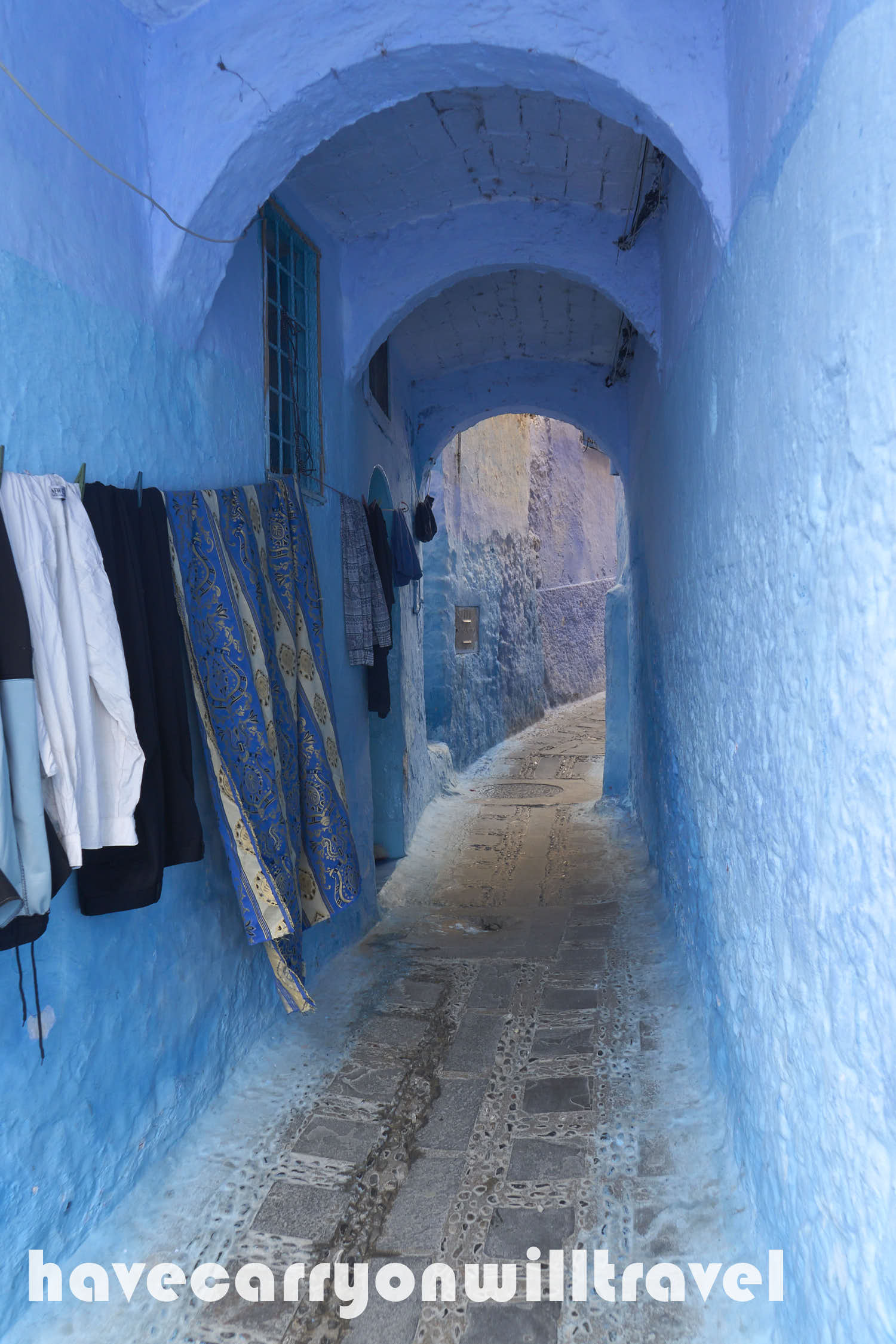
For me, the landscape was one of the highlights of Morocco, especially through the Atlas Mountains. Another highlight was Chefchaouen, the Blue City.
The Blue City
I certainly have had my fill of olives and dates. In restaurants, a basket of bread and a bowl of olives are brought to the table after we order. Murray nibbles on the bread and I nibble on the olives, black and green. Instead of olives, dates are sometimes used. Olives and dates are often offered at breakfast too.
The pomegranates here are lighter in colour, almost yellowy orange. The seeds inside are pale red to white, instead of the dark red we have at home. And the taste is so subtle, not tart at all. I have enjoyed eating these tasty pomegranates.
Today is a shopping day! Yahoo! As we travel around Morocco, I keep my eye out for fabrics, scarves, weaving etc that I like. Today, we go in search of a scarf for me. I also want to buy a stuffed camel for our granddaughter. I know, the camel is too touristy, but every child needs a camel!
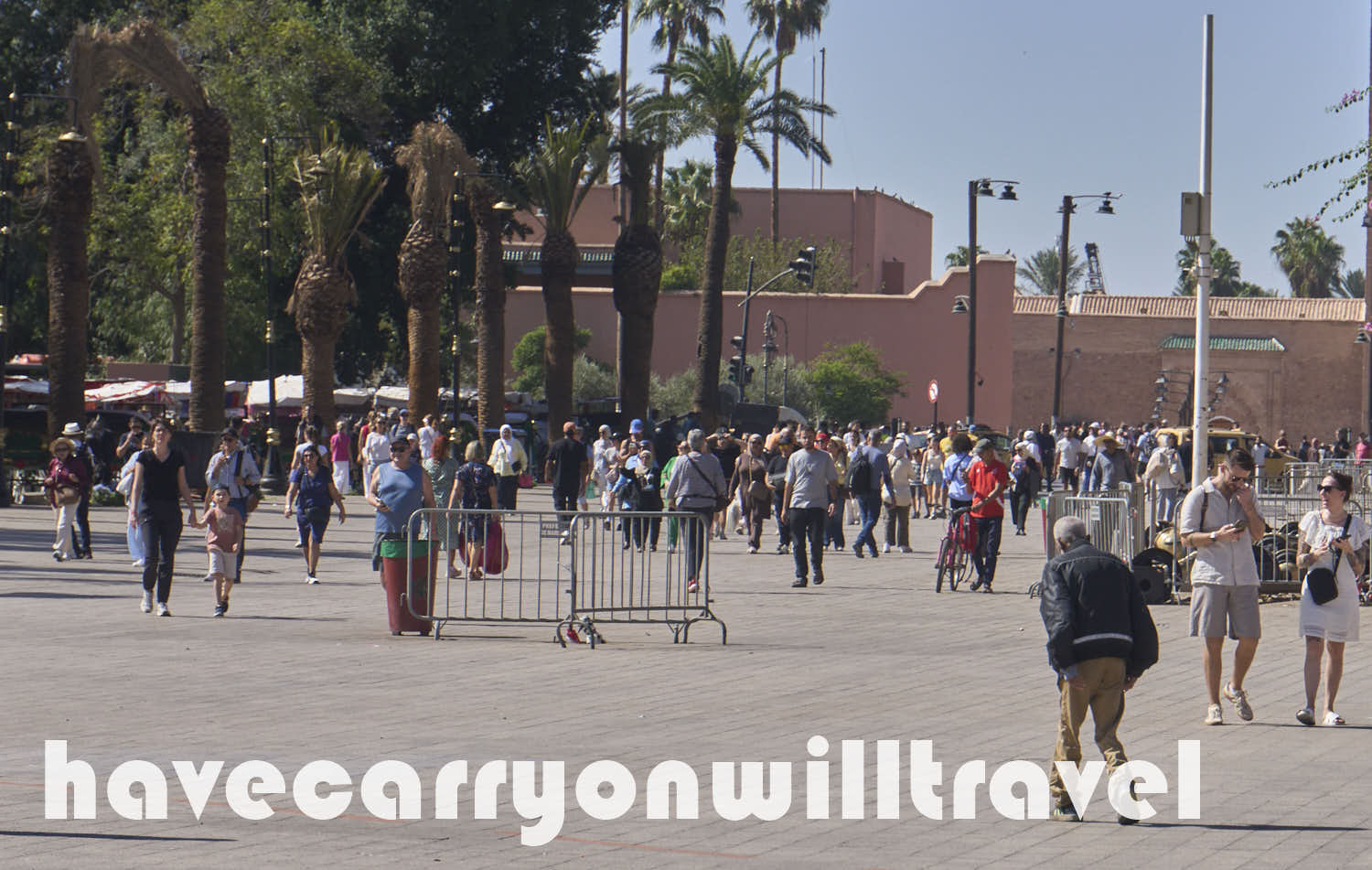
It is a long walk to the Medina and when we get near the gate, we are reminded of the crowds.
Crowds at the Medina
The camel was easy. Bargain hard. How much? 120 DH. What? How about 50? No no no. 90? 80? 85? Okay okay. I get the camel for $12 Cdn. Still too much.
The scarf is a little more problematic. Cannot find one I like that is the quality that I want. I have a list of possible weaving/scarf shops and we slowly make our way to each. A pashmina scarf catches my eye, but I do not buy it. We walk further and then……
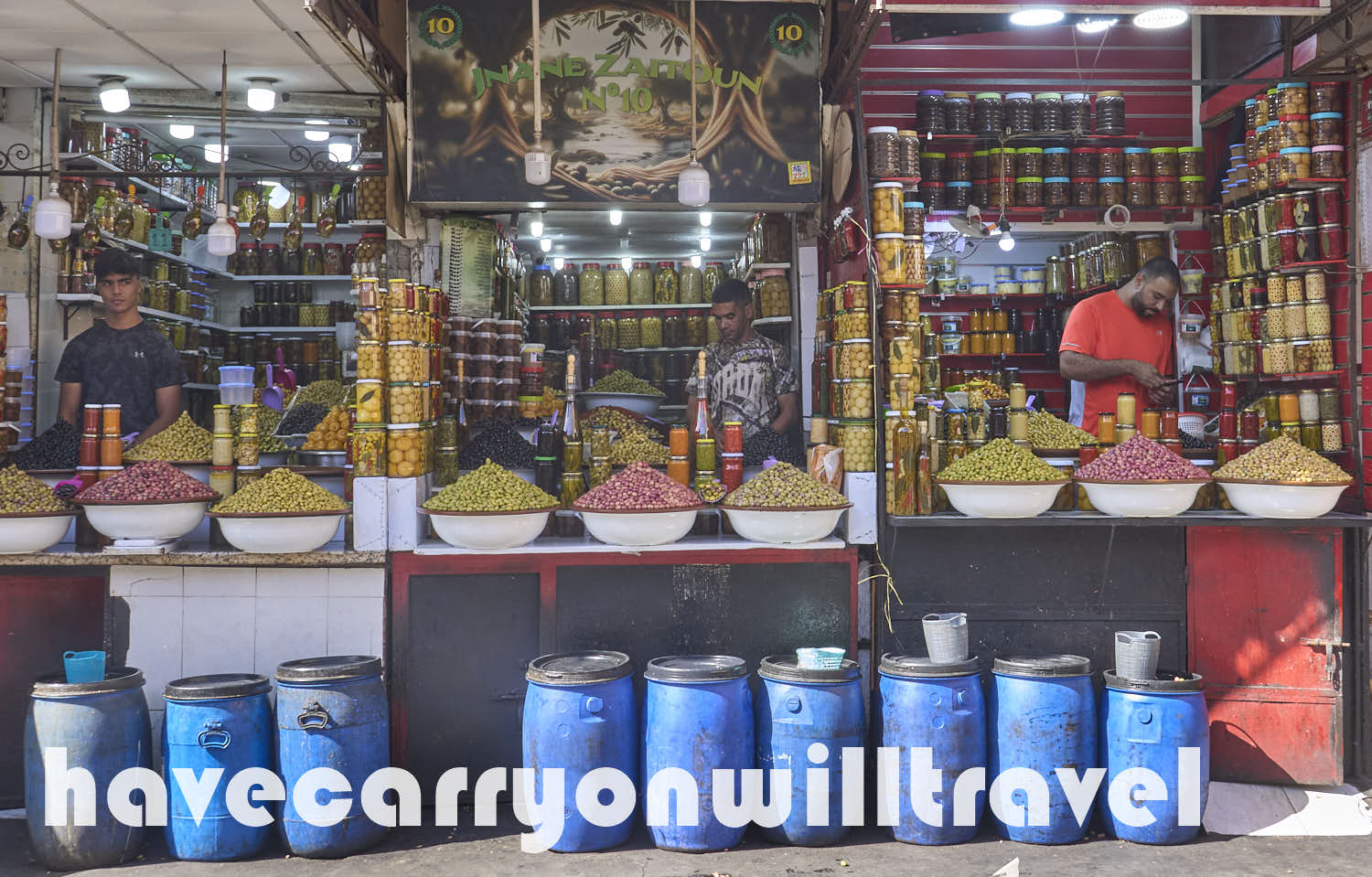
More olives! We are in Olive Souq. A cluster of stalls that are selling numerous types and flavours olives.
Olive Souq
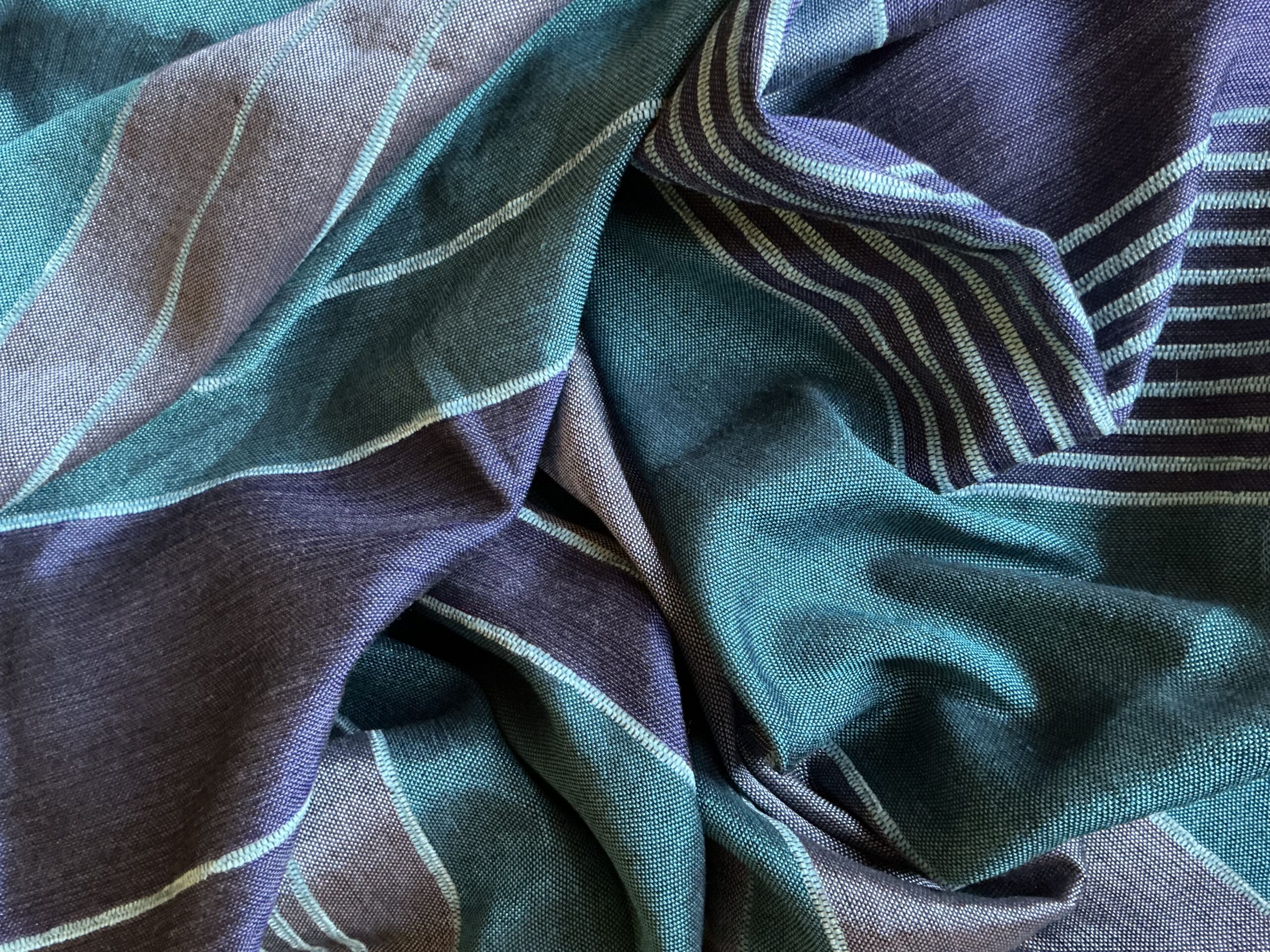
We do a u-turn to walk back through the Souq Semmarine, a short way down, I spot something interesting. We stop and after testing several scarves for colour, and a good bout of bargaining, we walk out with a hand woven scarf made of sabra silk, the silk from agave plants. I am happy and both bargainers are happy with the deal, so all is good.
The crowds are getting to us, so we bee line it out of the Medina to the sanity of less populated avenues and boulevards.
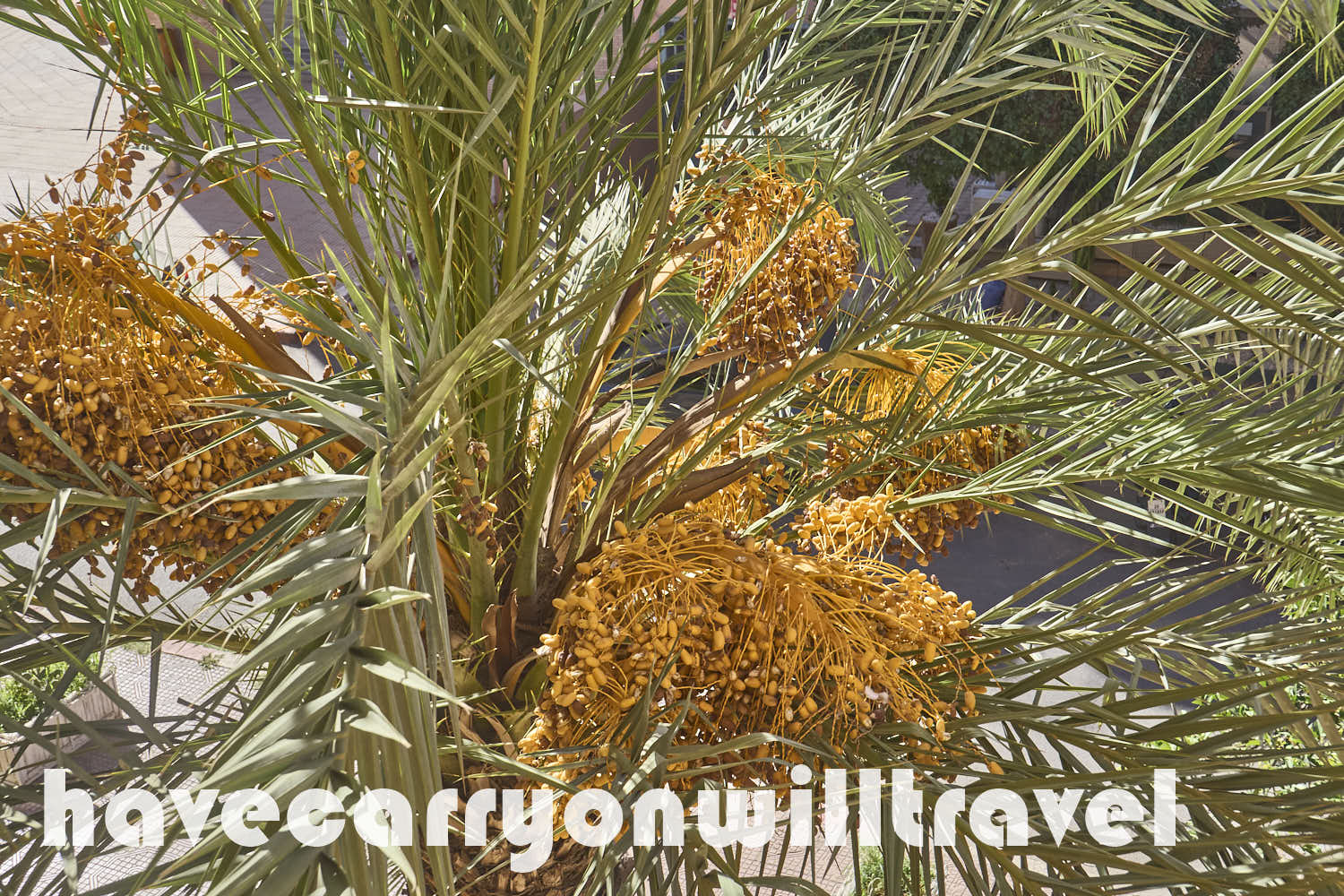
Date Palm by our hotel
Tomorrow, back to Casablanca on the ONCF, the fast train.
Pickup is at 8:15 today as we are stopping at Ait Ben Haddou on the way back to Marrakech and it is a major tourist stop. We want to beat the crowds.
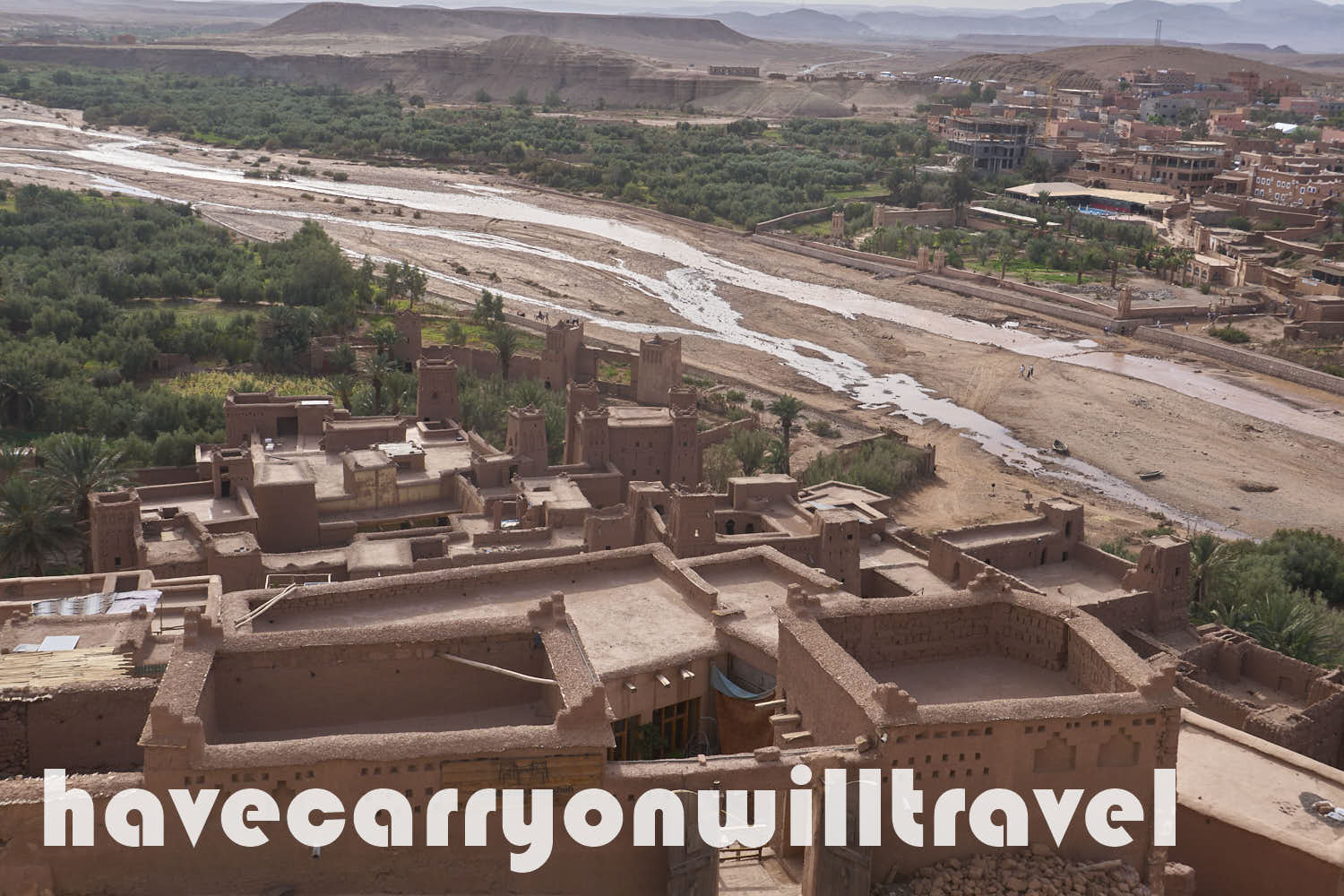
Ait Ben Haddou
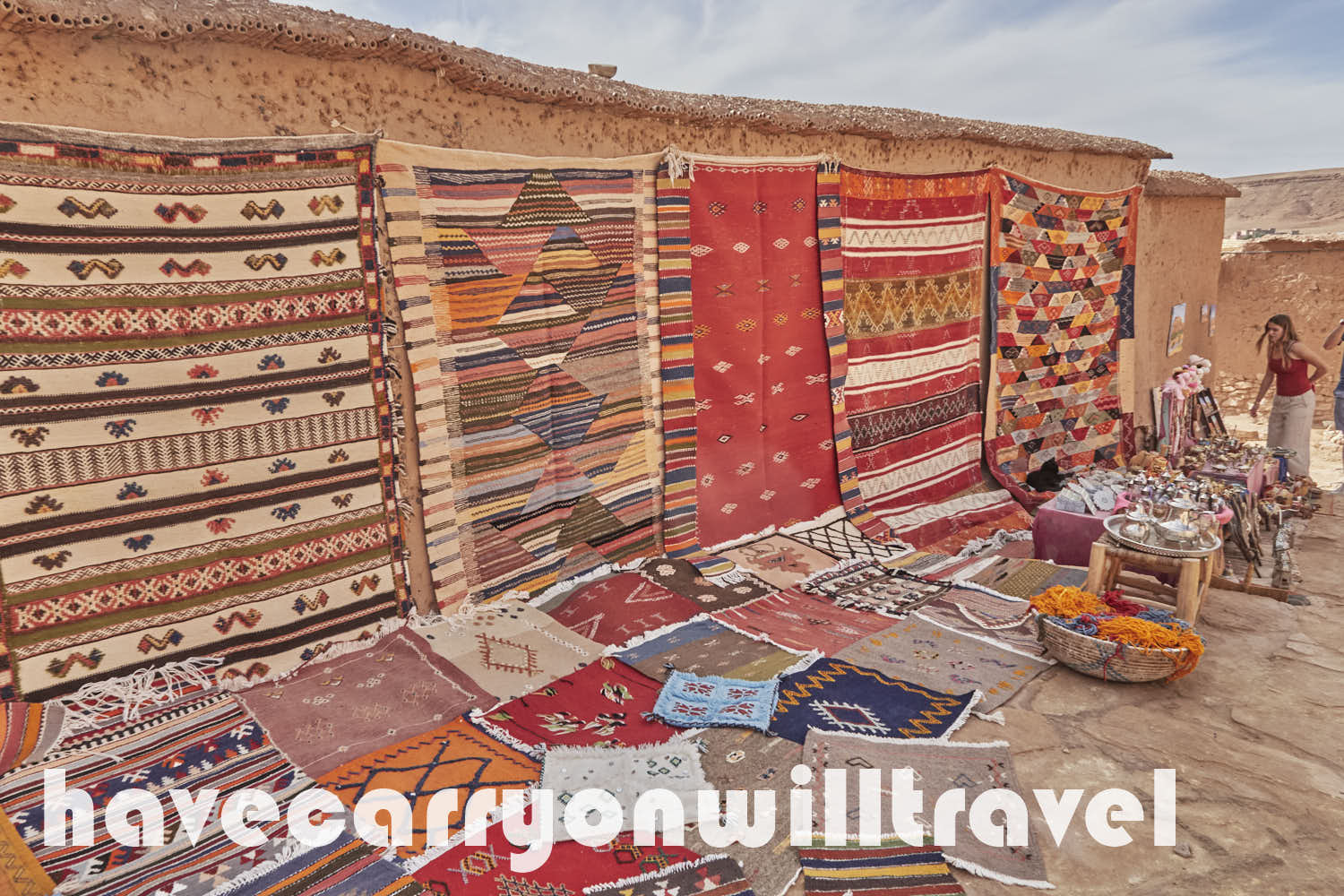
Ait Ben Haddou is a kasbah (fortified village) from the 11th century. It was on the caravan trading route between the Sahara Desert and Marrakech. Now, most of the buildings date back to the 17th century. It has a citadel, or high point, in order to view the surrounding countryside. The walls are adobe, red clay mixed with straw. There are shops selling scarves, ceramic bowls, earrings, jewelry, rugs and clothes.
Ait Ben Haddou
Ait Ben Haddou’s claim to fame is that it has been used as a set in many movies. Recently, parts of The Game of Thrones and Gladiator were filmed there.
Atlas Mountains
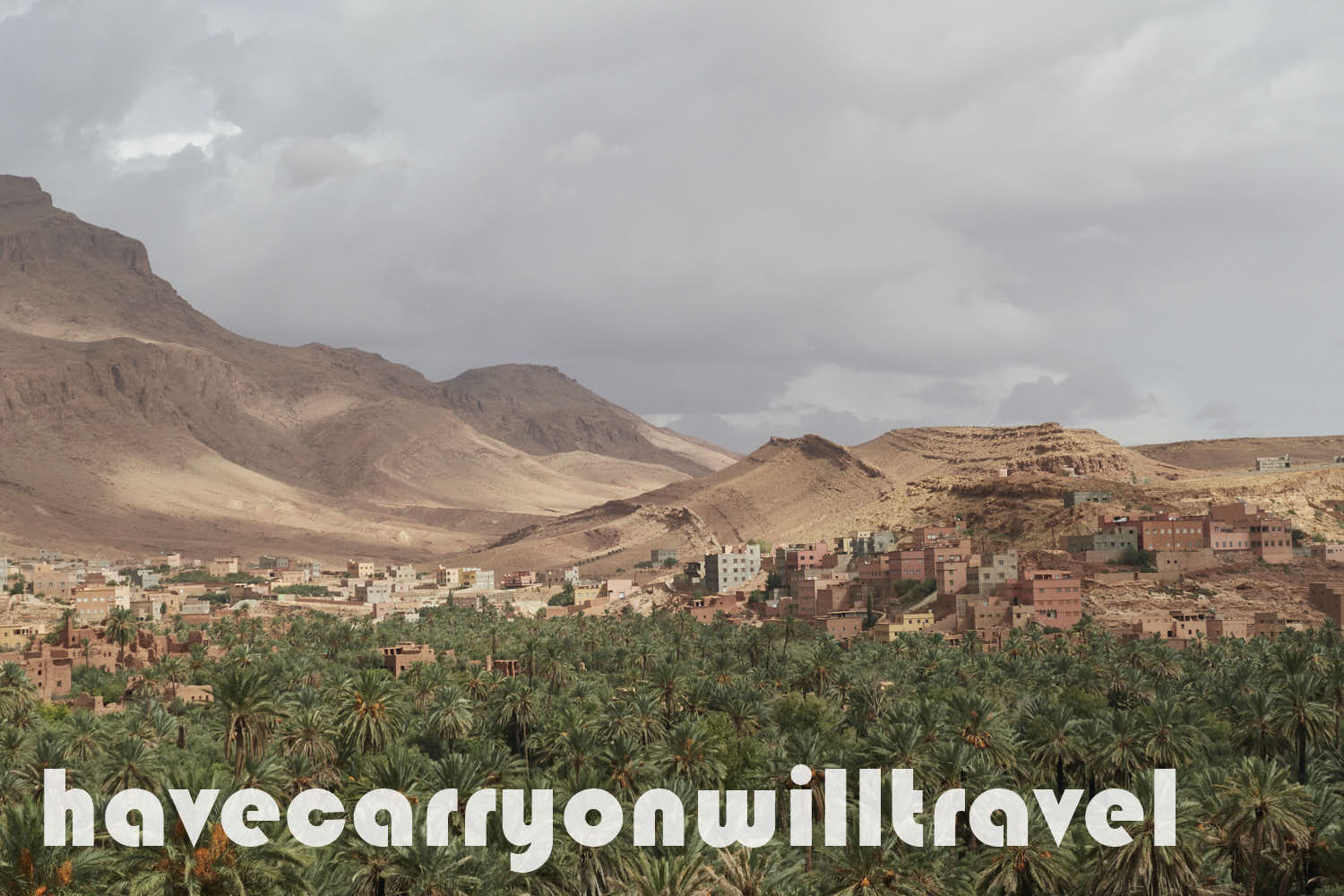
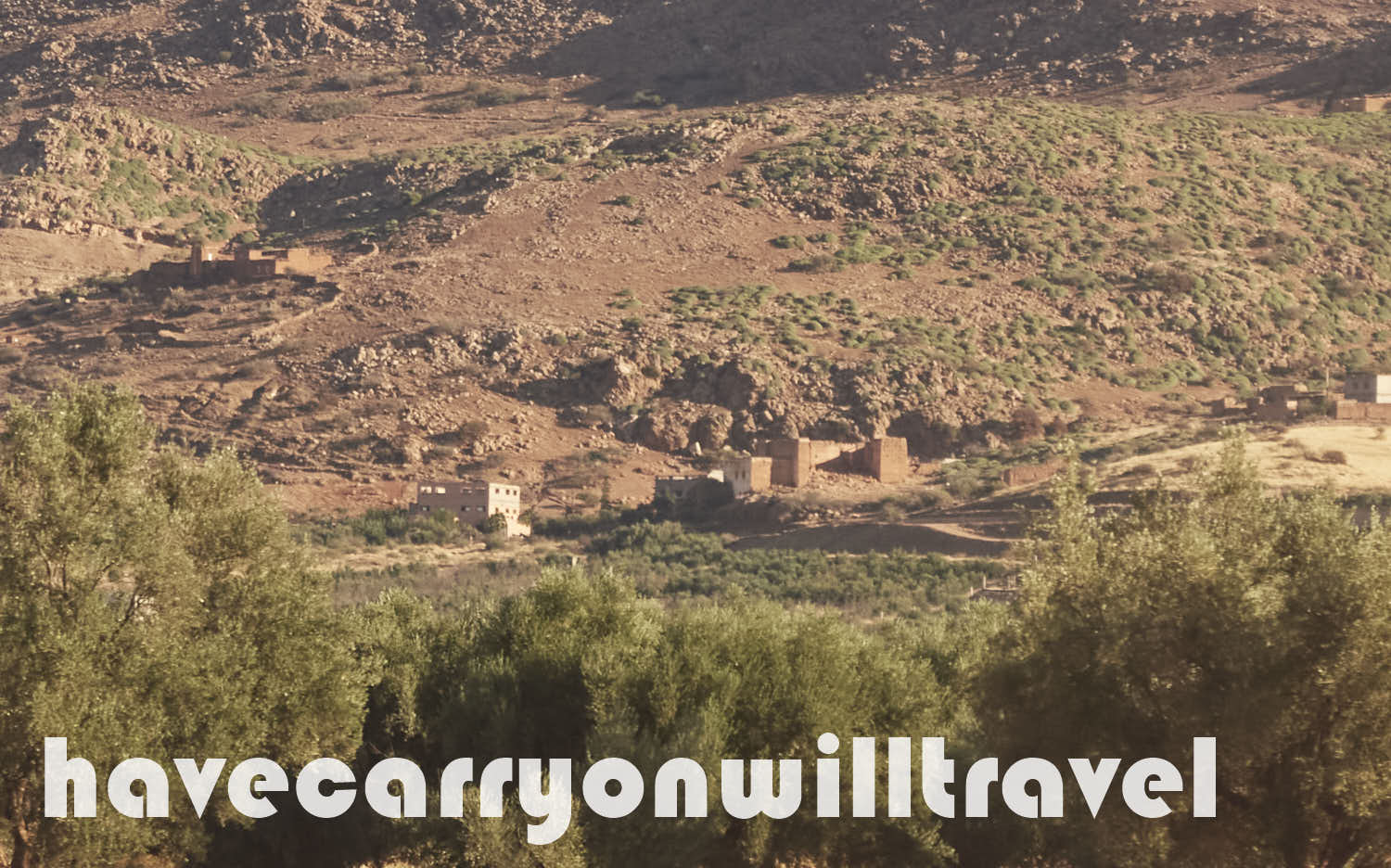
We choose to drive a road less traveled through the Atlas Mountains and it is very scenic. Once again Namibia, the Alberta Badlands, the Grand Canyon, and even Bolivia come to mind as the landscape changes. On the south side of the mountains, there are fields and agricultural plots, rivers supplying water. Trees in the valleys, looking very much like an oasis. Once we cross the high plateau and start the descent down the north side of the range, there are no crops and only scrub. Descending to a certain elevation brings trees, olive groves and agriculture back. The Moroccans know how to coax produce from inhospitable conditions with a plot of dirt and some water.
Atlas Mountains
We have seen solar panels being used to supply power to water pumps. The panels sit close to a pool sized manmade reservoir where the water is pumped into. This water is then used for agriculture.
Atlas Mountains
Murray spotted, for only the second time, evidence of wildlife today. A Barbary Ground Squirrel!
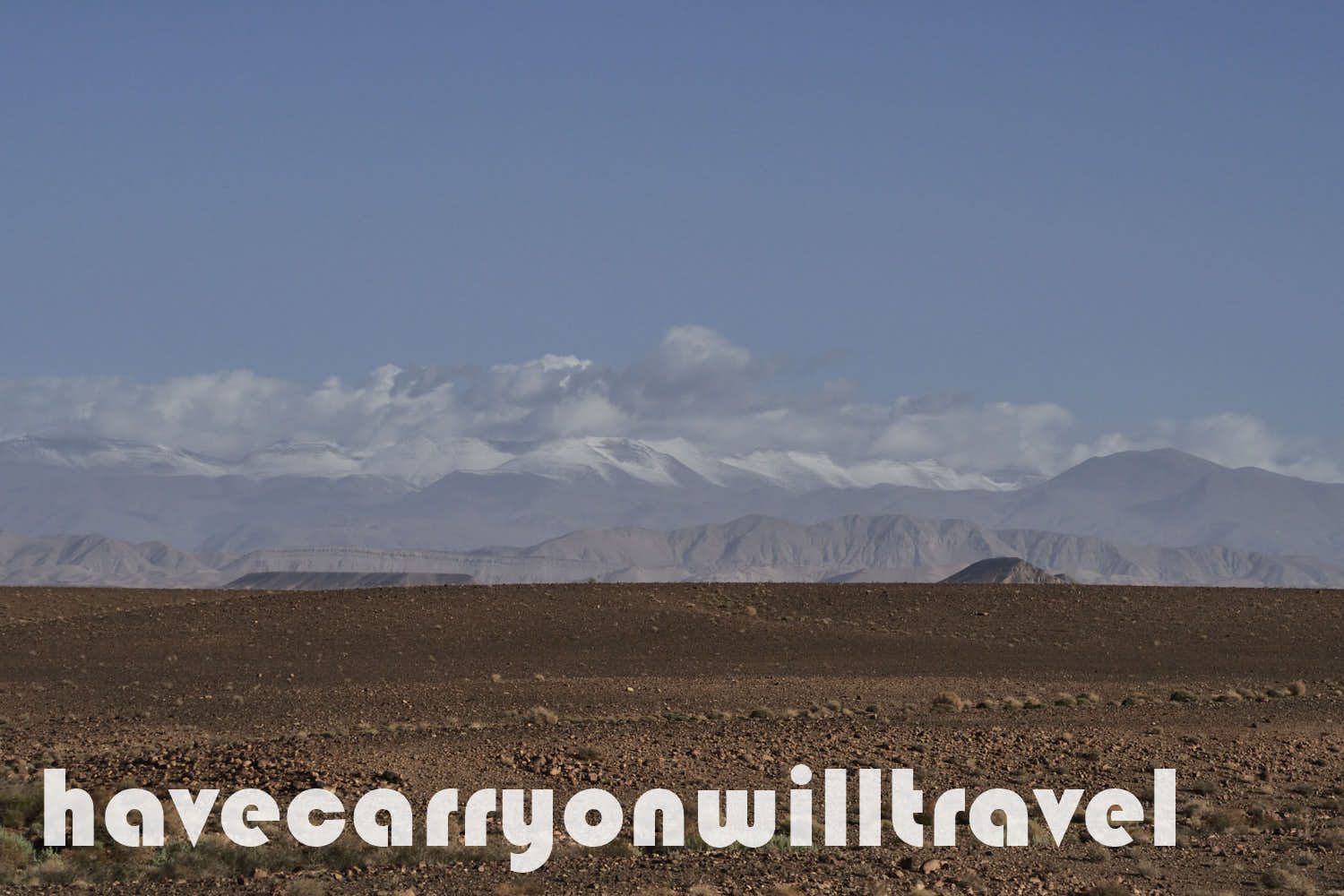
Todgha Gorge and Dades Gorge are where we are headed today. As we start to drive east of Skoura, we see fresh snow high up in the Atlas Mountains.
Todgha Gorge
Todgha Gorge is about 140 km from Skoura, but at the speeds we have to go, it takes us 2 plus hours to cover the distance. We cruise along at 80 kph for a bit and then have to slow to 60, then 40 and then 20 for road construction or a police stop or a traffic circle. The speed through the towns is 60 and the driver sticks to the limit as police radar is everywhere.
Snow in the Atlas Mountains
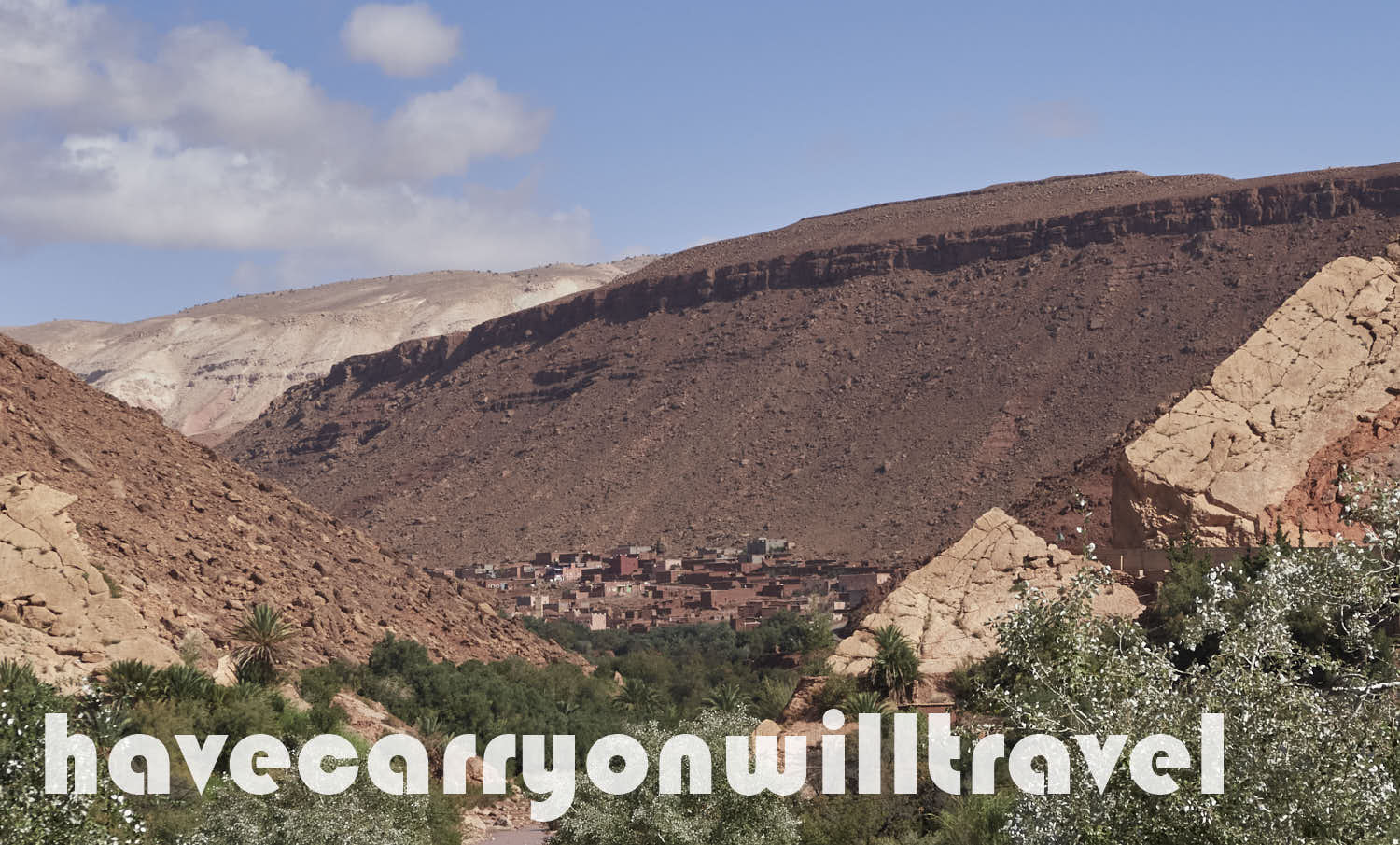
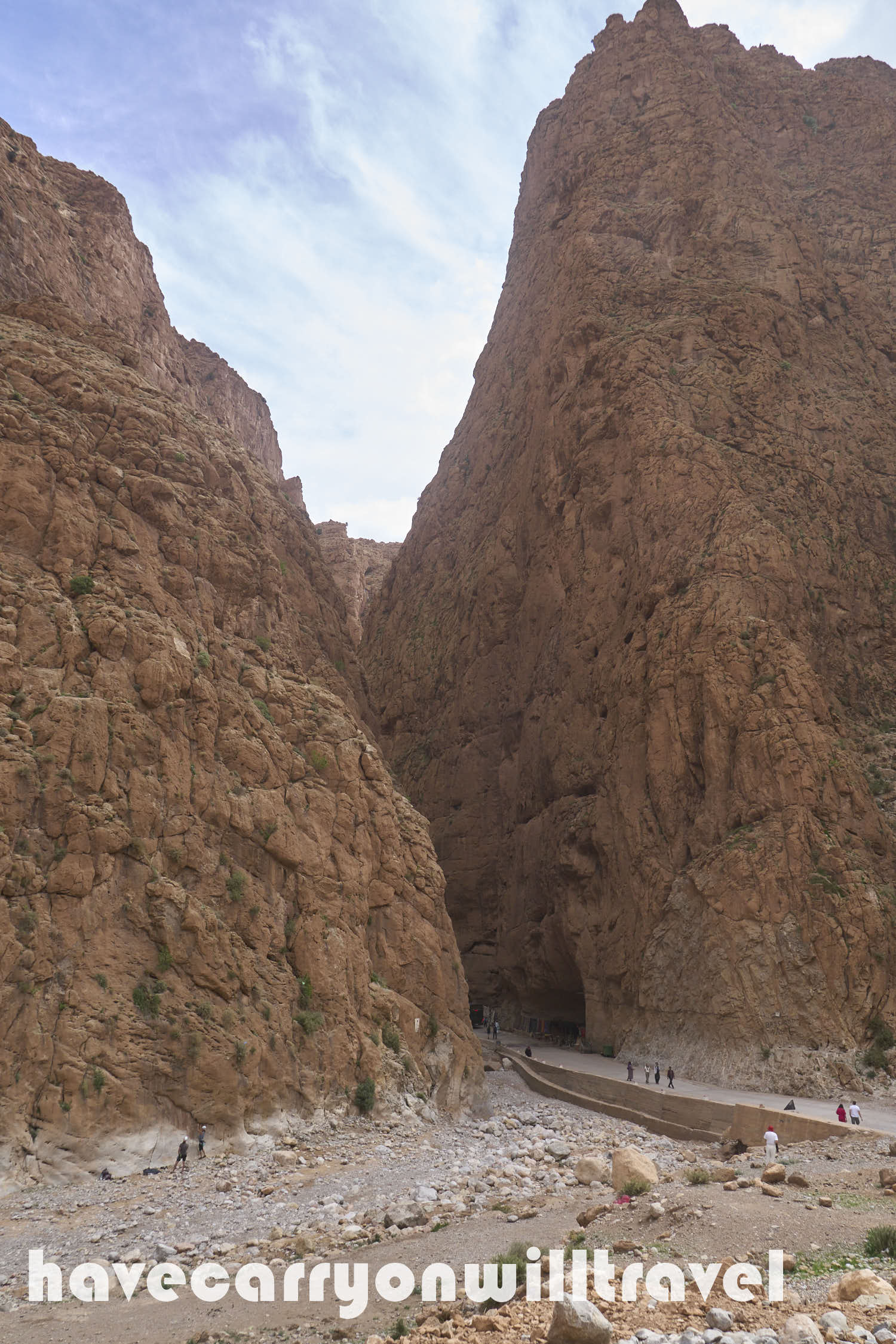
The Todgha Gorge is grand in scale. We walk through it on a road that happens to be a national highway that carries tour buses and large trucks. There are loads of tourists and everyone is on road. Rock climbers scale the sides of the canyon and tourist tip toe on the rocks in the river bed adjacent to the highway. The water running through the gorge is crystal clear and surprisingly not frigid. The vegetation is lush as the river supplies the valley beyond the gorge with vital water for irrigation .
Dades Gorge
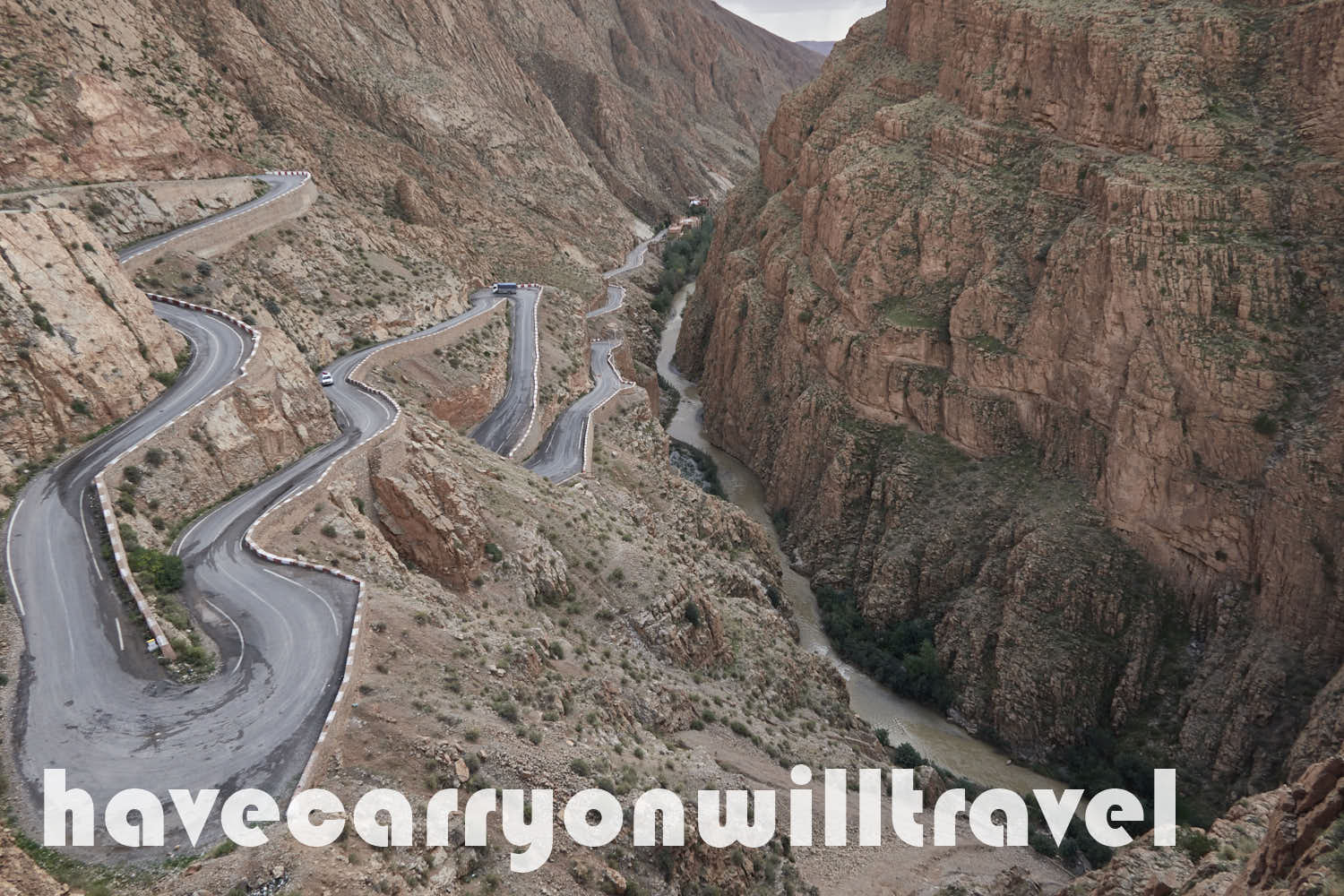
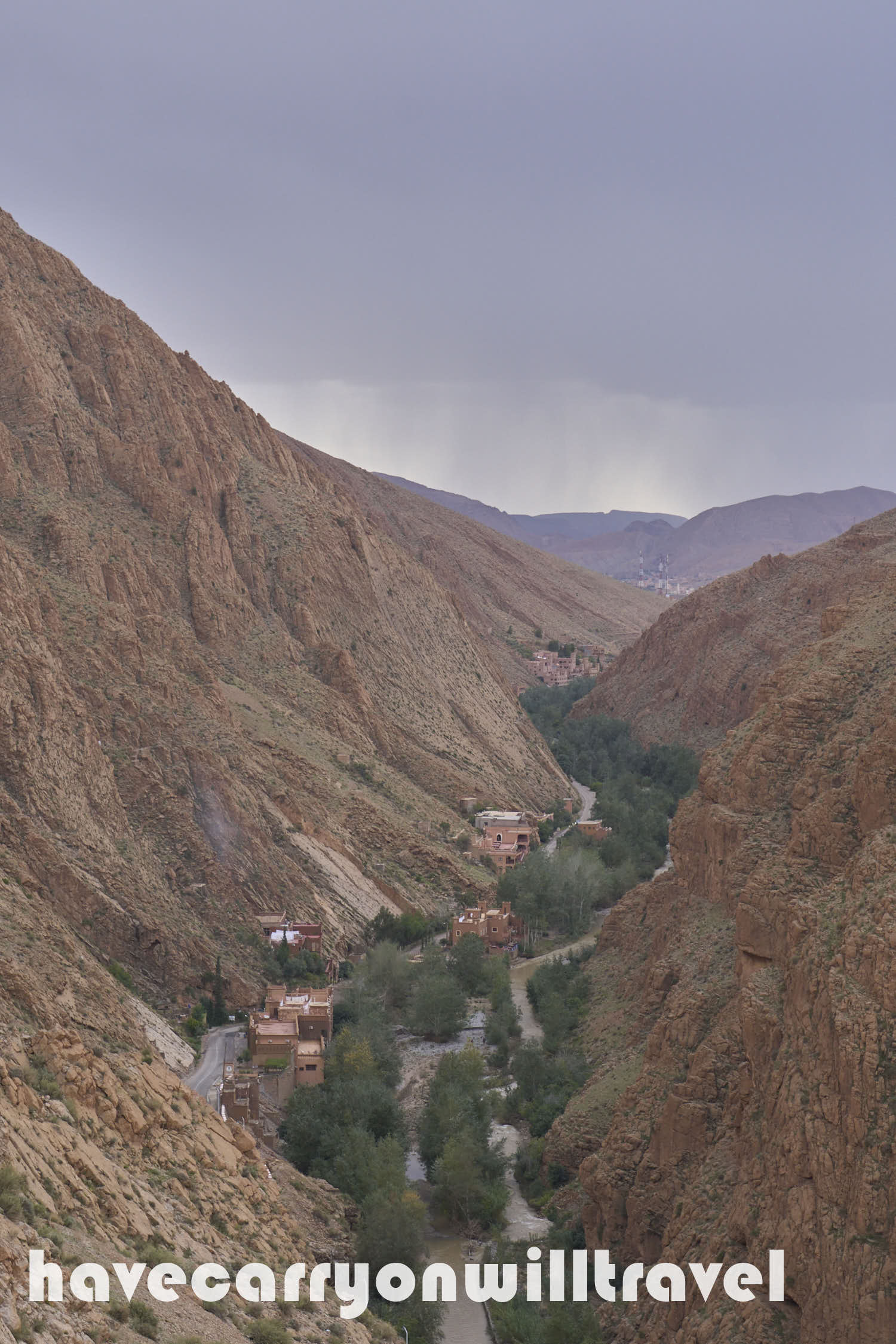
We drive through the Dades Gorge but its grandeur is only apparent from above. The drive up is on a steep zig zag road. Once at the top, a viewpoint allows us to see the gorge and the river flowing through it. We figure the large tour buses cannot manoeuvre through the switch backs so this gorge isn’t populated with as many tourists.
Dades Gorge
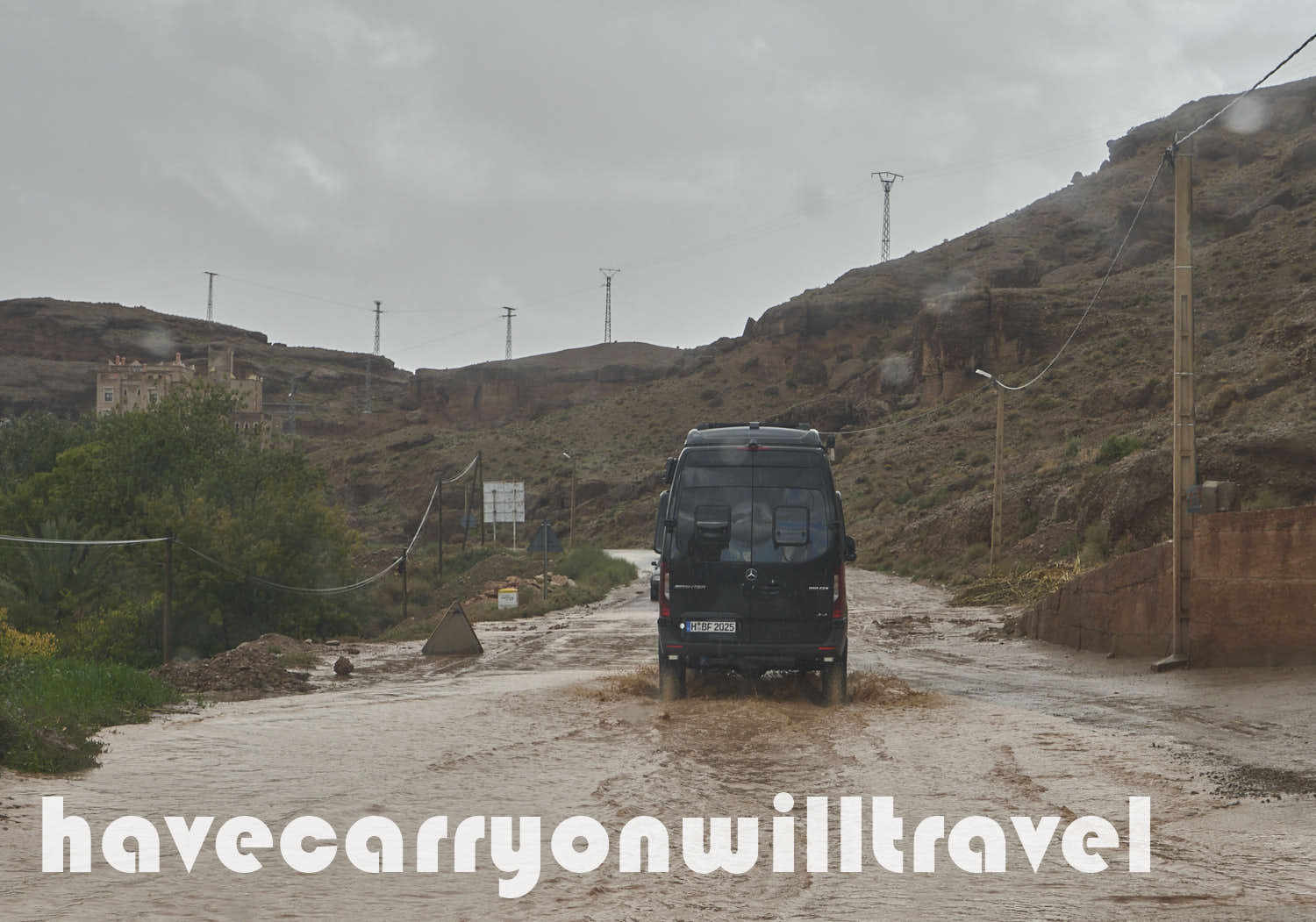
On the drive back down and towards Ouarzazate, it starts to rain. Because the drainage is poor, the rain causes havoc in the villages and on the roads. The water runs down the side streets and collects on the main road. Huge pools form and we must drive through them.
Rainy roads
Murray writes:
The last few day we noticed Moroccan kids out and about when they should be in school. Checking the internet, the reason is a nation wide school holiday this past week. The kids are out on the street playing or hanging out but very few of them have their noses pinned to a cell phone. I don’t know what the reason would be but unlike almost every place in the world Moroccan children are not wired 24/7.
Another odd thing we noted on today’s journey in Tighir, close to Todgha Gorge, there are new apartments being built in new subdivisions. Not just a few apartments, there are hundreds of new apartment buildings. The city is big enough but there are definitely not enough people hanging about to fill all the new housing. I don’t know if someone is expecting an influx of people moving to Tighir or what. The buildings don’t look particularly inviting as there appears to be windows on one of the four sides. This would make for very dark interiors as the natural light would only penetrate so far.
When we arrive at the hotel in Ouarzazate we find our room is again up 3 floors of horrendously steep stairs. Even though we travel lightish those stairs are hell. The young hotel assistant grabs both of our bags and walks over to the coolest thing, a lift. The lift is not for us but for the bags. It sort of looks like the elevator on the exterior of a building that is being constructed. One press of a button and the bags are on the way up.
Although today’s destinations were quite grand the journey was equally impressive. The country side in Morocco is well worth exploring.
We jump in a Toyota Land Cruiser at 9:15 with the same driver that drove us from Fes to Marrakech. Today, the destination is Skoura, via Demnate and over the High Atlas Mountains. The drive starts out through the same pancake flat valley we drove the other day.
Murray has been mentioning the fences in the fields in his posts. The first new fences we pass are made of what we would call adobe. Earthen material combined with straw. The rock fences are soon replaced by spaced out single rocks in a row with the occasional small cairn, to delineate fields.
A right hand turn takes us towards the mountains. Right away we notice we are on ‘the route less travelled’ Soon we are climbing. The road grades are much steeper here than in the Rockies and we ascend quickly.
Iminifri
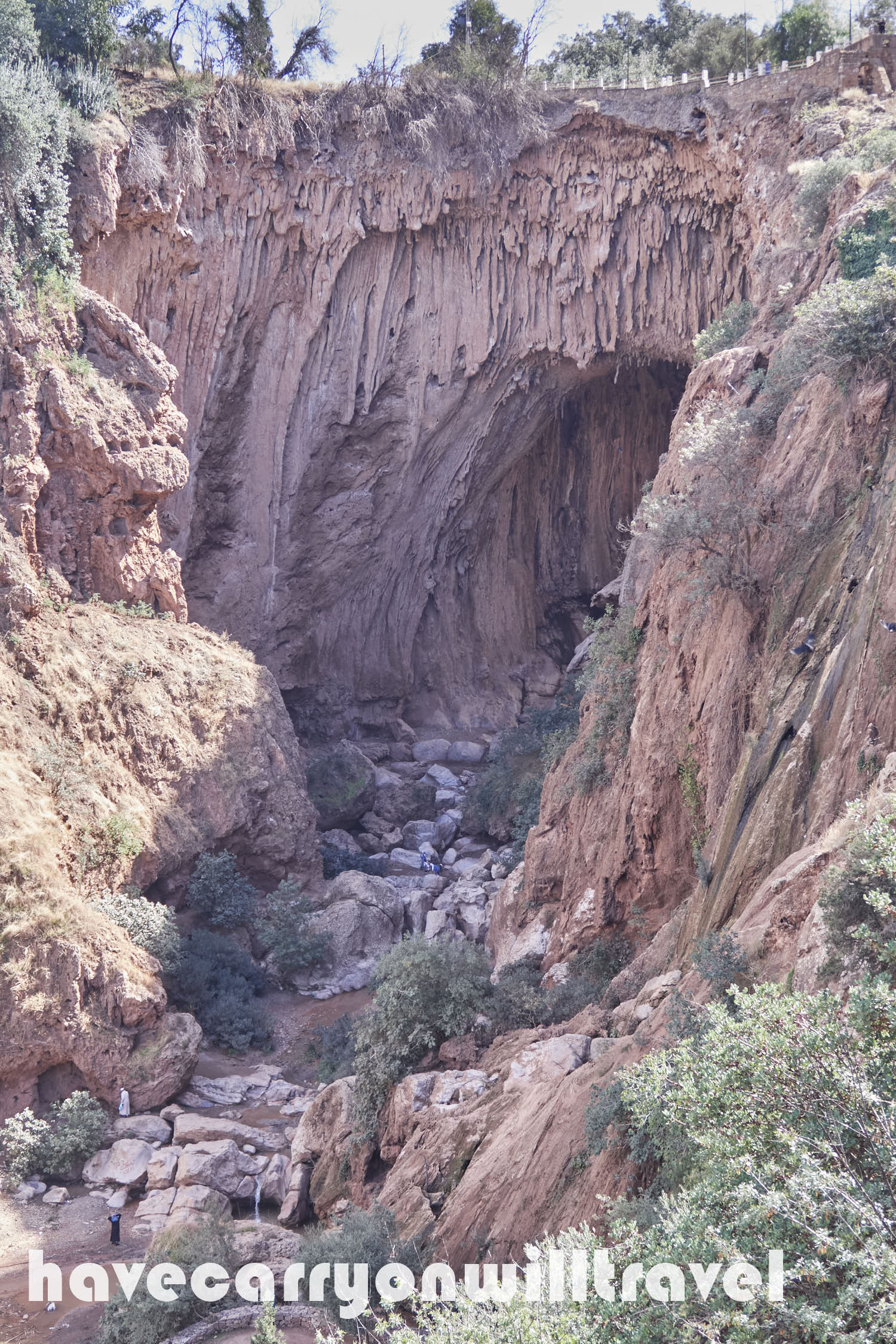
Our first stop is at a natural bridge at Iminifri. The bridge is a travertine rock arch that has created a huge cave below, some 70 m tall. A stream runs through it and we see people climbing on the rocks in the cave. I like watching the birds catching the thermals and flying like they have no cares but to swoop and glide.
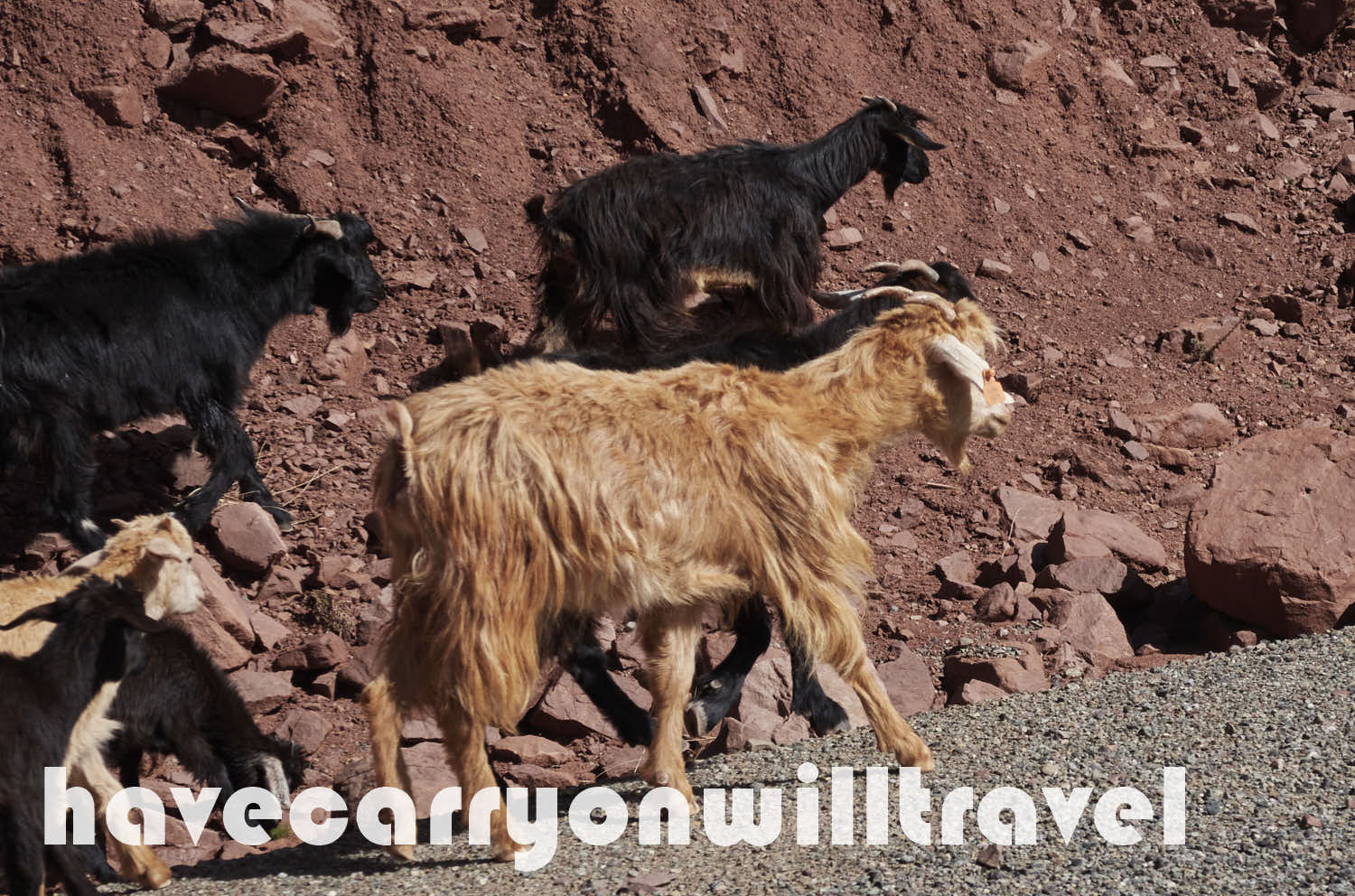
Some goats
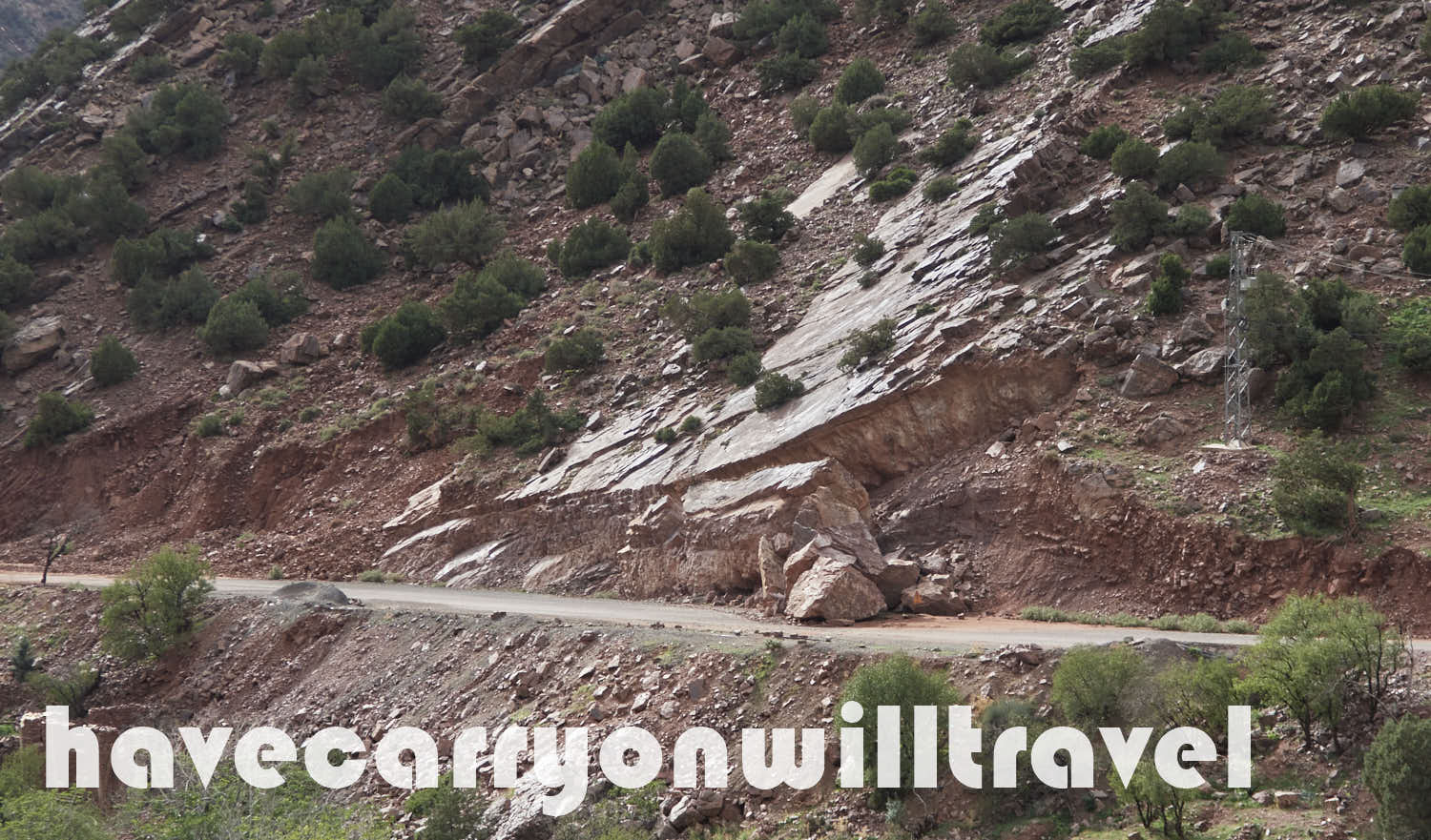
As we climb steadily up, the road changes and becomes rougher and rougher and the speed gets slower and slower. There are many spots where rocks have slid down the cuts and are piled along the shoulder. When this road was updated to asphalt there was not much consideration towards the angle of repose or the stabilization of the rock wall next to the highway. Guard rails are few and far between and the slope on the side of the road is very steep and the valley is very deep. Soon, we are driving through a construction zone that is kilometers and kilometers long as they try to improve the road and the shoulders. They are also working on bank stabilization and it will be a decades long project, I think.
High Atlas Mountains
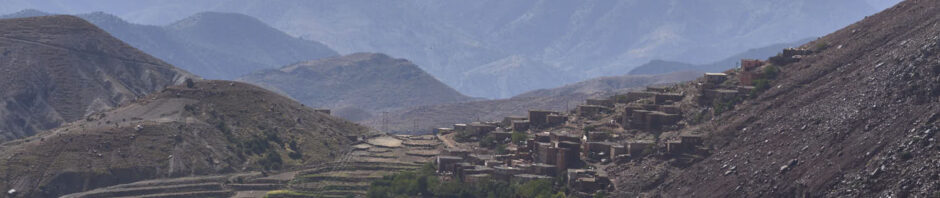
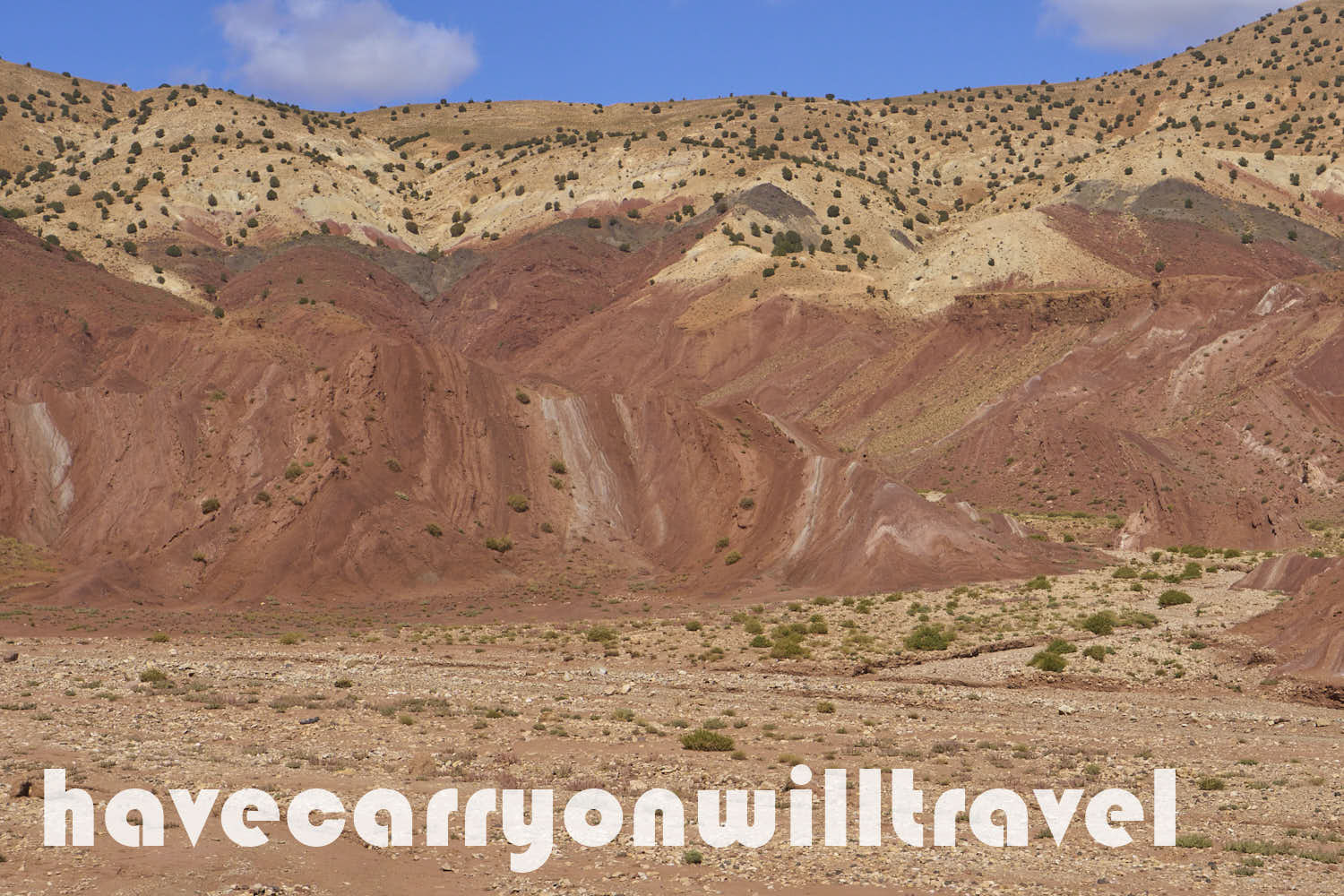
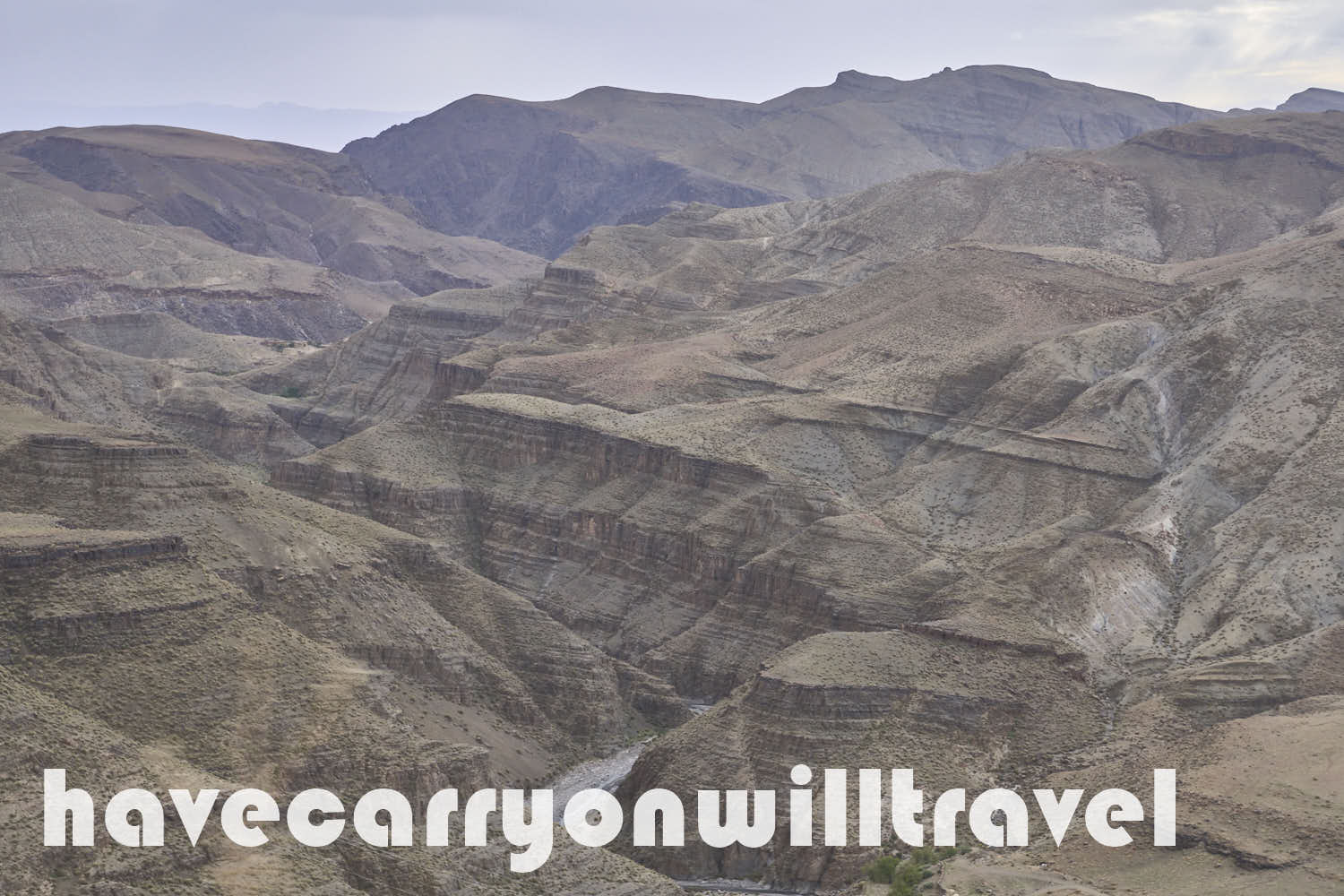
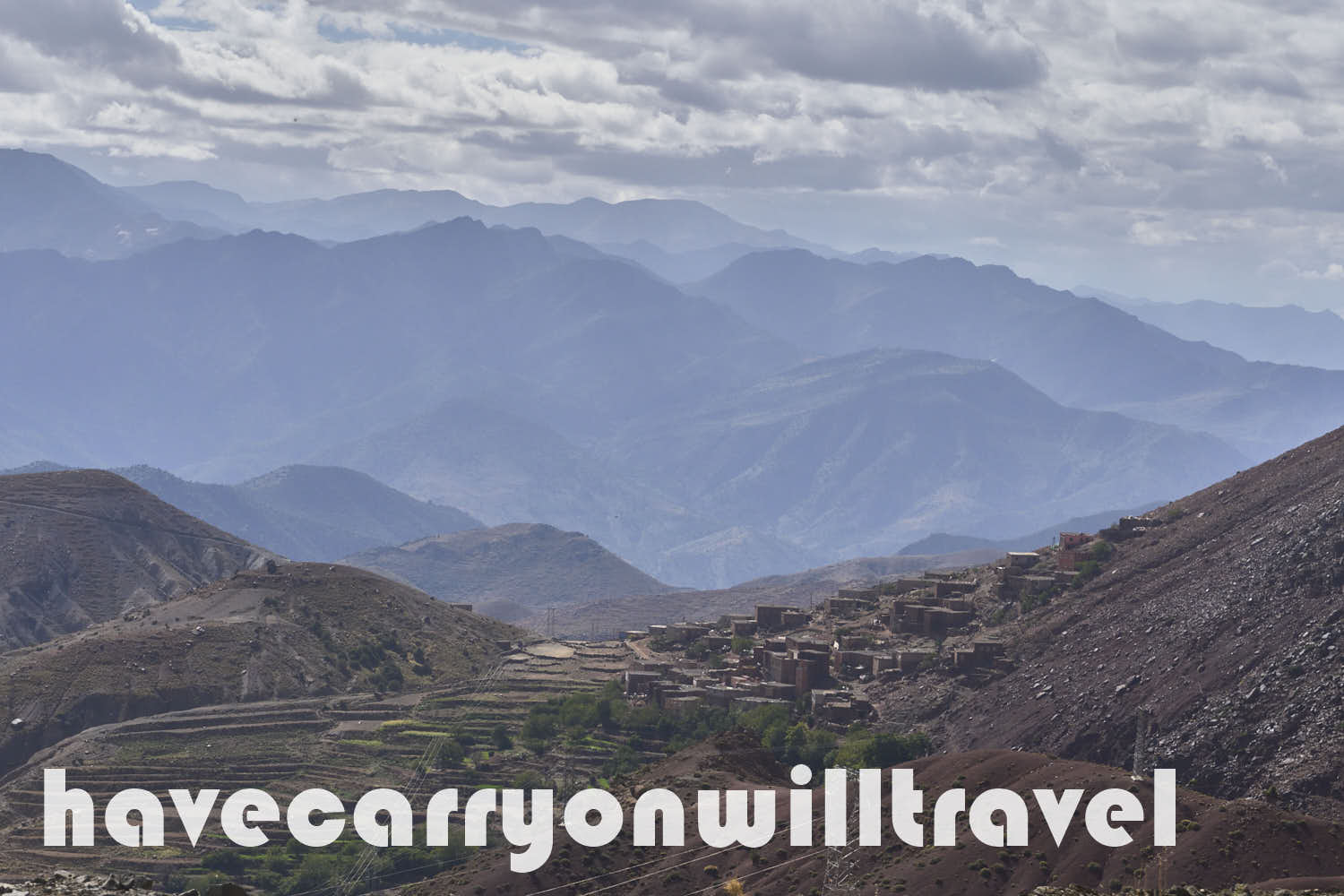
The landscape is stunning! The high Atlas Mountains are rugged mountains. It is a cross between the Alberta Badlands, the Grand Canyon, Namibia, Mars and the moon. The soil and the rock turn from brown to red to tan to grey and back again. The mountainsides are barren, rocky, have scrub brush in areas and pine trees in other areas. There are Berber villages here and there in the valleys and the villagers have cultivated every bit of horizontal land that they can access, with terraces cut into the slopes to grow crops. These mountains and this route is absolutely stunning. I think we are the only tourists after we leave Iminifri. If you get the chance take this drive.
High Atlas Mountains
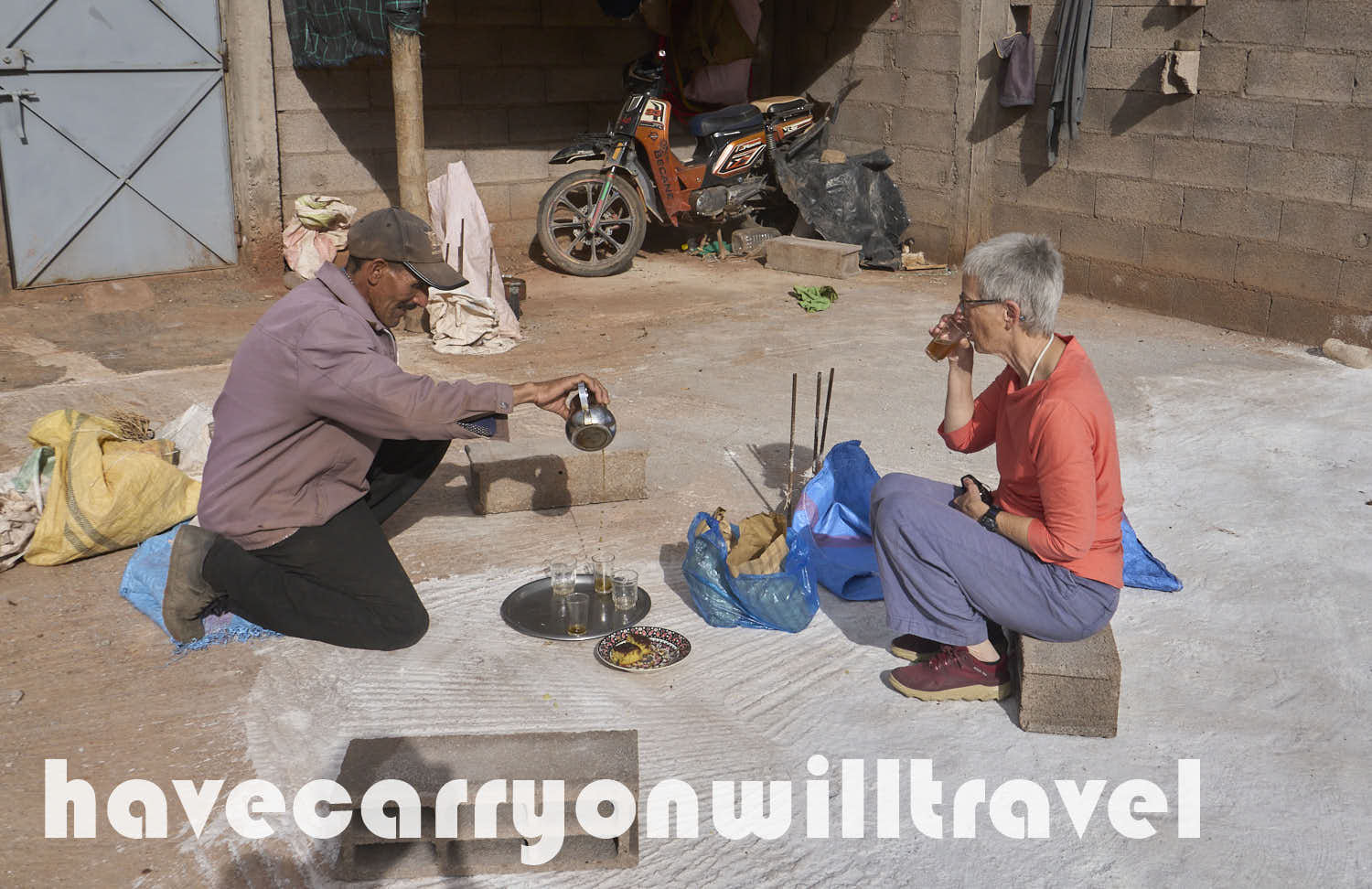
We stop at one point to take photos and a fellow comes out of his house to see who stopped. Before we know it we are having tea and home made lemon cake with the fellow on, basically, his roof top. Our driver buys two lunch bag sized bags of freshly picked walnuts from him. He grows them in the valley below where we are sitting. I eat a few and they are delicious! Fresh walnuts! We chat, using our driver as a translator, and find out that he is married and has three sons. He seems so excited to have visitors and we enjoy the chat. Our guide explains that in Morocco, this kind of hospitality is normal.
Tea and cake with a villager
Our driver tells us that the owner of the tour company wanted him to drive the Mercedes for our three day trip, but our driver said, No! I need the 4 x 4! Luckily we have the Land Cruiser as by the time we get to Skoura, we drive through 4 streams of water running across the road. The Mercedes would not have been happy.
We finally get to our riad in Skoura after a seven hour drive, a little longer than we were anticipating. The drive was worth every hour.
Marrakech is a tourist Mecca and it is unbelievable just how many tourists there are here. We get dismayed by the numbers and immediately head outside the walls of the Medina.
We walk towards an area called Gueliz, where there are a couple of art galleries and perhaps some Art Deco architecture. The farther we move away from the Medina, the fewer tourists we encounter. Yeah!
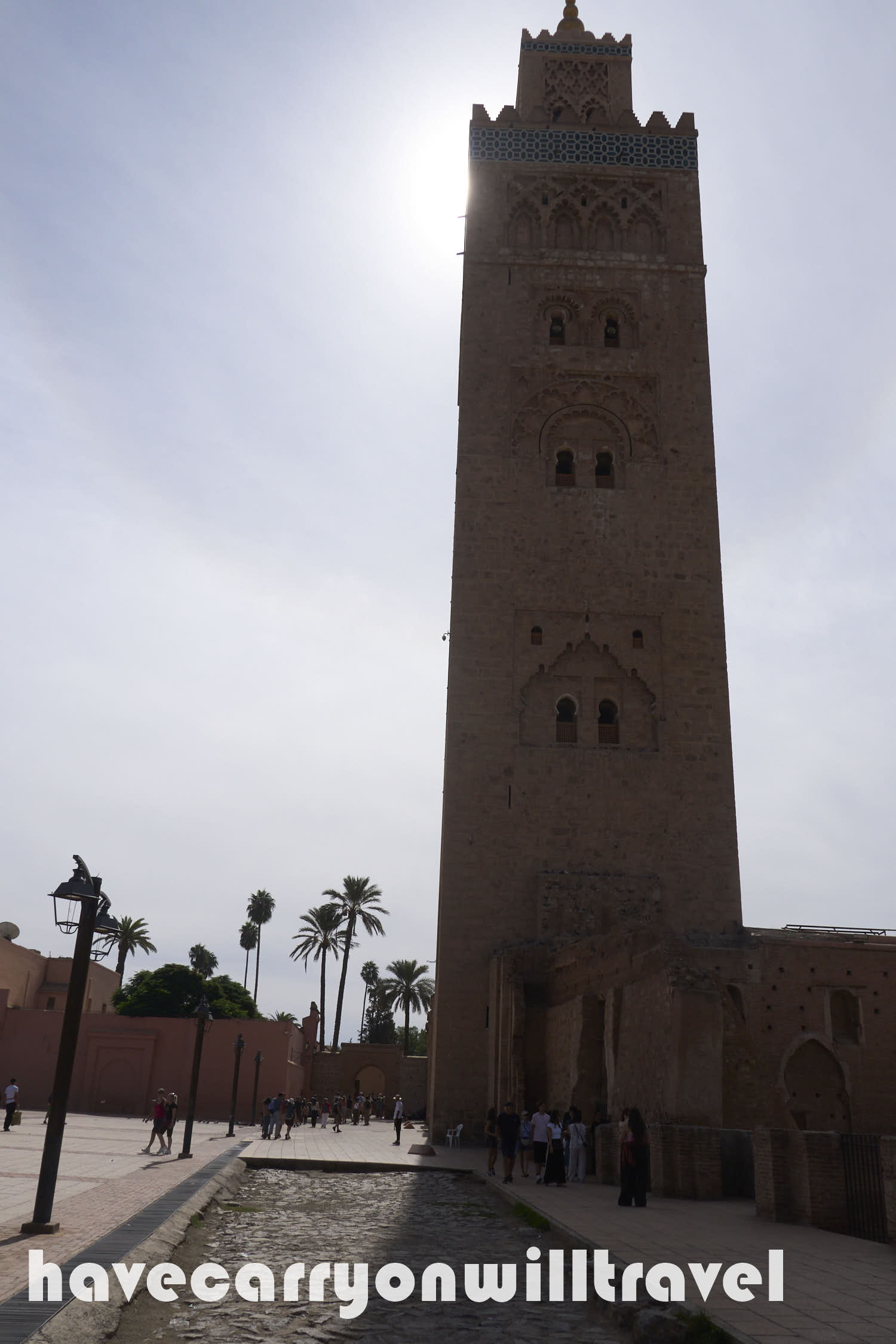
Minaret
The Comptoir des Mines Galerie is on the second floor of a building and it is free to enter. We walk right in, with not a soul around. The artwork is large, modern and quite fascinating. A woman stops us on our way out and asks if we had taken any photos, which Murray said no to. One exhibit isn’t actually open to the public yet and she didn’t want photos out there. The gallery is actually a private one, but they encourage everyone to come visit to experience art. If you are in Marrakech, I would recommend you drop by.
Murray and I have been needing a taste of familiar food, so we find a sushi restaurant to have lunch in. As we walk back, we see a McDonalds and it is packed with tourists. Guess they needed a taste of home too. It’s funny how some people’s taste of home is a burger, and for some it is sushi!
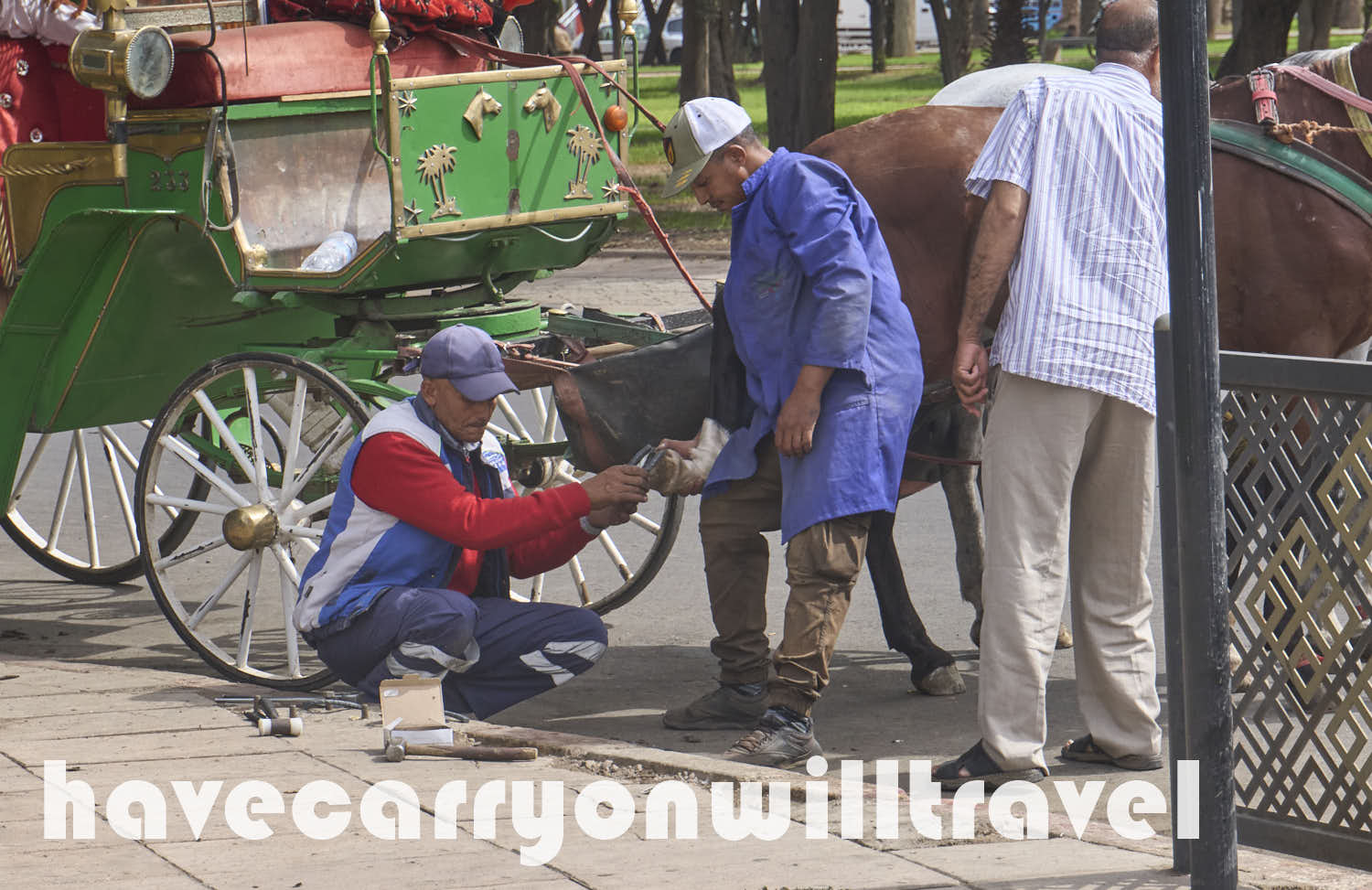
Horseshoe repair
We navigate through the tourist maelstrom in the Medina towards our hotel. The Jemaa El Fnaa square has buskers who are monkey handlers and snake charmers, jewelry sellers and juice makers.
The Medina allows motorized vehicles, mainly motorbikes, to travel the lanes. It is sometimes so dangerous as they go very fast for how crowded the Medina is. I wonder how many people get run over. Yesterday, we saw the aftermath of two motorbike accidents on the drive into Marrakech.
I need to talk about culture sensitivity. In my pre trip reading, a number of articles mentioned that women should cover their shoulders and collarbones while in the Medina. Looser clothes are favoured. I ensured the tops I packed were three quarter sleeved and with somewhat modest necklines. I worried as one top had buttons down the front and fell open all the time. In our travels through Morocco’s Medina, I have seen women with spaghetti straps, backless dresses and low cut tops, and short shorts. I watched a couple of men stare hard at a mom and three older daughters as they were dressed in short shorts and tank tops. Ladies! Please read up on the country you are travelling to find understand how to dress.
I think we are going in search of familiar food again for supper. Pizza anyone?
Eleven and a half hours since leaving Fes we arrive at our riad in Marrakech.
The paradigm changes in Fes. Cars have the absolute right of way although walk lights at the street corner are somewhat effective, credit cards are not accepted, at least around the Medina, the scooter riders wear lids and there are more stray dogs then anywhere else up to now. As far as cars go they do obey the traffic lights.
Today we leave Fes and head to Marrakesh. The driver shows up with a very fancy Kia. It has 6 seats, the four in the back face each other like a limo. Debbie and I pile in and we are officially VIPs.
The landscape is grided with rock fences. They follow the road and define the crops of apples, strawberries, plums and the ubiquitous olives. There are a few wire fences that appear and some fields are surrounded by olive trees mentioned a couple of days ago but the rock walls are more prominent.
Ifrane
Our route takes us into the area of Morocco that gets covered in snow each winter. Enough snow to have a few ski areas about. Ifrane is known as the Moroccan Switzerland. It’s a really personable town. With the ski slopes nearby, I could live there!
The route from Fes to Marrakesh is a little more populated than the route from Chefchaouen to Fes. The roads are in a bit better shape. After all is done I think I prefer the Chefchaouen to Fes route. Time would be better spent on the super highway and get to Marrakesh faster. Although you can see the high Atlas Mountains as you drive along you don’t traverse them at all. And more olives.
Because there are more towns and cities enroute we were able to stop part way at a very local restaurant. The driver orders up lunch. He doesn’t like tagine because he does not know if it was made yesterday or two days ago or this morning. He goes straight to the fresh meat counter and orders .5kg of chicken and about the same in cutlets. The meat is grilled and then served hot off the BBQ, with bread. We later find the cutlets are mutton, no wonder I didn’t like them. The meal is filling and reasonably cheap but not as cheap as the driver would have us believe. The restaurants Debbie and I have been eating in are not any more expensive.
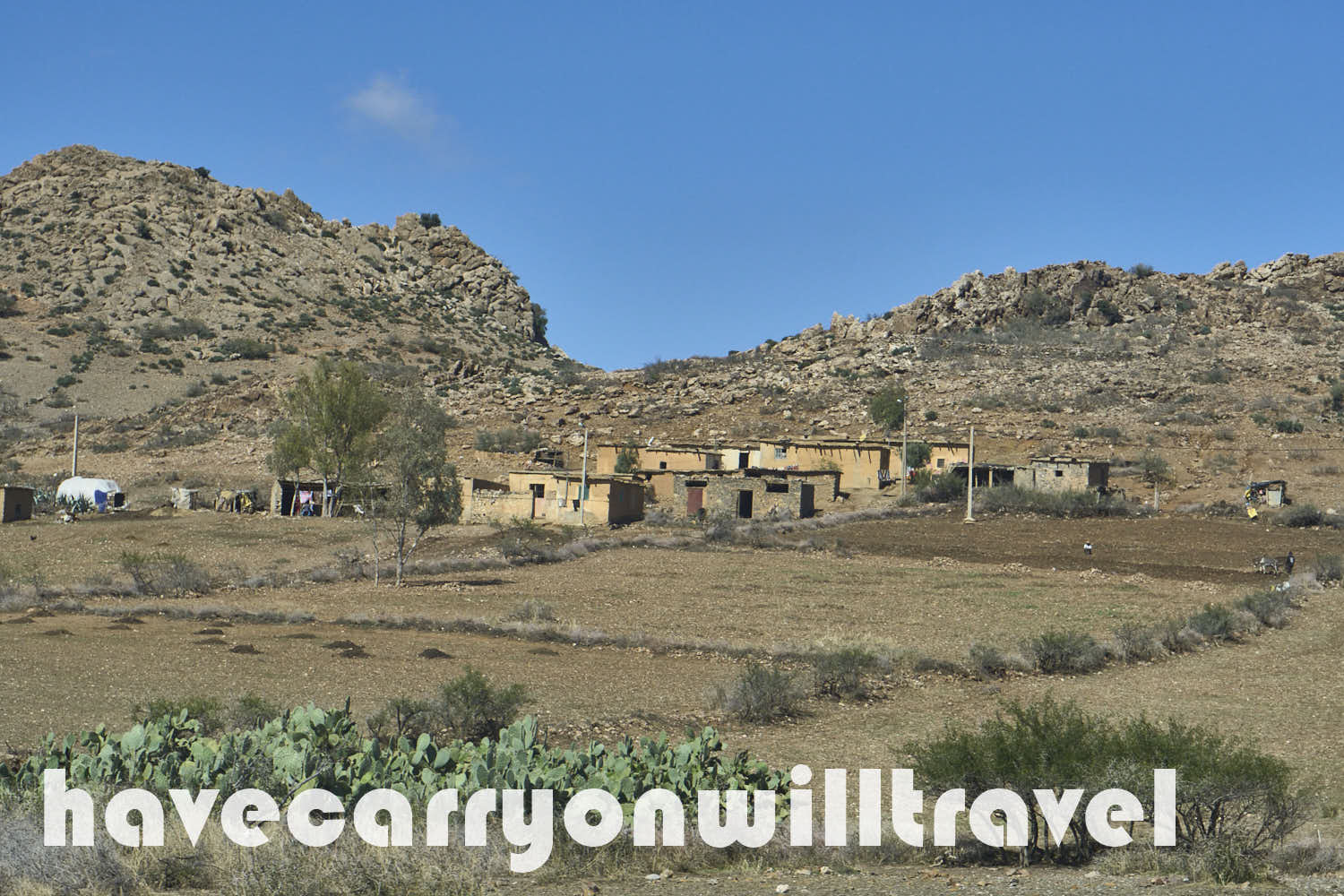
Rural Morocco
There are more changes as we progress along the route. The sheep herds are bigger. Instead of 10 or 15 sheep for a herder the numbers have grown to say 30 or 40 and bigger. And more olives.
More and more scooters are on the highway and in the towns and villages we pass through. And more olives. When we finally get to Marrakesh the number of scooters almost matches the number of cars and it is more like the roads in SE Asia. And more olives.
When we are in the rolling hills the farms change to grazing land. Mostly sheep, a few goats and hardly any cows, at least that is what is in sight from the road. Once again in the valleys crops are the dominant farm product. Just north of Marrakesh within 150kms the sky gets bigger and the plain we are on is flatter than Alberta. And more olives.
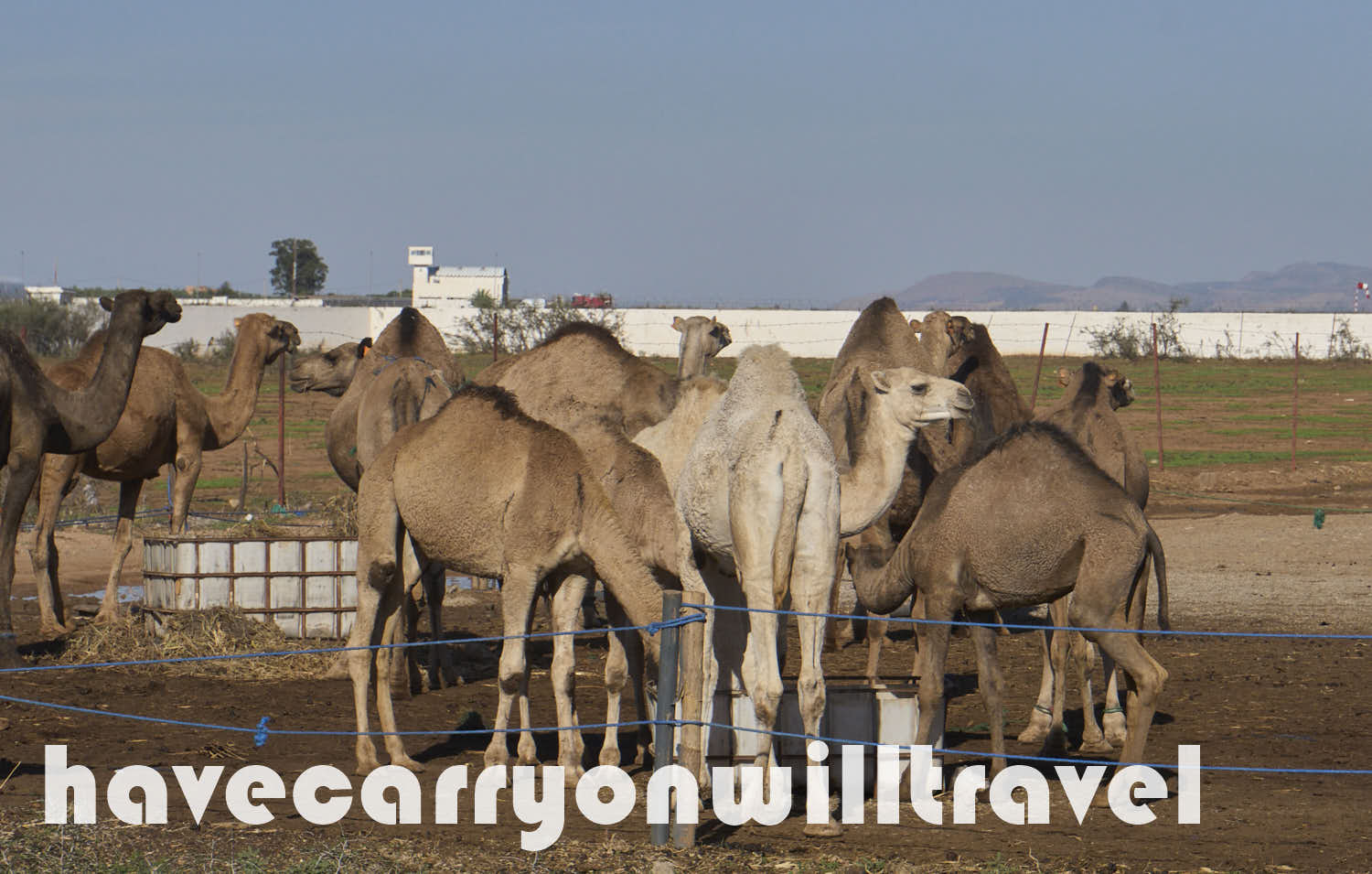
Camels !
Real life strikes, traffic slows and is diverted onto a gravel side road. As we pass I see someone laying in the middle of the highway and a scooter being pushed to the side of the road. The injured person looked to be moving but none too quick. The accident must have take place at highway speed. I’m sure it was not pretty. Shortly after we arrive in Marrakesh as we near the Medina there is more traffic kafuffle. As we go by the intersection there is a girl prone beside an e bike and not moving very much. Maybe not high speed but it was going to hurt none the less. The drivers, including those on scooters, seem to go with the ebb and flow of the traffic but they are not very careful and I would imagine these types of accidents are common.
The last part of the adventure pissed me off. The driver drove us to what he was sure was our riad. Debbie had located the riad on Google maps and was sure we were not at the right place, she said so but the driver insisted. The driver again insisted we have some guy standing on the side of the road lead us to the riad and then tells me to tip him 20 MAD. The driver heads off and the hotel guy says we are at the wrong hotel. We phone the driver; he has to come back pick us up again and get us to the right spot. I did not appreciate being treated like an incompetent tourist. I don’t care how many people he has dealt with when Debbie says we are at the wrong riad we most likely are and when I say we don’t need a guide to get to the riad we don’t need a guide. It was only 3 bucks for what, I DON’T NEED A GUIDE.
As to that statement Debbie and I have traversed 5 different Medinas and have not got lost once. People, good travelers, told us they are so complicated, so twisty and turny, you will get lots. Granted we did download Google maps and use it to navigate but we always eventually found where we were looking for without too much trouble and we always got back to the riad we were staying in very easily.
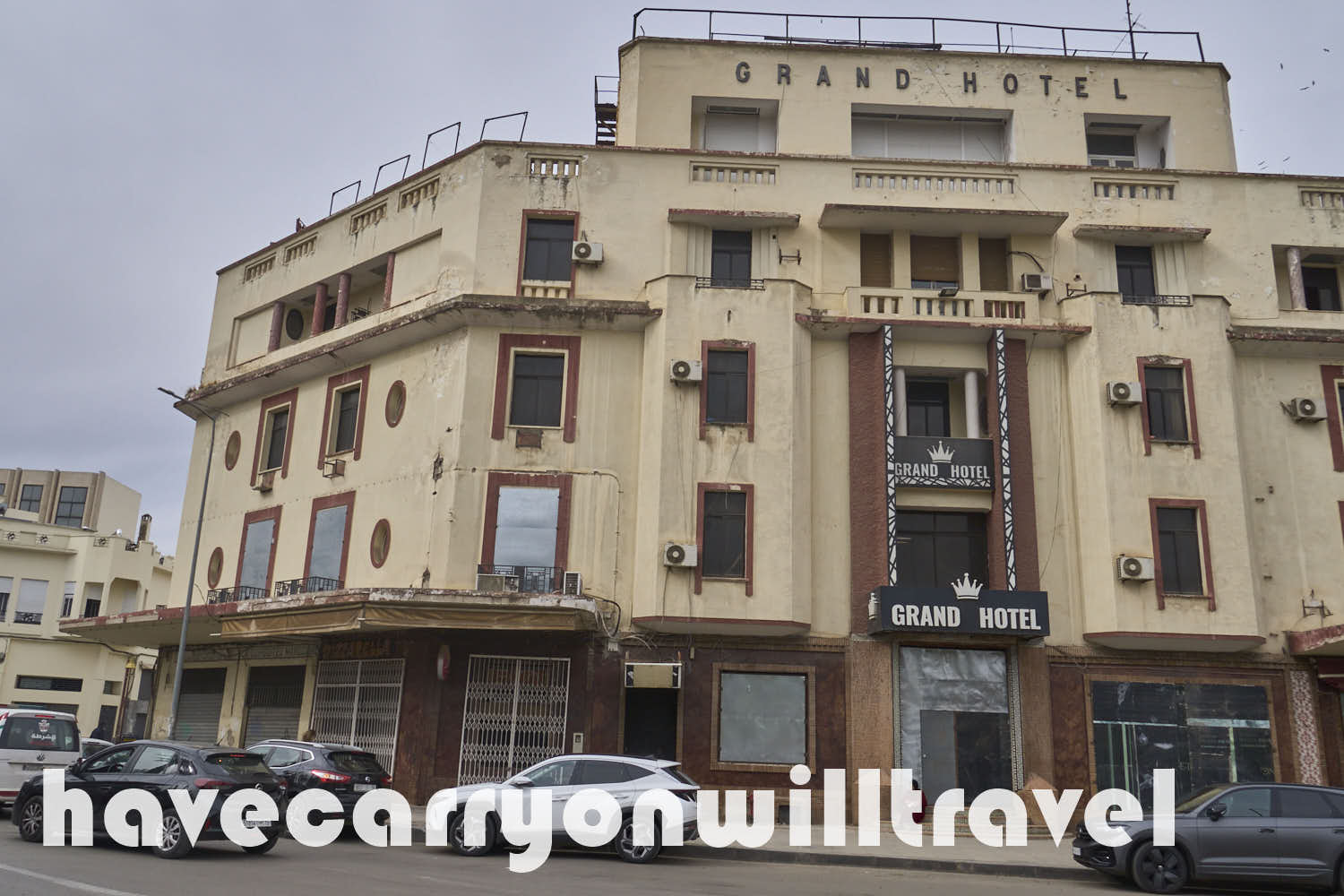
There are Art Deco buildings in downtown Fes, so we venture outside the Medina. A 10 minute Petit Taxi ride for 15 MAD (about $2.00 Cdn) takes us to the Grand Hotel. I had envisioned an operational hotel in all its Deco splendour. Sorry no, the building is boarded up and weary. The Deco influence is still prominent.
Grand Hotel
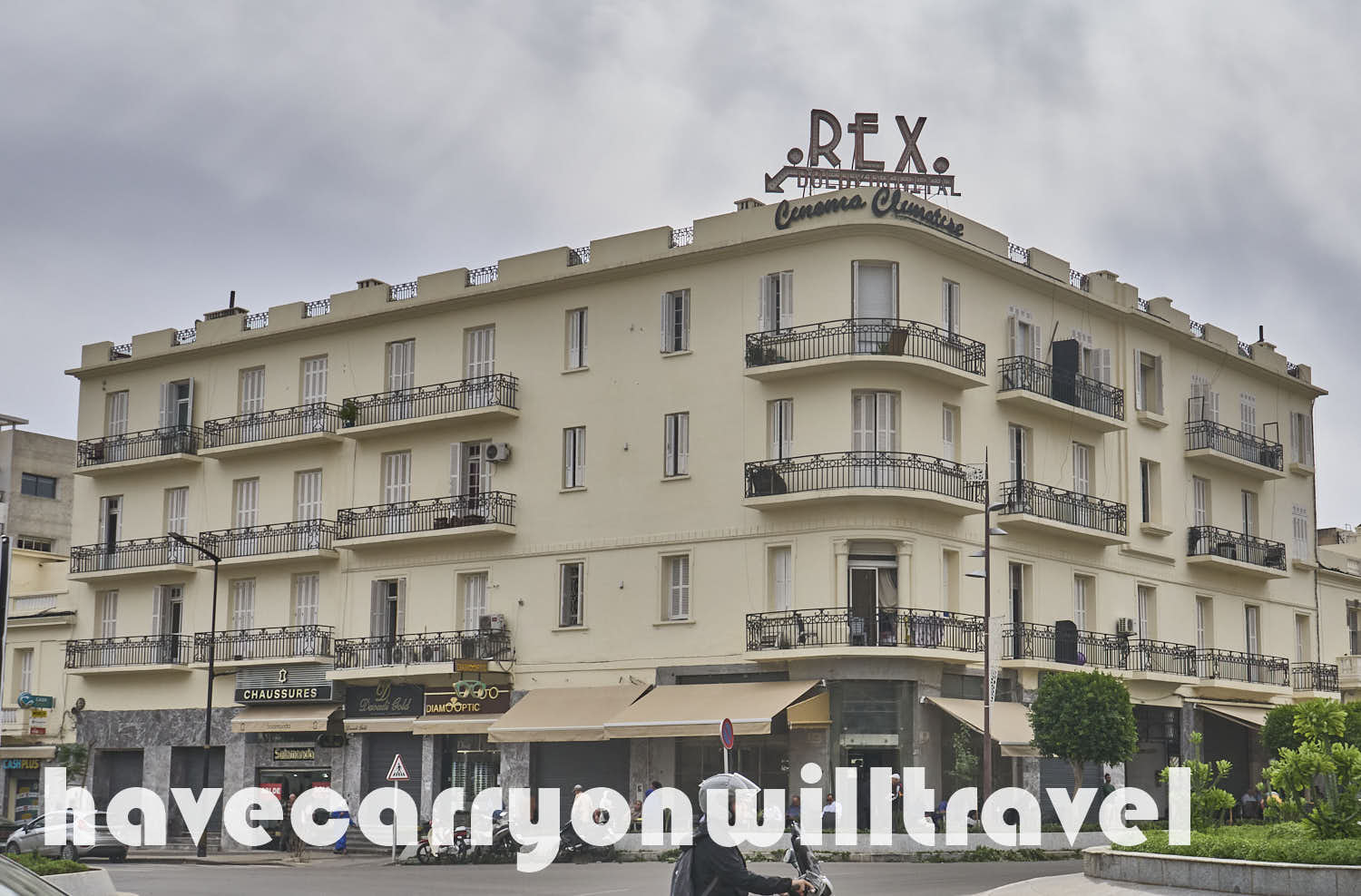
Next is the Rex Theatre across the traffic circle. The building has been refurbished, but doesn’t look like a theatre, more like condos. I believe the theatre was in the basement. It is closed but the sign remains and it is a fine example of Art Deco.
Rex Theatre
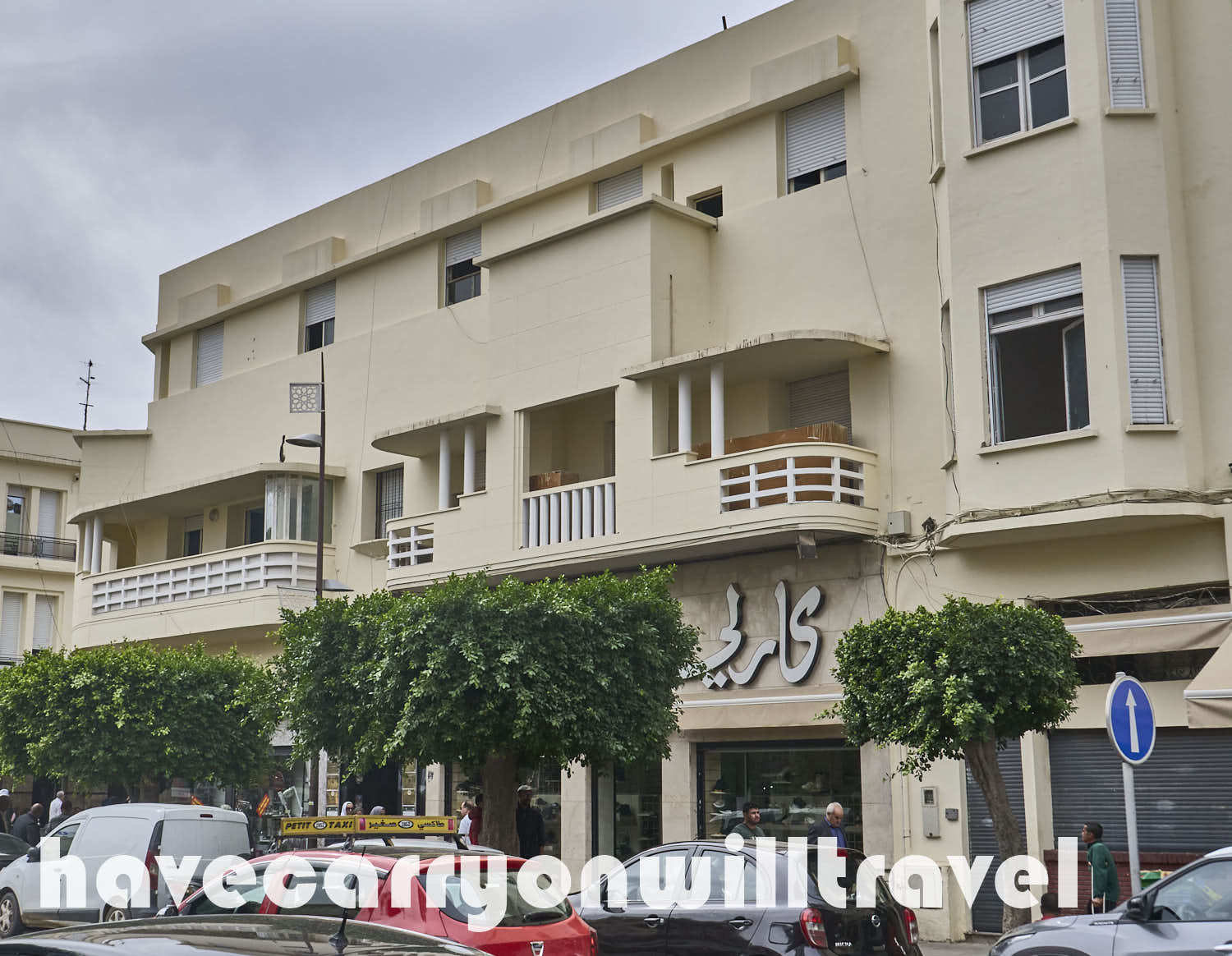
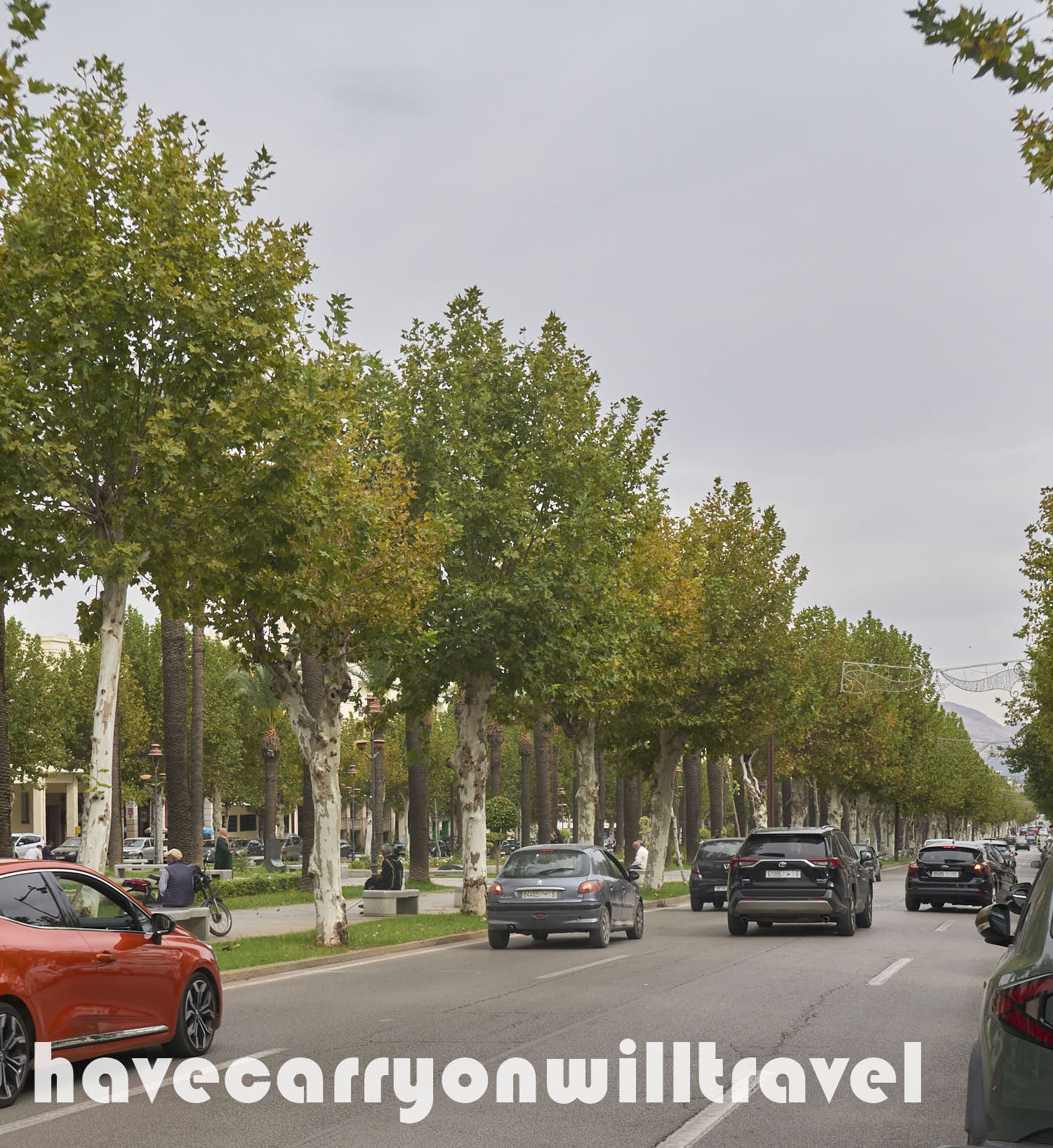
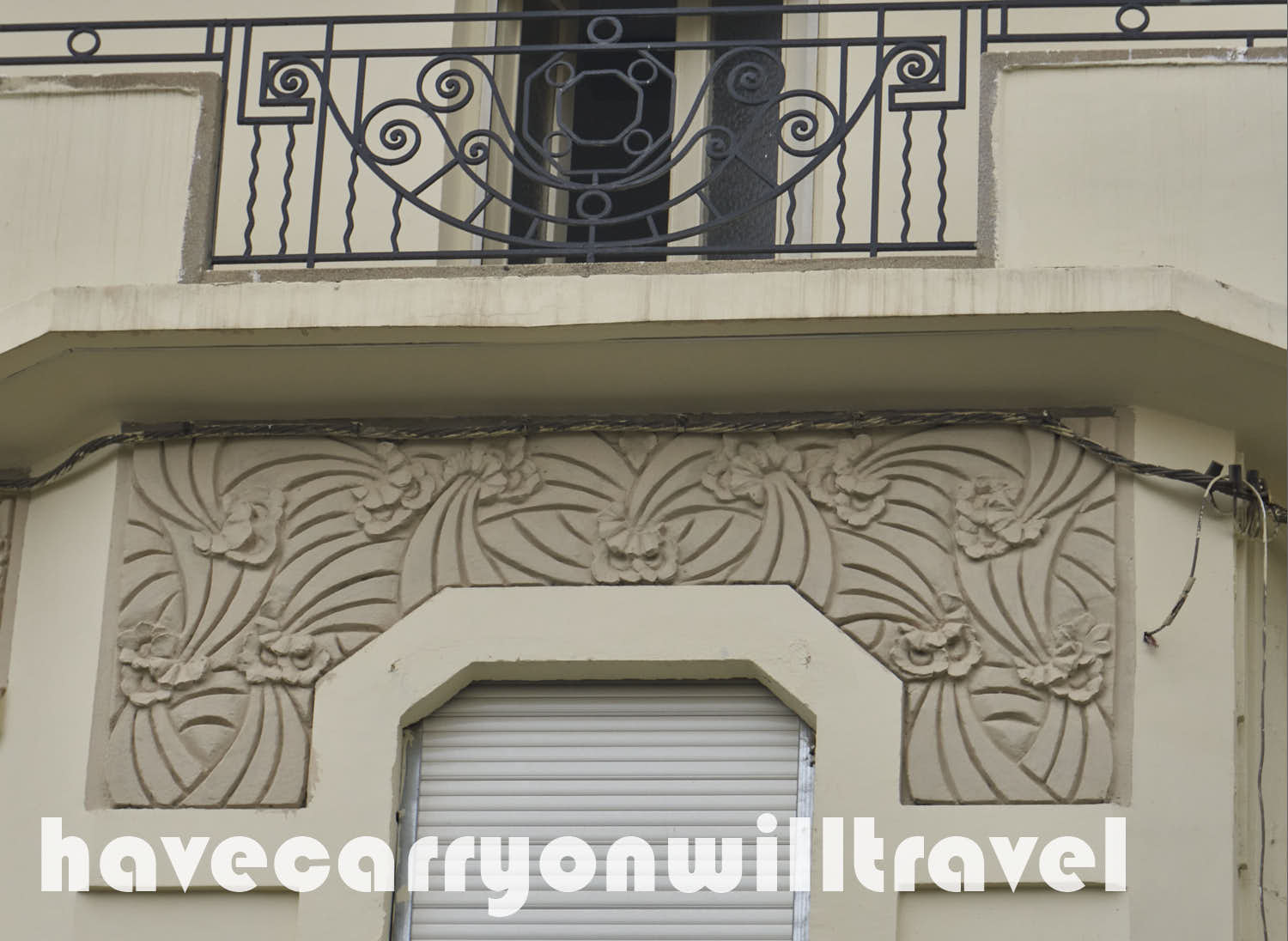
Avenue Hassan II is prominently decorated with trees lining its curbs. Government type buildings line one side while cafes line the opposite side of the street. We turn onto Boulevard Mohammed V as there are Art Deco traces here too. Curved balconies, oval or circular windows, flat roofs, pipe detailed railings and wedding cake tiers adorn the structures.
Art Deco
Downtown Fes is modern and mostly well kept. The Monday traffic is heavy, but not horrendous for a city of 3 million people. Our walk back into the Medina is pleasant and then it is back into the fray of the tourist zone inside the walls.
Avenue Hassan II
We have noticed that Fes does not like credit cards. Up until now, Murray has had no problem paying at restaurants with his credit card, but here, everyone wants cash. Hard to make a cash budget when the rules change suddenly. We expected the food to be spicy, but it is not. Tagine, either chicken or beef, is the typical traditional food here, and we are eating our share. It is cooked in a special vessels that has a flat circular base and a conical lid that allows for slow cooking with little water. My favourite is chicken with lemon and olives. Another item is chicken pastilla, a pie with chicken inside and philo pastry outside, sprinkled with cinnamon – Murray’s fav.
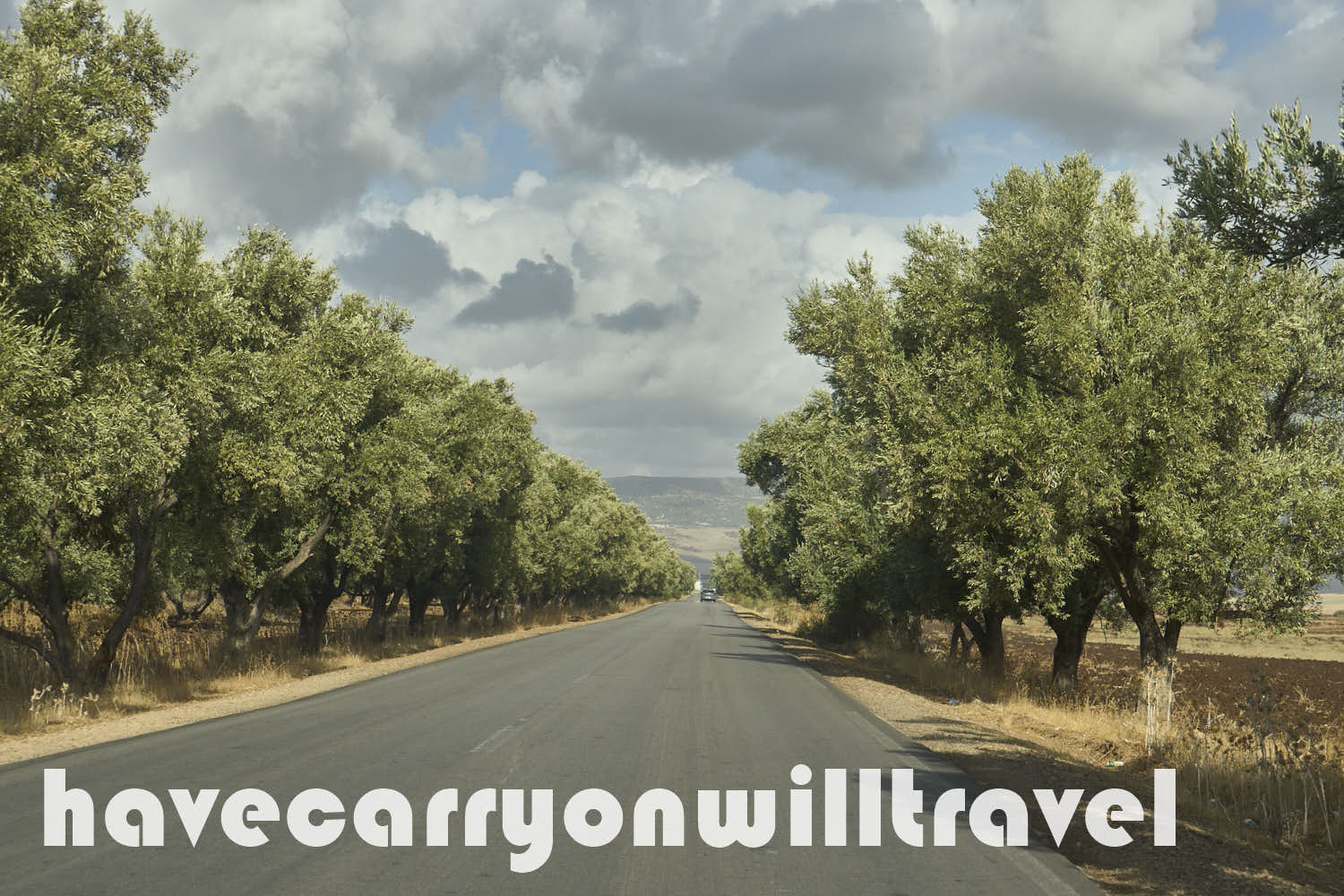
We seem to have seen an inordinate number of olive trees the last few weeks. Albania was covered in them and after travelling around Morocco, I would think that olives are one of the main crops here. These two countries are small stuff compared to Italy or Spain where the olive production is much greater.
Most of us think of olives as something that comes in a jar or maybe on pizza. Except for Mediterranean countries, olives are not consumed in great quantities.
On our drive today I started thinking. With all of these trees how many olives would each human have to consume to make sure all that grew were eaten.
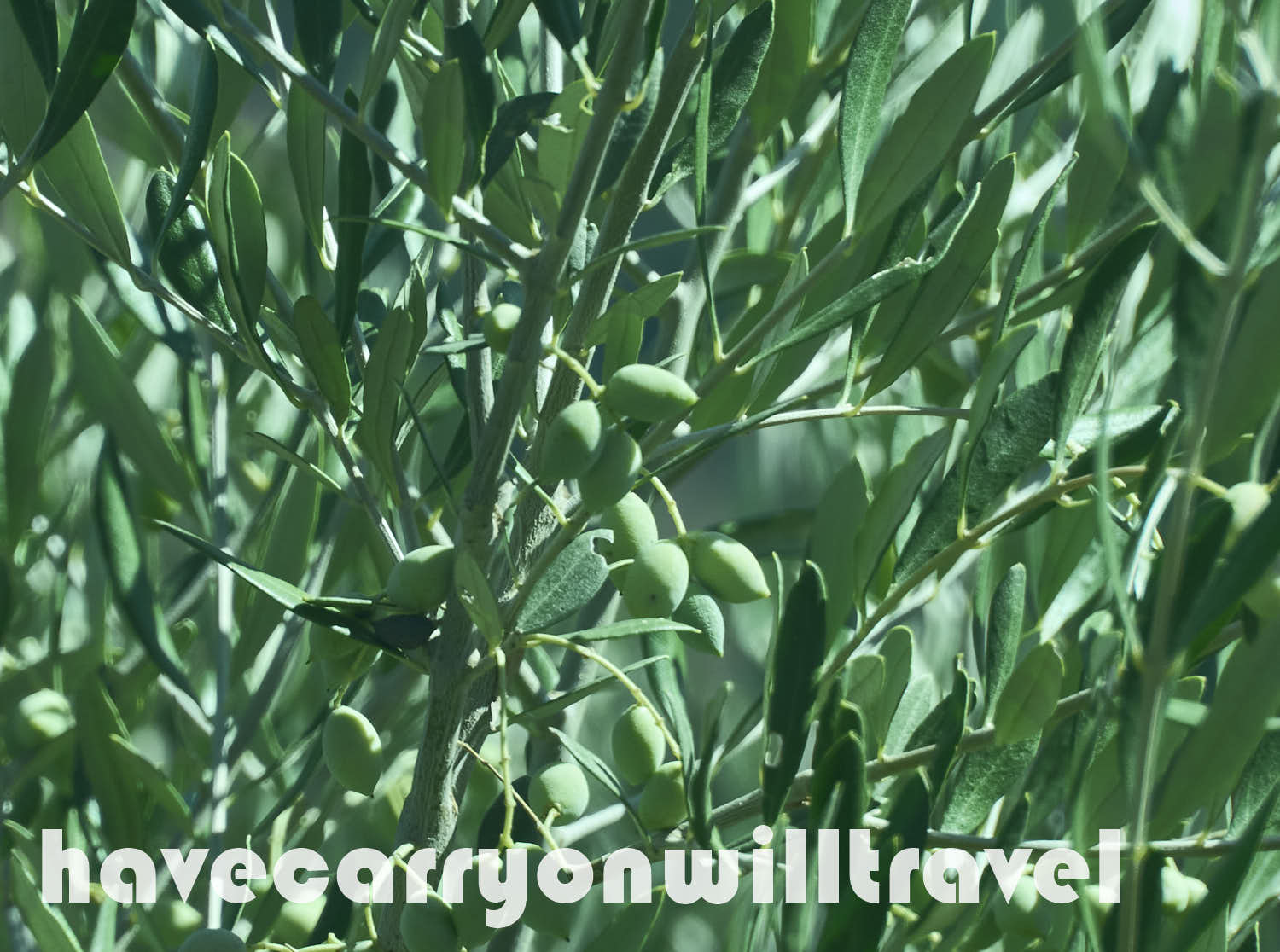
So I check into a few estimates. How many people are in the world right now, answer about 8 billion. Then, how many olive trees are producing, answer about 1 billion. Last question and this one is a toughie, how many olives does one tree produce in a year? This one depends on so many things, like weather, the location of the plantation, the variety of olives and the fact that the trees have off and on years. The last variable is, farmers don’t count olives, they quantify by weight. This all means a tree produces 15 to 25 kgs of olives per year, there are about 250 olives per kg. So the range is large, 3750 to 12500 olives per year produced by each tree.
I will use a mid point on the olives per year, say 8000. With 8 billion people and 1 billion trees means the olives from one tree will be divided between 8 people. If that tree produces 8000 olives each person has to eat 1000 olives per year. Sounds like a lot but really it is only 2.7 olives per day. Quite plausible especially for people from the Mediterranean region. For the rest of us it seems like a bit much but this calculation does not take into account olive oil production. A person may consume hundreds of olives per year while cooking.
What all this means is I don’t have to eat olives and the world production will still be used up. I don’t like olives.
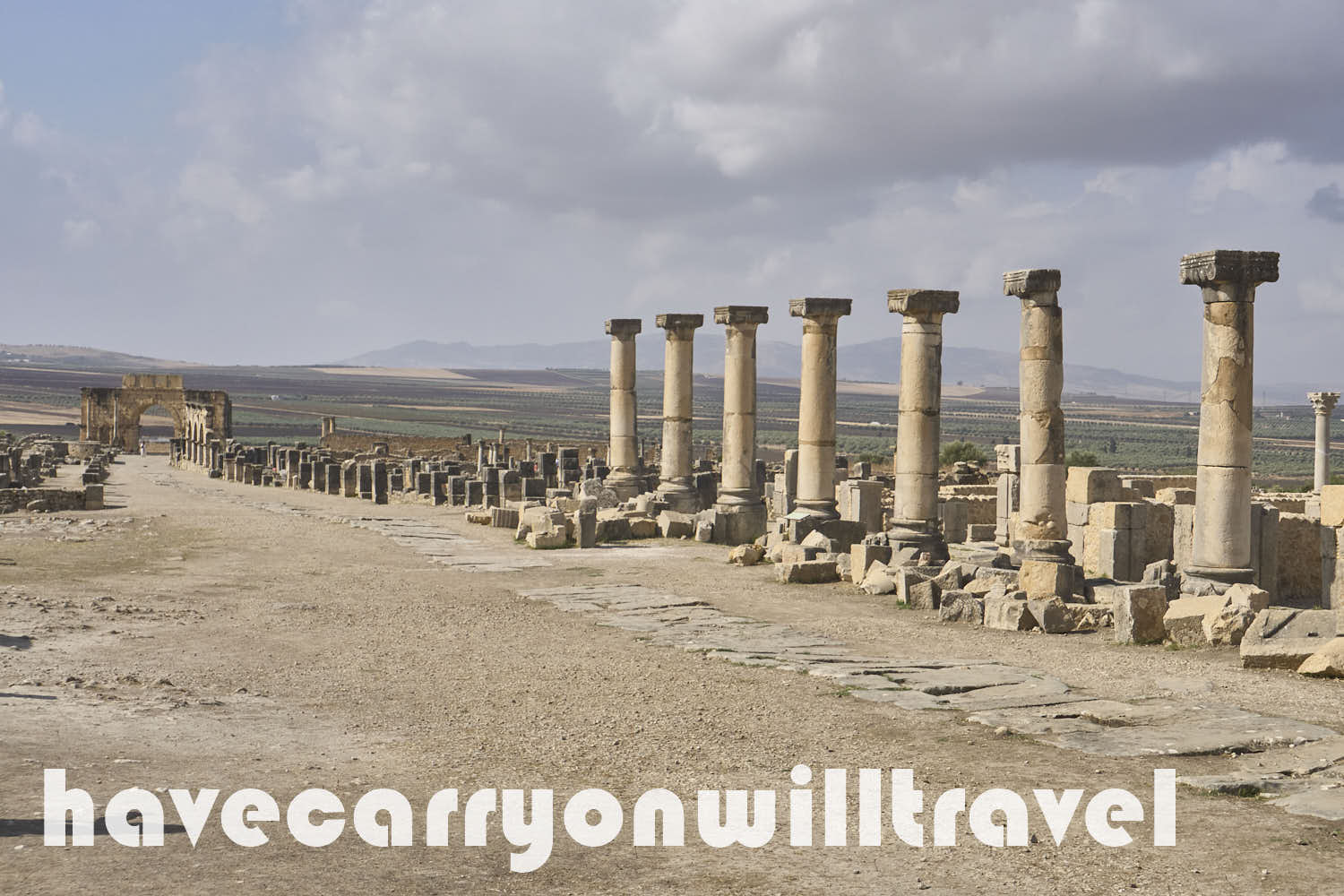
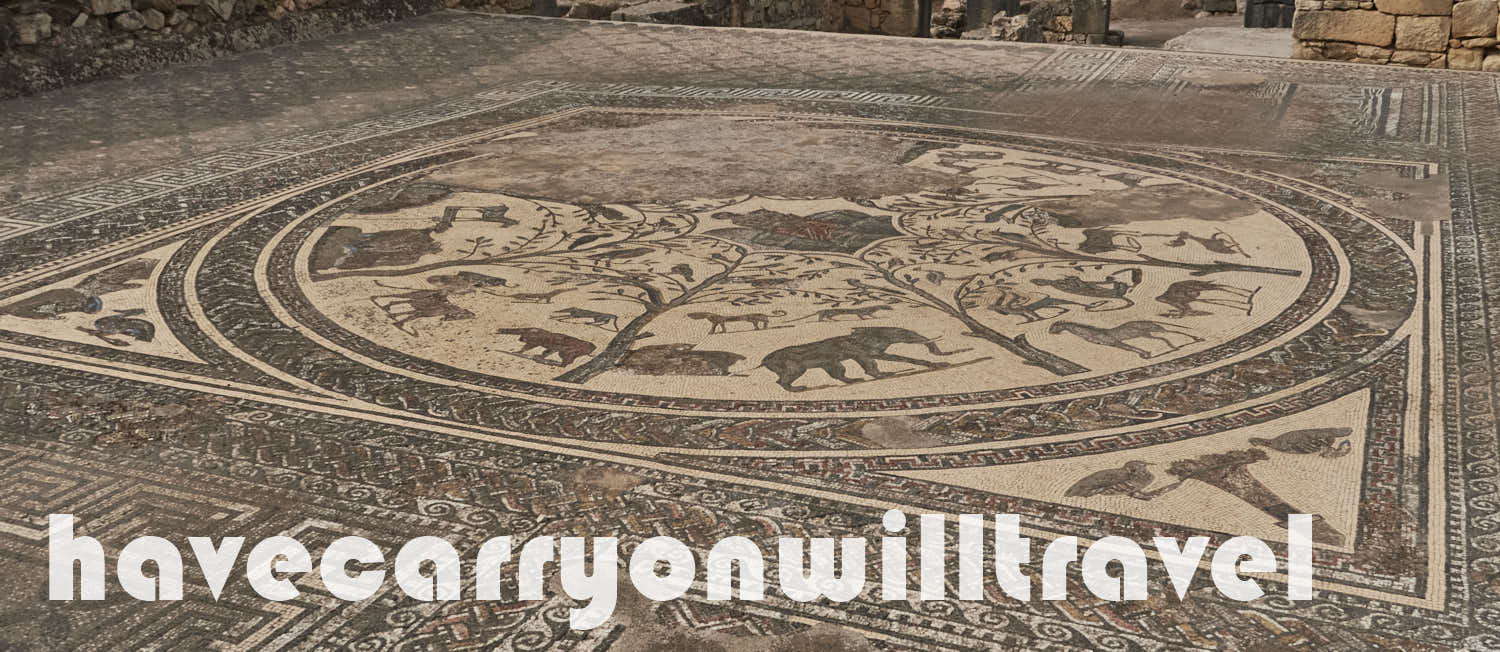
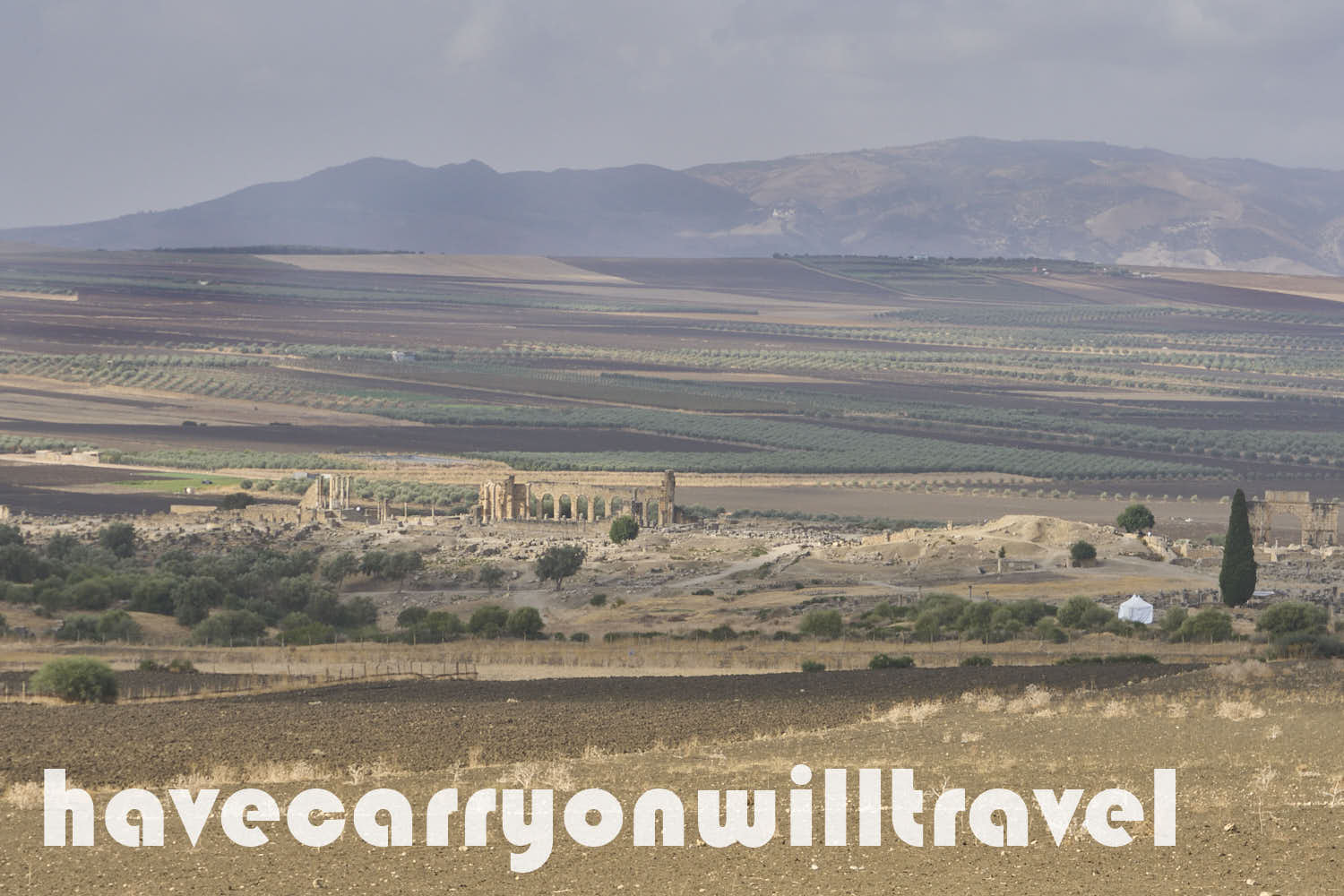
The ruins of Volubilis are about 60 km west of Fes. The area was first developed in the 2nd century BC by the Berbers and the Carthaginians. Then around the 2nd century AD the Romans developed more of the area, building grand avenues, large houses, arch of triumph, basilica, forum and many other structures. There are two things that make this site important. It’s located on the top of a small hill, where the breeze is used for cooling and the views of the surrounding countryside are stunning. We saw the same design on Crete at the Minoan Palace of Knossos. The second thing is the number of tile mosaics that have been uncovered. They are intricate, colourful and beautiful.
VolubilisVolubilis
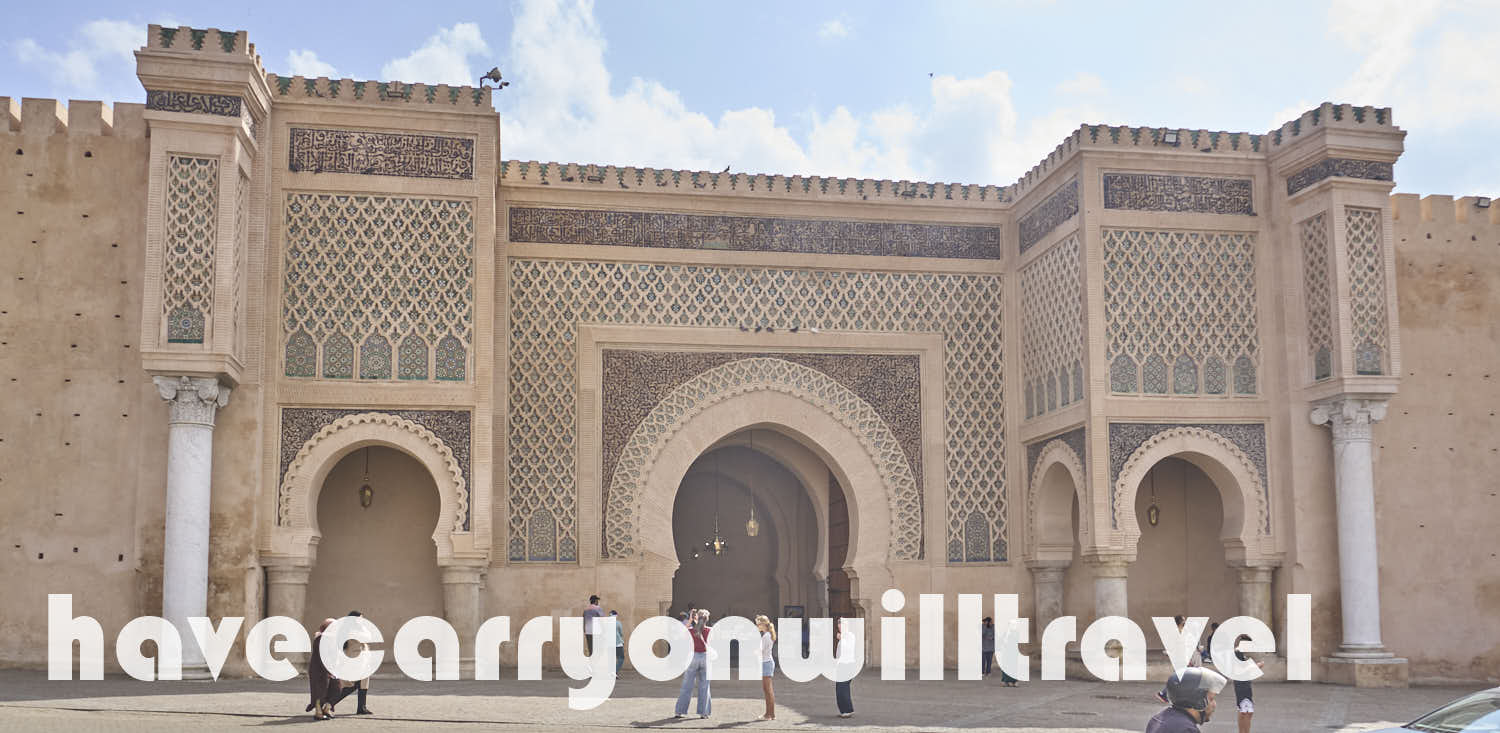
The other stop on our day excursion is Meknes. It was the capital of Morocco in the late 1600s. There is a grand palace there, along with huge stables thought to have housed 12,000 horses, thick walls, fancy gates, and a mausoleum. We, of course couldn’t get into the palace grounds, or the mausoleum but drive past the stables. Unfortunately, Murray and I take a wrong turn and never find the Medina. We wander down a street of residences and find a real locals market just outside the Medina walls. End up having lunch at a real touristy restaurant that serves tour bus loads of people. So, Meknes was a bit of a dud for us. The one semi highlight would be the main gate that leads to the palace, the Bab El Mansour. We did see our first snake charmer in the big plaza leading to the Medina.
Bab El Mansour, Meknes
The drive through the countryside is very much like the prairies and foothills. Large sections of land have been harvested and are awaiting spring. Rolling terrain leading up into the hills. There are other crops too, oranges, potatoes, squash. Rural towns spot the landscape. Murray sees olive trees used as separation between fields rather than fences. Great idea as the olives are harvested also, making two crops for the farmers.
Volubilis
We have noticed that in Morocco the car AC is opening the windows, old school. The Moroccans do not use AC to excess like some other countries. We like this. I’m not sure if they acquiesce and use the AC in the summer when it is 40C plus.
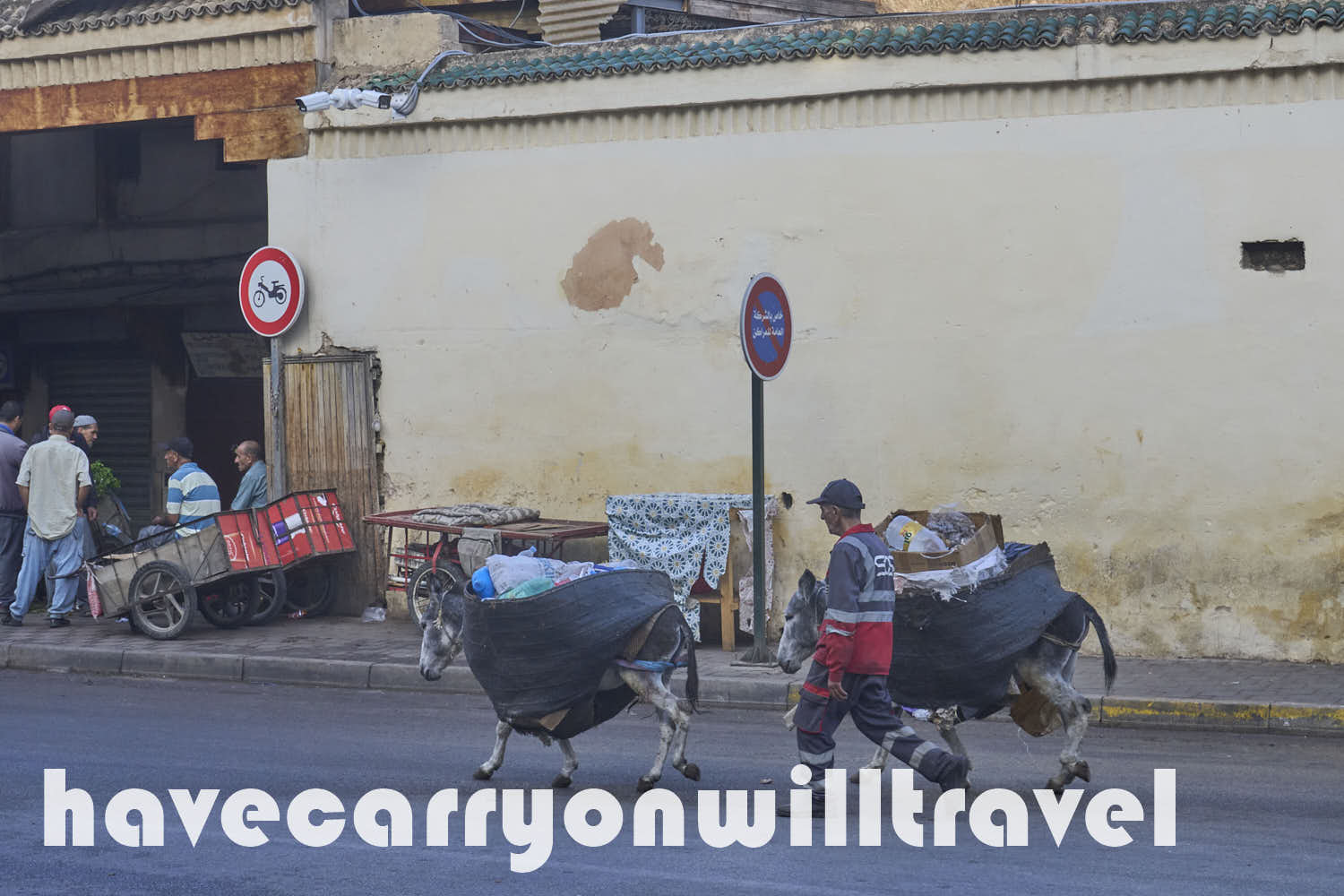
Garbage collection donkeys
Donkeys, not mules, are used here for many chores. Carting garbage out of the Medina, hauling cleared brush away and carrying goods and owners. They work on small paths in all terrain. Our driver tells us that donkeys are known as the Moroccan 4 by 4!