Warthog

Warthog in the Serengeti

Warthog

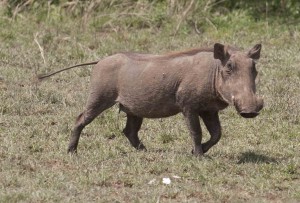
Funny little fellows. They seem shy, scurrying away when the vehicle approaches. If the truth be told they are quite ugly. While running, their tails stick straight up in the air, just like the movie character Pumba. Apparently this tail thing is so that warthogs know where each other are, even in higher brush. Ever wonder where the idea of those fluorescent orange bike safety flags came from? Pumba!

There is a mother warthog and her children hanging around the hotel in Kasane, Botswana. The kids are playing and I am amazing at how fast they move.

Every time we see warthogs on the move they look like they are on a mission.  Don’t spend a great deal of time watching these guys but they do make us laugh every time we see them.

Warthog in Botswana

Warthog


Posted in Tanzania and Botswana | Tagged , | Leave a comment

The Cell Phone Dilemma

I am now in a dilemma. The dilemma is whether we should travel with a cell phone. One that actually works in the countries where we are going, of course. This confusion comes about because of our two airline episodes in Tanzania and Botswana. Both situations might have been resolved much quicker, and perhaps with less stress, if we had a phone that worked where we were.

In Maun, Botswana, we would have been able to phone the Air Botswana office rather than going there and making multiple trips to and from the hotel. (Refer to “November 30 – Safari Goodbyes”)

In Tanzania, we might have been able to resolve the issue with our flights the night we discovered it, rather than waiting until the next morning. Although I do not think either of lost sleep over the matter. We also would have been able to phone the hotel in Vancouver and Westjet/Air Miles easier and rearrange our travel plans. (Refer to “December 11 –  Delayed”)

So, do we take the plunge and start traveling with a usable cell phone? Do we incur the extra expense for situations that may, or may not, happen? We have traveled to China, India, Vietnam, France and various Caribbean countries without any issues, so was this trip just bad luck? We managed to get both our travel issues resolved without a cell phone, so in the end everything worked out. I should tell you though that we borrowed three different people’s cell phones to deal with the Tanzanian airline issue. Who knows whether they got charged for the calls to Canada.

I don’t really know that much about cell phones and international travel, but my son was saying there are a number of ways to do it. One option is to get a cell phone plan that allows you to buy a roaming plan for the countries where you will traveling. The other option is to buy an open cell phone, which he says can be quite painful, and buy SIM cards in each country you go to. Either way I would have to replace the antique that I currently own.

So, there are options, but the big question is whether we really need to carry a cell phone. Do we carry a phone for “what if” scenarios? Any suggestions? We do not have another long international trip planned, so I have some time to think about the cell phone dilemma.

Posted in Planning and Packing, Tanzania and Botswana | Tagged | Leave a comment

Birds

Yellow Hornbill

Yellow-billed Hornbill

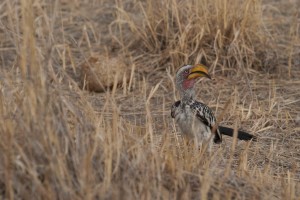
We do not have a comprehensive list of the birds we see in Tanzania but in Botswana we have a very long list of possible bird sightings given to us by the safari company.  Even though we check-mark sightings off the list, we do have trouble identifying them in the field. There are just so many different birds here in Africa.

Ostrich

Ostrich

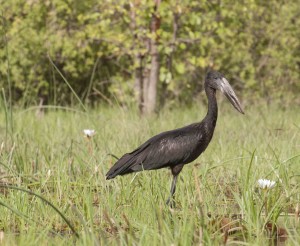
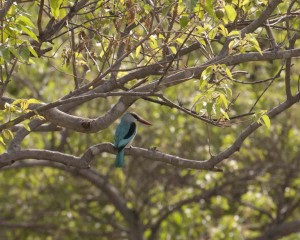
There are Water Birds – storks, ibis and hamerkop. There are Ground Birds – ostrich and cranes. There are Raptors – the infamous chicken stealing kite, secretary birds and vultures. There is a group called Near-Passerines – hornbills, kingfishers and rollers. And these are just a few of the birds that we see.

Open-billed Stork

Open-billed Stork

We see many Crested Guinea Fowl and from a distance they are eye catching but up close their beautiful colored heads are completely prehistoric. Egyptian Geese roughly resemble our geese but are much prettier and smaller. A Spectacular Starling is indeed spectacular with its blue back and brilliant gold breast. Secretary Birds look like stenos with a drooping black crest that looks like a Victorian clerk’s quills.

Kingfisher

Kingfisher


Posted in Tanzania and Botswana | Tagged , , | 2 Comments

Antelope

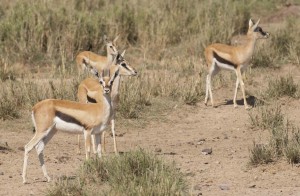
Thompson Gazelle

Thompson Gazelle

We see so many different types of antelope that we have trouble keeping them straight. We see too many to include all in a post, so here is a sampling.

Thompson Gazelles are the only ones to participate in the great migration. They have a black stripe down their sides. Grant’s Gazelles (no stripe) were named after the fellow who liked to hunt them, Ulysses Grant, an ex President of the USA. Dik Dik are the smallest with a height of maybe 60 cm. Delicate and nervous, they seem to travel in 2’s. Thompson Gazelles, Grant’s Gazelles and Dik Diks are all grass eaters. Phew!

Dik Dik

Dik Dik

Impala are colored much the same as a Grant’s but they have a distinctive set of black and white stripes on their rear end. Pat says their stripes form an “M” shape for “McDonalds”, which is where the cats and the wild dogs go to eat. Their horns spiral away from their head. Leaves rather than grass are their meal of choice.

Impala

Male Impala

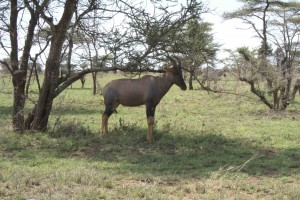
Tsessebe are multi-coloured and have a sloping back profile. It is said to be the fastest of the antelope.  We only see them in ones, twos or threes.

Tsessebe

Tsessebe

Waterbuck have a shaggy coat and a distinctive white ring around the rump. We find them near water only in small groups. How do they stay cool with that shagginess?

Waterbuck

Waterbuck

Posted in Tanzania and Botswana | Tagged , | Leave a comment

Mongoose

Banded Mongoose

Banded Mongoose

Small, curious little fellows. They travel in packs. Sometimes live in termite hills. The group of them runs around bumping into one another, wrestling and rolling around. They remind me of the Keystone Kops.

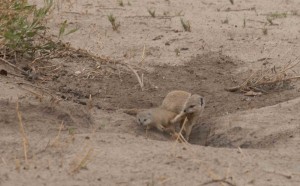
Yellow Mongoose

Yellow Mongoose

We came across the scene below one day in Botswana. A Leopard Tortoise strolled through a Banded Mongoose neighbourhood. The mongoose were very curious and watched and followed but didn’t get too close to the meandering hard shell.

Curious Banded Mongoose

Curious Banded Mongoose

Posted in Tanzania and Botswana | Tagged , | Leave a comment

Giraffe

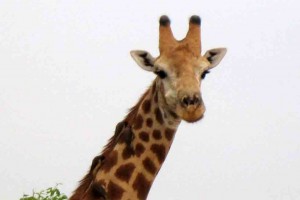
Giraffe

Giraffe

Tweega, in Swahili. Tall and lanky, sort of like a teenage basketball player, but more graceful. After observing them for some time we are amazed at how well they manage their long neck and skinny legs. They move in an elegant manner almost flowing over the landscape. Being as tall as they are, the giraffe are able to reach the highest and tastiest leaves. The tall acacia trees are the giraffe’s private feast. They do have a bit of trouble with the low stuff but can kneel down if need be. I understand they can run if necessary but generally the are not in a hurry to go anywhere.

blog giraffe2This giraffe below was chewing on some leaves and chewing and chewing. He swallowed and then….glup…..regurgitated the clump of cud and started chewing and chewing again. It is amazing that this ball of cud travels so far along the giraffe’s neck. He performed this regurgitation numerous times while we watched.

blog giraffe1

Posted in Tanzania and Botswana | Tagged , | Leave a comment

Buffalo

Cape Buffalo  in Tanzania

Cape Buffalo in Tanzania

These creatures are big suckers. Off in the distance they look like cattle but when the vehicle pulls up within 3M we have a real appreciation as to their size. We are told they can be down right ornery as well. From what is said they are probably the most unpredictable of all of the animals here. We did not test the hypothesis.

They have a comical look to them with their ears pointing downwards and their horns pointing up. Their horns are massive and I would not want to carry those on my head for too long.

African Buffalo in Botswana

African Buffalo in Botswana

Pat, our guide in Botswana, gave us a list of YouTube videos to watch. There is one called “Battle of Kruger”. Give it a watch!

Posted in Tanzania and Botswana | Tagged , | 1 Comment

Animal Butts

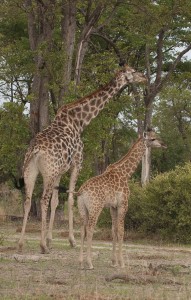
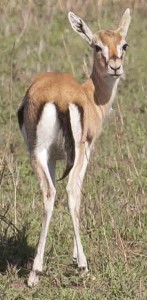
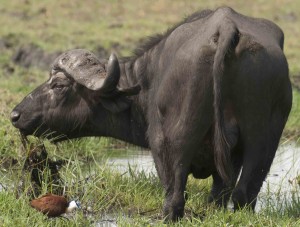
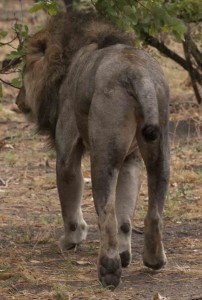
We spend time watching animals walk away from us. Some animals are shy, some are tired of us watching them, some are just moving along. We take pictures anyway. Here is some of our butt collection.

12 Afr 11 15 0039blog

Impala Butt

12 Afr 11 13 0018blog
Zebra Butt
12 Afr 11 21 0029blog

Waterbuck Butt

12 Afr 11 21 0122blog

Buffalo Butt

12 Afr 11 22 0063blog

Giraffe Butt

12 Afr 11 23 0099blog

Lion Butt

12 Afr 11 25 0006blog

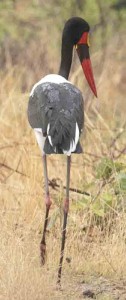
Saddle-billed Stork Butt

12 Afr 11 27 0057blog

Monkey Butt

12 Afr 11 28 0113blog

Red Lechwe Butt


And my favorite…….


Elephant Butt

Elephant Butt


Posted in Tanzania and Botswana | Tagged , , | 1 Comment

Kitanga and Kanga

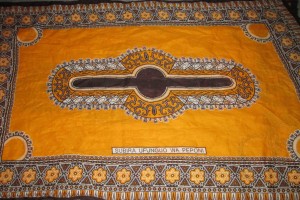
Most ladies in Tanzania wear kangas or kitangas. These are large pieces of material that they wrap around themselves as skirts, shifts, shawls and head coverings. The patterns are wild and the colors are stunning. I notice them right away and take immense pleasure in looking for colorfully dressed women.

Kitanga Material

Kitanga Material

A kitanga is about 44 inches wide and about 136 inches long. It is longer than a kanga. It is wrapped around to make a sort of dress or shift and tied. The tag on the one I purchase for about $6 Cdn says it was 100% cotton. The material feels very smooth for cotton. It turns out it isn’t cotton – while ironing a corner of the material it got too hot and melted – I do not think cotton does that! I love it anyway and the green fronds remind me of a plant that we saw in the Serengeti.

Kanga

Kanga

A kanga is about 36 inches wide and about 60 inches long. They are usually bought in pairs and worn in pairs. The pair is called a “doti”. One kanga is for a skirt and the other for a shawl or “tube” top, or even to gift to a friend. Each kanga has a Sawhili saying imprinted on it.

"Wait for the key to heaven"

“Wait for the key to heaven”

I buy a kanga pair in Stonetown from a vendor selling to local women. Murray bargains him down to 4,500 Tsh, which is about $3 Cdn. The “pair” is two imprinted kangas on one piece of material, definitely cotton this time, and some cutting is required to separate them.

Posted in Tanzania and Botswana | Tagged | Leave a comment

Wildebeest

Wildebeest

Wildebeest

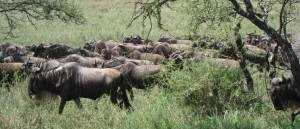
AKA Gnu. They resemble a svelte American Bison. They each sport a beard and are slightly hunched back. Their rear hunches are lower than their shoulders.

Wildebeest are the largest group of the four animals that participate in the semi-annual migration across the Serengeti Plains.  We witness the leading edge of the migration and the herds stretch for kilometers. The migration brings wildebeests, zebras, Thompson Gazelles and elands, and it also brings the flies and the carnivores.

Wildebeest

In conversation with an Australian fellow, he mentioned that the reason the wildebeest exist in such great numbers is because during the times of the colonial animal massacre there could not be found a use for this lowly animal, their meat being tough and their hides not pretty, so they were not killed in the numbers the others were.

Posted in Tanzania and Botswana | Tagged , | Leave a comment