Chile First Impressions

New country. I think this country has a bit more cash than Bolivia. We cross the border and after about a kilometer we are on a brand new paved road. The shaking ends.

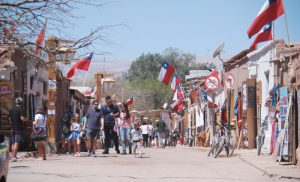
San Pedro de Atacama is a large town, most of it is fairly new. The character is distinctly different than that of a Bolivian town. The building type is not so indiginous. I cannot put my finger on it but the second we start our walk through town we know we are no longer in Bolivia.

San Pedro de Atacama, chile

Sab Pedro de Atacama

This town in particular exists for the tourist industry. Literally every second shop is a tour agent. It is also obvious the target group is young people. 80% of the other 1/2 of the shops are bars. The final 20% are tourist trinket shops. You have to get off main street if you want to find a corner store or a pharmacy.

Today we are to tour a bit around this area and see the Chile side of the Atacama Desert. Yesterday we passed the line that divides the altiplano and the desert. The difference is subtle but the desert is definately barren. Not sandy and duneish like the image of a typical desert but flat and gravelly and completely barrren of flora. The smoothish terrain is as far as you can see. The desert looks the same on the Chile side of the border but is at a much lower altitude.

Chile

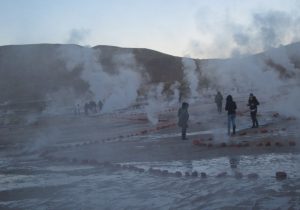
As I said San Pedro has grown on the tourist industry. This morning we leave the hotel at 5am, destination the Geisers del Tatio. Us and 50 other tour cars, vans and buses in a convoy on a gravel road in the dark. There were so many people at the geysers you could not get a photo of the bubbling water without a tourist in the foreground. OK but not stunning.

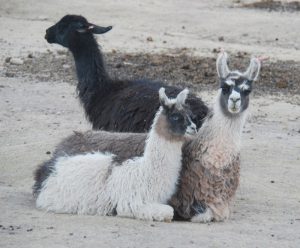
Onward to a small village of folks that raise llamas. Damned if I can remember the name of it but it is a place I would not send people to. First of all, the entire troupe of tourists is in a 20 building village at the same time and second, the village has been entirely updated for those tourists. I was not the slightest bit interested in the place.

We have travelled across the entire width of southern Bolivia and I enjoyed every minute. So far Chile has not impressed me one bit. It is however a big country and there is a lot more to cover so I have to keep an open mind. I will see what the next few days bring as we travel to Santiago.

Chile

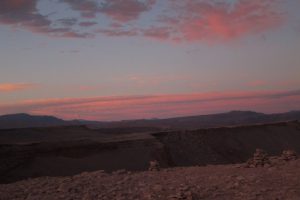
Sunset on our last day of the tour.

Posted in Chile | Tagged , , | Leave a comment

Bolivia

Bolivia

Our hotel in Villa Mar.

We blow into a village, not much different from any of the other villages. Car turns off the main four wheel drive track and there is a non descript building ahead. The driver says ‘hotel’ and we pile out onto a dusty parking lot. The wood door we enter through could be hung on any of the adobe houses in town. The lobby is the first indication we are in a special building. This place is really nice. In fact it is beyond nice. Our hotel for the night has decor to match any boutique hotel in any city in the world. The rooms are furnished funky stuff that give it real character. Wow, who woulda thought. And this happens over and over.

We were warned that in the spring and fall and anytime really, on the altiplano, it can be very hot in the day and really cold at night. We came prepared for this each bringing long underwear tops and bottoms as PJ’s. The hotels did have heat we could access but the thing is they have these amazingly heavy, amazingly warm wool  blankets. I do not know how anyone could be cold under covers such as these.

The days are sunny and the sun is hot but there is this icy wind that blows through. So even though you think you should be hot it is quite cool. The ladies for the most part are wearing puffy jackets even with the noon day sun over head. Something I was not quite prepared for is the dust. We stomp it up when we walk, it blows up with the wind, we sit in it and it seeps in all the cracks and crannys of the car when we drive on the road. A shower is in order before dinner every day.

Bolivia

The altitude is silly. When we left Santa Cruz we were at 416M. Nothing to fret about. A couple of days later we are in Sucre at about 2800M. Another couple of days and we arrived at Potosi, 4090M. We then dropped to 3650M in Uyuni. After that we went higher and higher until today we topped 5000M for a part of the drive to Chile. Last night we again slept at over 4000M in a small village of Villa Mar. It was last night the elevation finally got to a couple of troop. N and T both had headaches at supper so Liz treated them with 15 minutes of oxygen. A didn’t have a very good night and received oxygen in the morning. The thing about altitude sickness is there is no way to determine who will be affected and when it will be a bother. Fortunately O2 is available all over the altiplano and our guide just happened to have a couple of bottles with us. A few breaths of oxygen can do wonders! Once we crossed the border into Chile, the road went down, a long way down, 2000M lower then we had travelled today and that drop seemed to alleviate the problems for our friends.

Our journey is planned to take in a sight or two on the way to San Pedro de Atacama. The most spectacular today is the Laguna Verde, (Green Lagoon), and man is it green. There is arsenic in the minerals in the lake and when the wind stirs up the chemicals they display the most vivid green color. In contrast to the cloudless blue sky it is a jaw dropping sight.

Laguna Verde, bolivia

Laguna Verde

The mountains here are somewhat different than the Rockies of western Canada. The mountains at home are not nearly as high in meters above sea level but may be as tall from the base to the tip. The big difference is the ruggedness. The mountains in BC and Alberta are jagged, sharp edged and mostly rock faced. Here they are much softer. The features are rounded and even though the tops are above treeline there seems to plant growth to the top. These are no less impressive just different.

Bolivia

This country is full of contradictions and suprises. Every day, every hour we experience something new and different.

Posted in Bolivia | Tagged | Leave a comment

Real 4 Wheeling in Bolivia

We are off the bus, not even figuratively. The bus took us as far a Uyuni and we traded it in for 3-4 wheel drives. Yesterday was across the salt flats. Just shy of 4000M. We get on the salt and it is a b line to our destination. No lines, no signs, no speed limits and the smoothest damn road you will find anywhere. It is like travelling on a concrete road but without the regular clack, clack of the construction joints. We spend most of the day on a canvas of white.  Even though the surface is hard, the vision is soft like freshly fallen snow or a top of a cloud as seen from an airplane.

Bolivia

Today we are to travel the Ruta Laguna. This is real 4 wheeling. Two track roads that braid across terrain with absolutely no indication as to where we are going except the tracks under tire. Up and down, bounce, bounce, sand, rock, grassy sections, and every centimetre untraversable by any other type of vehicle.

Bolivia

Laguna Canapa

Laguna Canapa, our first flamingo gathering place. Hundreds of photos taken. I have seen flamingos before in a few places but they are usually far away and only distinguishable with a telephoto lens or field glasses.

Bolivia

Laguna Hedionda

Laguna Hedionda is also about flamingos. Only hundreds more and very, very close. Hundreds more photos taken. Three kinds of flamingos ply these waters, Flamenco Andino (Andean), Flamenco Chileno (Chilean), and Flamenco James (James). Everyone is impressed, the birds are so close and their colors are so vivid. It is going to be hard to top this and we have just started.

More treacherous roads, if they can be called roads. It is well after noon and we are headed to lunch. All of a sudden we are on a super highway. Gravel, but as flat as can be and wide enough for two lanes and shoulders. A short while later we arrive at Laguna Turquiri, the black lagoon, guess what? the water is black! As far as we can make there is no creature. The tables and chairs are brought out and we have lunch overlooking the lagoon. Somewhat like an 19th century picnic for the aristocracy.

Bolivia

Laguna Turquiri

Lunch finished and we are off to our last destination for the day. Amazing enough we head north on the super highway again. Soon we turn right and onto a double track, driving closer to the massive lava flow we have been driving amongst for the past hour or more. The cars pull up at a place of no apparent importance. A short 15 minute walk and in front of us lays the most beautiful laguna we have seen today. Laguna Catal, the water is bordered by 15M vertical walls of lava rock, the sun is low in the sky behind the wall and setting, creating deep shadows and reflecting off the water.

Bolivia

Laguna Catal

The hotel is a big suprize. A funky place in a totally non descript village. The drive was tough but the sights are worth every body shaking bump.

Bolivia

Our room for the night!

Posted in Bolivia | Tagged | Leave a comment

Salar de Uyuni

We start the day learning how the people of Colchani harvest and package salt from the salt flats. They scrape salt loose by hand or machine. There are three grades of salt: construction salt which has lots of dirt in it, cooking salt which has a tad of dirt in it and souvenir salt which is the purest grade. The cooking salt is dried, has iodine added to it and packaged. Unfortunately the labour involved in this process exceeds the price obtained, so it is a difficult business. The souvenir salt is mixed with water and white glue and placed in molds to make various items for the tourist trade.

Colchani, bolivia

Packaging salt for cooking.

Driving across the salt flat, we stop to see where they harvest this salt
and also where they cut salt blocks, like bricks, to use in construction of
walls. The blocks are cut, dried and taken away by truck. The hole left is
eventually filled in when the rain water melts the salt and the slurry mixed with a little dirt creates a new layers over the next few seasons. So it is a perpetual business as long as there is a need for these salt blocks.

Salar de Uyuni, bolivia

Salt blocks used for construction.

We drive further onto the center of the salt flat, and we see that there is
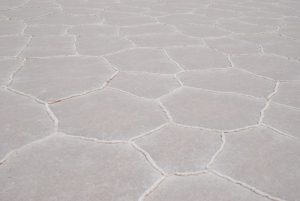
less and less dirt on the surface, and more whiteness. The hexagonal shapes
on the surface are intriguing and fascinating. Looking in each direction, there is just whiteness far off into the distance.

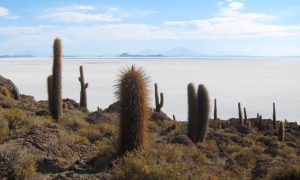
Salar de Uyuni, boliviaThe surface is flat in the center of the former inland sea but as we approach the edge and drive onto land again, the salt ground is rough and broken up just like ice on a lake does in the spring in Alberta. We hike to the top of Isla Incahuasi, in the middle of the flats and looking out over the expanse, the salt flats appear to be the top of a cloud when flying at 35,000 feet or a blanket of freshly fallen snow.

Salar de Uyuni, bolivia

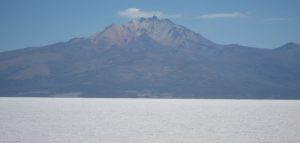
We cross the salt flats and drive onto the base of a volcano called Tunupa’s. Liz tells this story. Tunupa was a young girl who fell in love with Cusco, a young man. They married and wereliving very happily, when another woman, Cosuna, came along and stole Cusco away. Tunupa cried and cried and the salt from her tears made the salt lake and the Gods felt sorry for her so they turned her into a volcano and made the land on her slopes very fertile, which is why that area is the only place where royal quinoa, is grown. Cusco and Cosuna were also turned into mountains, close to one another but never touching. Cusco was turned into a deserted mountainwhere nothing grows and Cosuna was turned into a mountain that is covered in snow and is the source of water for Uyuni.

Tunupa, bolivia

Tunupa

The day is spent on and around Salar de Uyuni. It is an exceptional place with great vistas everywhere, on the flats, high on the island and on Tunupa’s slopes.

Posted in Bolivia | Tagged , | Leave a comment

Salar de Uyuni

The group is excited about our destination for today. It is the Salar de Uyuni, or the salt flats of Uyuni. The salt flats are Bolivia’s biggest tourist destination. It is a great expanse of flat salt terrain.

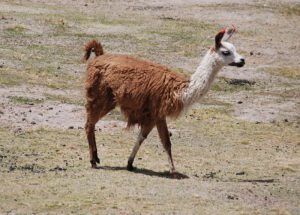
There are llamas and vicuna along the way. Llama have shorter necks, stubbier noses and more wool. Farmers own herds of llamas but they let them roam free, and intermingle. When it is time to gather them up, the farmers have to decide whose llama is whose, which is aided by ear tags similar to the brand marks on cattle. The llamas could have wandered quite far away so I can see this chore taking a bit of time.

Bolivian Llama

Llama

Vicuna have longer necks and are not as shaggy. Their wool is the finest of the 4 camelids of South America. Vicuna are protected, they were almost hunted to extinction so now no one is allowed to hunt them. They are wild and roam the great expanses.

Bolivian Vicuna

Vicuna

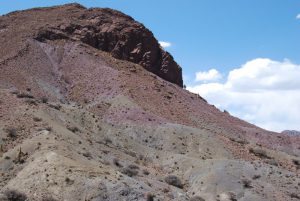
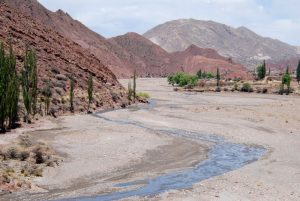
We notice the variety of colours in the landscape as we travel south west. From deep reds to lush greens to pale sandy colours. The colours of the rocks are also stunning, there is the standard black and brown, then there is red, green, blue, purple and yellowish tone.


Bolivia

We see flat plains, rolling hills and tall craggy mountains. White is added to the palette when we note snow on the top of one far off peak.

Bolivia

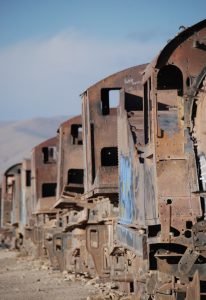
We stop in Uyuni to lunch and change to 4 wheel drives and go to the Train Cemetery. Trains were brought to Bolivia from the United States. This area is where the derelict engines and cars have come to rest after a life of toil.

Bolivia

We end our day at the Palacio de Sal, one of the salt hotels on the edge of the flats. It is indeed palatial and is made (wholly or partially, we are not sure) of salt. The sun sets on another great day.

Posted in Bolivia | Tagged , | Leave a comment

Bolivia Politics First Hand

Last night at the briefing we got a bit of a warning. Real life Bolivia might be in the way of our progress along the intended route. We are headed to Potosi and it seems the folks there are a little upset with the local government and they think maybe the mayor should resign. The mayor of course has an entirely different opinion and doesn’t really want to give up a perfectly good paying job. So the local council has set up a 24 hour protest in the form of a city wide strike.

How does this involve us you might ask. Well. Besides the fact the next day and a half our schedule lists activities in Potosi, the only road to where we are headed is through that center. Often a city wide strike includes road blockades. Since we are travelling by bus our progress could be severely hampered. We leave at 8am and the tom tom telegraph has sent no information about any road blocks being sent up.

Our highway journey chugs along without incident. The driver is excellent, driving to the road and never once scaring the pants off us. There is very light traffic so progress is exactly what is expected. Again we watch the landscape change several times in a few hours. There are a couple of things that stand out. Trees in full bloom and the flower is the most vivid purple. I can’t help but stare every time I see one. The other was the mining of the more or less dry river bed for fine rock material. For miles and miles they have been sifting the sand from the river bed into dump trucks, hauling the material they need and leaving the rest in long linear rock piles. The rainy season is about to start and I think they have totally messed with the status quo. My guess is there will be hell to pay. I suppose they are willing to deal with that when it happens as long as they get the sand and gravel they need now.

Soon we are going through the suburbs of Potosi. As we get further into the city we notice there are many semi trucks parked on the side of the road. I, innocent as I am, thought, well it is lunch time these guys all stop at the road side market to eat. Debbie said, just as we were about to come upon the road block, maybe there is a blockade ahead. At this point our driver makes a left onto a side street thinking maybe we can do an end around the blockade and still get to the town center. Nope. We weasel our way on residential roads and soon enough in front of us is another Bolivian flag draped across the road impeding our progress.

Potosi, Bolivia

One of many blockades in the city.

The option now is to abandon the bus, walk across the line and find transport to the hotel on the other side. Liz managed to hail a cab. Not big enough for us all but four and the luggage fit. Off they go leaving S, T, A and me in the middle of the road watching a few of the local guys drinking up a storm on the sidewalk. They kept us throughly entertained as we await the return of the taxi to give us a lift.

In the mean time a car load of tourists is trying to find a barricadeless route. Not so easy. They manage to get through the first stop without incident. At the second blockade the driver and our guide had to get out of the car and convince the irate male picketer the tourists in the car had no vested interest in the battle at hand and therefore should be allowed to pass. It took some persuading but eventually they got through.

Potosi, Bolivia

Another blockade.

The return trip for the cabby and Liz was a route finding expedition and when the four of us got picked up we had a somewhat circuitous, but uneventful ride to our accomdation for the night.

It is all part of the adventure and not the first time we have had to dismount a bus and walk with our luggage across a line to engage another form of transport on the other side. It is the first time either of us have had to run barricade. It was not on the trip agenda but we go to places to see what life is like and this is part of the fabric of Bolivia and we got to experience it in action.

Potosi, Bolivia

Typical street in Potosi.

Posted in Bolivia | Tagged , | Leave a comment

Sucre, Bolivia

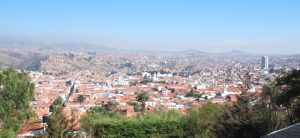
Sucre is a city of about 500,000 people set on hills surrounding a colonial center. The colonial center was built during the time of the Spanish. Most of the buildings are still intact and it is a joy to walk up and down the blocks viewing the architecture.

Sucre, boliva

Sucre, as seen from the Recoleta.

The elevation in Sucre is 2,750 meters, or 9,000 ft. We have slowly gained elevation from 416 m at Santa Cruz to 1,950 m in La Higuera to here. Murray doesn’t feel the altitude, but I do. If we walk too fast or climb a hill, my heart rate goes up and I need to take some Extra breaths. I keep reminding myself to breath deep. We are still heading higher as we approach the altiplano, so I will be drinking coca tea and breathing deep to alleviate the symptoms.

We have noticed that the personal space envelope in Bolivia is much smaller than in Canada. When passing folks on the sidewalk, they pass close rather than taking a wide arc around. This is not scary or bothersome, it just takes a little getting used to.

Sucre, bolivia

The Governor’s Office.

For lunch today, we try “saltenas” at a sort of fast food place. Liz ordered and paid for the food at a window and then it was delivered to our table. Saltenas are a pastry shell about six inches long shaped like an enclosed boat, filled with either a hot chicken or beef mixture with lots of gravy. Liz tells us that the person who drips gravy on their plate while eating has to pay the bill. Everyone drips great puddles as we have not acquired the skill to eat them daintily, whereas Liz, eats hers without a threat of a spillage.

Sucre, bolivia

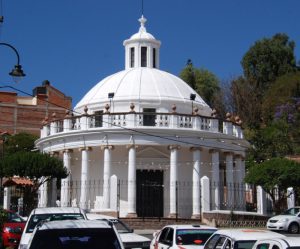
La Rotonda.

This week there is a celebration of tourism in Sucre. Tonight there is live music and dancing in the central square, which is just two blocks away from our hotel. We stop by to watch some dancing and A, N and J get picked to dance. They look like they are having fun. I, on the other hand, disappear into the crowd when I see the dancers moving to find new partners among the crowd of watchers. We watch for a bit longer and then walk back to the hotel after a busy day in Sucre.

Posted in Bolivia | Tagged , | Leave a comment

Candelaria to Sucre

Today is market day. Anyone travelling in southern Bolivia has heard of the Tarabuco Sunday Market. Most towns shut down on Sunday. Tarabuco opens it doors. It is our first intersection with the tourist trail.  We have not seen this many tourist since Miraflores over a week ago.

Tarabuco, bolivia

Tarabuco Market

The market is very big. It has out grown two market buildings and fills about 4 square blocks of the surrounding streets. Terabuco is at the intersection of roads heading in all directions and all that live along those roads congregate to ply their wares and purchase what is needed. It is a bit of an unusual market as a good portion of the commerce taking place is barter. A farmer with his wheat for sale will trade another seller for what ever they have, say potatoes, and completely skip the cash stage.

Tarabuco, bolivia

Selling coca leaves.

Our whole group splits up and we all go about purchasing something we see that has tweeked our interest or something quite ordinary we might need. T heads off to buy a razor as his seems to have waundered off at the last hotel we stayed at. He finds a pack of 2 for about a $1.50. N went off in search of some things on her list, ogled a ‘jumper’ and in the end decided not to buy it. Debbie wanted to find a table cloth to add to the collection at home. She thought a woven piece of fabric might be nice but we have a hard time finding one large enough. After traversing every street a second time we find a suitable piece, bargin a bit and make a solid purchase for about $12.

Tarabuco, bolivia

Back Carrier used by locals.

Onward to Sucre. Upon arriving in town we head straight for Parque Cretacico. The highlight of this park is a huge vertical wall imprinted with dinasaur footprints. I was personally quite disappointed. The wall is 300M away across a gorge made by the excavations of a cement plant. The prints are visable, but barely, and definately not identifiable as the markings of a bygone era. There is several castings of the prints in the park’s buildings and one real chunk of rock with four prints on it that are more what I was expecting and worth a look but the rest of the place I would give a pass.

Sucre, boliviasucre, bolivia

Dinosaur footprints.

All in all not a hard day with the market being the highlight. Debbie and I have visited many markets, in many different places but I think Tarabuca, although quite ordinary in some ways, is one of the most impressive. The sheer size of it, and the variety of goods available is worth the visit.

Posted in Bolivia | Tagged | Leave a comment

Candelaria Hacienda

We spend our day today at Candelaria Hacienda. It is a break from riding in a vehicle for long periods of time. We are learning new skills.

Candelaria hacienda

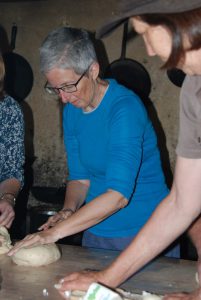
Mixing dough for buns.

We start with baking buns. Elizabeth, the owner of the hacienda, mixes the dough, with the help of J, in great quantities, explaining to us the ingredients she is using. We leave the dough to “sleep” and Liz, our tour guide and daughter of the owner, takes us on a tour of the hacienda. There is a chapel dating back to the Jesuits in the 1600’s. We view the museum that is being created, the grain storage, corn storage and surrounding land. We are visiting as winter is turning to spring, so the fields are brown. This area would be a wonderful sight when all is green and ripe.

Candelaria hacienda

Once the dough has risen, we crowd back into the kitchen to knead it and make the buns. I knead bread for the first time in my life. After a rough start and some advice, I get the hang of it and knead about four small blobs. Some of our fellow travelers, A and J, are obviously make bread as they are expert kneaders.

Candelaria hacienda

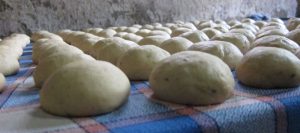
Bun sized orbs are formed by the group of T, J and Liz, and set out on a tablecloth to rest some more.

Candelaria hacienda

We go watch the adobe brick oven’s fire being lit. And then we return to the kitchen to flatten the orbs into small pancake sized buns. The oven cooks a thinner bun much better than a thick bun, so these are flat. It doesn’t take long to cook them and we get to sample our hard work.

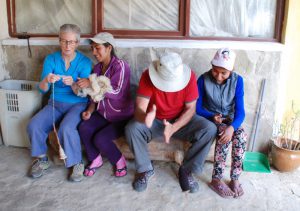
After lunch of vegetable soup and picante chicken with pasta, we learn how to spin and dye wool and weave. Spinning wool onto a large bobbin is much harder than it looks, I keep breaking it by pulling too hard. The young girl showing me is very patient and laughs along with me. Murray tries spinning a finer thread and the local women have fun with him.

Candelaria hacienda

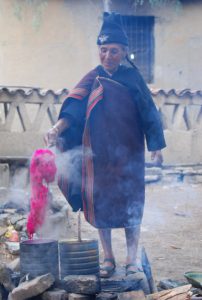
Dying wool is an art that only master dyers perform. The 70 year old dyer creates four colours – yellow, magenta, orange and green. The green starts out blue, but they do not use the colour blue in their weaving, so she takes out the wool, adds some yellow and creates a lovely green. All the colours are vibrant.

Candelaria hacienda

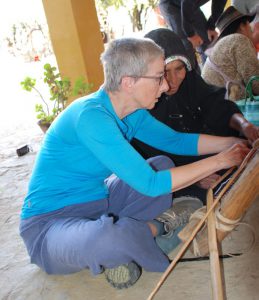
Once the wool is dyed, it is spun again to make finer thread which is used for weaving. There are two ladies weaving and we are encouraged to try. I weave part of one line with the weaver instructing me in Quechea (ie no idea what she is saying!) about which threads to pick up. I must have looked like I knew what I was doing because the weaver told Liz that I was good.

Candelaria hacienda

Shopping comes next and everyone purchases items such as wall hangings, purses, bookmarks and table runners. We have fun bargaining with the ladies and both sellers and buyers leave happy.

It is a relaxing day full of learning and laughter at Candelaria Hacienda.

Posted in Bolivia | Tagged , | Leave a comment

La Higuera to Candelaria

The last two days have basically been a road trip. 7 or 8 hours each day seated in a 4 wheel drive. Road conditions vary greatly. The roads from Samaipata are mostly paved but in poor repair. The majority of yesterday’s journey is one lane gravel roads in very rough shape. We went through pass after pass using steep switch backs. Today we started on the same gravel roads and then progressed to recently constructed cobblestones and on to a super highway (two narrow lanes) of newly paved asphalt.

Bolivia

Part of out route through Bolivia.

The switchback roads traversed mountain pass after mountain pass. I have to guess it has been at least 15 passes and valleys. We also passed through as many ecosystems. From out and out desert, to pine tree forests, to the altiplano.

Yesterdays objective was to follow the Ruta de Che. Che Guevara was captured and executed in Bolivia. After accomplishing the goal of revolutionizing Cuba he wanted to convert the whole of South America to socialism. The idea was to start in the center, Bolivia, and work out to the edges conquering one bit at a time.

Two bands of revolutionaries, with a total of only 52 fighters, set out to recruit the local Bolivian population to join in and take over the existing government then handing control to the people. In August 1967 the first group of fighters was found and all were killed in a battle with the Bolivian army. On October 8, the army, with help from a local farmer, located Che’s group. Four of the group were killed in the ensuing battle, Che and two others were taken prisoner. The next day an order from the CIA to execute the prisoners was carried out and they were shot in a school house in La Higuera. Their bodies were helicoptered to the near by city of Vallegrande and put on display to show the world Bolivia had helped to rid the globe of a menace. I suppose it is debatable as to whether or not socialism is a system that should be thrust upon any population and/or if in fact it would be a better system than what is in place and your opinion on this would be what you base whether or not Che was a hero but he was a champion of the poor and many love him for that. I would venture to guess he is more of a hero because the CIA was sticking their nose in what was not really their business resulting in a folk hero being snuffed.

Point of interest, I asked our Spanish speaking driver if che had any meaning in Spanish. I’m quite sure he said, Che is a sort of slang used to describe an Argentinian. A perfectly good reason to call Ernest, ‘Che’.

Bolivian charango

Besides again passing through some amazing countryside our one task enroute is to visit the world’s largest charango, a type of Bolivian guitar. When we enter the museum where it is kept I am surprised to find this thing is a real cheranga. It can be played and is on special occasions. It takes four people to make music, 3 to work the frets and 1 to strum and pick. It is 6M long and 1.5M wide. It was made by a sculptor but with help from an engineer, and several other experts to make sure it makes the proper sound.

Our convoy of 4 wheel drives pulls into our next destination about 4.30 pm. A hacienda, first built in the 1600’s in the smallish town of Candelaria, more or less south of Sucre. This is where we say good bye to our chauffeurs of the last 2 days as we are stationed here for the next 2 nights.

Candelaria hacienda

Candelaria Hacienda

Shortly after we arrive the other two guests E & S get back from their outing. They are geologists studying the rocks of the area. Soon they are part of our group and we sit in the kitchen (the warmest room in the place) and chat while dinner is being made. Moving to the dining room our conversation traverses many subjects and you would think we had been friends for a long time.

Our group of 7 J,J,A,N,S,T, Debbie and I ,and our guide Liz. Have gelled quite well. Every single person has travelled extensively and we all trade stories of other places. From my point of view it does create a bit of a problem. We already have a list of too many places to visit before we die and the list is getting longer. It is amazing the ideas that are presented. Some of course are easier. Japan, always exotic and not hard to travel in so it seems natural for it to on a list of to be visited. Then North Korea pops up, I would never have thought of going to NK with the crazy person they have for a leader but T insists it is not only a good place to consider but should be upgraded to a must.

Our day ends with setting a shower schedule so we don’t blow a breaker drawing too much electricity with the on demand hot water heaters. The road conditions will not be much of a concern tomorrow as we stay put.

Posted in Bolivia | Tagged | Leave a comment