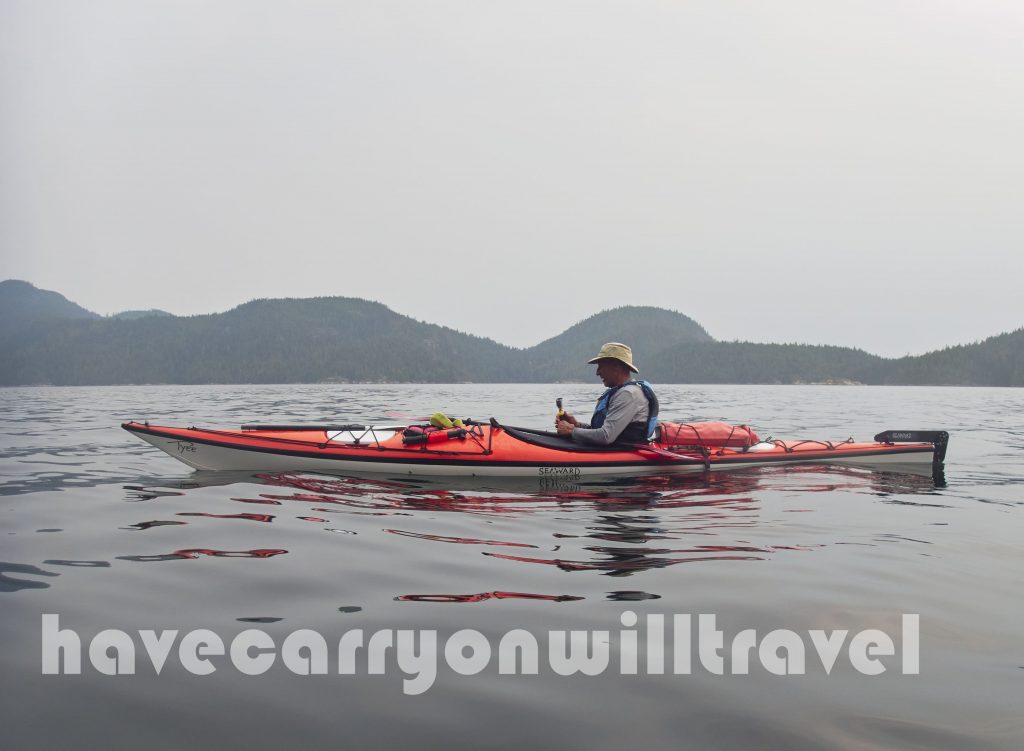
Today’s paddle takes us back out the Arm, south along the coast of West Redonda Island, past Refuge Cove to the Martin Islands. Again the water is glassy smooth. Richard just shakes his head and once again says, “I have never seen it this smooth.” I think he has been saying his every day since day 2. And each time explain the weather gods want to make it a good trip for me ensuring I come back, so they are making the ocean calm.
Teakerne Arm
We get startled as we see a buck deer swimming across from a tiny island to West Redonda. It’s surprising to be reminded deer swim! We see more seals and a sea lion enjoying a fish lunch. Peering into the water on the island’s edge we see sea stars, anemones and cucumbers.
The zen of paddling takes over, just like road riding or climbing up a mountain when back country skiing. The mind wanders, the body just moves, and we paddle.
When we land on Martin Island, actually it is on an isthmas connecting the two islands, we are amazed we arrive early, 2:00pm. After all the longer paddles, this 16 km one feels easy, and short. The campsite is well used, as indicated by all the “decorations”. There are swings, permanent structures, sign posts, benches, a fire pit and a picnic table. We wait to see if anyone else shows up.
Martin Islands Sign Post
The quiet continues. The only sounds are cawing ravens, buzzing flies and wasps, crickets and the occasional splash of water from a sea lion, seal or fish. Is there a world beyond this island? World, what world?
The sun is shining through the haze and it is spreading warmth so we lay out our mats, sleeping bags and kayaking clothes. They do dry some and it will be nice to not climb into a clammy sleeping bag tonight!
Loafing
We loaf and wander and watch John and Richard float an errant tree away from the beach. Then we watch the tree float closer and farther and closer and then far enough away that it won’t block the kayak loading zone. We cheer. The world is FAR away!
The kayaks are stored above the high tide line and are tethered together and to a log, just in case.
Secured Kayaks
After supper we gather around the fire pit where John has started our only fire on the tour. We stare into the depths of orange flame and before I know it, my eyes are drooping. I made it to 9:00 this time!
Whales in the night. BOOM! As loud and any thunder I have ever heard. We wake up and decide a whale has just breached. The sound echos off the adjacent islands. We drift off again and awake to deep breathing. There are maybe 2 or 3 whales laying very close, blowing. They aren’t moving. What a magical way to wake up in the morning. Murray finally decides to get dressed and check them out. Too late, they have moved on.
Today’s paddle starts with a chore. We have to cross the channel back to the coast of Cortes and the wind and tidal current are against us. We paddle steadily and after about an hour we reach the island and turn north after a quick snack of a granola bar.
As we round the northern point of Cortes and head into Lewis Channel, we are blessed with the current and wind now working for us. Murray, kayaking slightly ahead of the group, has a close encounter with a humpback. The whale surfaces about 15 feet in front of him. There were two and they both dove down, probably swam underneath us and were gone.
We get surprised by a sea lion and his lunch. It is explained that seals and sea lions cannot swallow under water. There is a commotion and we all look to see a sea lion’s head pop out of the water with a flopping fish in his mouth. He chomps, swallows and submerges. The birds then swoop down and pick up the head and tail of the poor fish for their lunch.
The long views are still obscured today but the medium views have opened up. The short views are crystal clear. We paddle down the Teakerne Arm, located on West Redonda Island, where there is a freshwater waterfall flowing into the ocean. We dock and unload three kayaks on the rocks and then our guides move the kayaks up onto the dock while we schlepp gear up a steep path to a small campsite overlooking the Arm. It has been a long day today and I am tired, but there is a fresh water lake close and a dip is too much of a temptation to ignore.
Teakerne Arm Waterfall
It is about a 10 minute walk up and down over boulders to Cassel Lake. The “beach” on the lake is a giant rock with a belaying rope for entering and exiting. I bring some tea tree soap for a quick wash, which is kinda humorous as I donned my dirty clothes after. The water was refreshing and it feels good to be clean, even if only for a few minutes.
Cassel Lake
For me, this trip is all about the art of staying warm and dry. We are wet all day paddling (will have to work on that one as John stayed dry). John uses more of a low angle paddle stroke and the drips from his paddle fall onto the deck of the kayak rather than his skirt. As we paddle along he explains how to imitate his paddling style. My paddle strokes drip water onto my kayak skirt and then when I get out of the kayak, the skirt drains onto my shorts and I am wet. Murray is suffering with the same issue. Once finished paddling and schlepping for the day, I change into my camp clothes (I will write a post about clothes at the end of the trip) and warm up.
The joke after supper is now “How long will Debbie stay awake!” Today, after 21.5 kms, not long.
It is low tide when we get up in the morning. A look on either side of the spit tells us the launch of the kayaks into the water is going to be a chore. John decides on the best spot to launch, which is about a hundred meters down the beach. Less treacherous green vegetation to walk over to get to the water. After breakfast, Murray and I schlepp gear down the beach while John and Richard have the heavier load of carrying the kayaks.
Richard and John schlepping kayaks to the water’s edge
Once everyone is on the water, we have to paddle way around the spit between the buoys, which is almost to the shore of Cortes Island. From there, we dodge the Quadra to Cortes ferry and head north hugging the coast and looking for wildlife.
Off the coast of Cortez Island
The sun is actually peaking through the smoke and clouds. It feels almost warm. It is so quiet on the water. Just the sound of my paddles. Splsh – dripdripdrip splsh – dripdripdrip is all I hear. The sound is soothing.
The water is calm. The seals pop their heads up to check us out and if we get too close, poof, they are gone. A flock of birds, perhaps harlequin ducks, flies by in formation. They move in unison, dipping wings and zig zagging across the surface.
We turn west and paddle towards the Penn Islands where we make camp for tonight. We join a couple already camped on the northern most island. The campsite we choose is a 5 star location as we find out from the couple that we are overlooking a bit of a whale channel.
Our 5 star view from Penn Island
Whales. They are the creatures of the day. Humpbacks. We see them during the day and now, as we dine in our 5 star restaurant, two whales travel through the channel. They even stick around for a bit and treat us to more sightings. We also spied, through binoculars, two orcas swimming through another channel far off to our left. Magnificent! We don’t want it to get dark as we want to keep watching for these splendid creatures.
Humpback off Penn Island
John cooks up another great supper. He adds a can of this and that, some veggies (chopped by Richard), coconut milk and red curry paste, and voila!, supper. It tastes so good it is hard to not over eat. Lunches are very similar but we eat veggie and canned salmon or chicken or turkey salads, nuts, sugared fruit, wraps or crackers. One day it’s Greek, the next is Indian, then Italian. John always keeps us guessing as to what we will eat.
Inside our tent we notice our tent, sleeping bags, mats and clothes are getting damper and damper. We need some serious sun and some wind to dry us out. Us prairie folks with our drying wind have trouble comprehending this moist wind and damp environment, especially with no sun. Maybe tomorrow.
After breakfast, Richard gives me a lesson on how to paddle properly and I realize that if I do it his way, my neck doesn’t hurt unless I revert to my old shenanigans of pulling on my paddle. I concentrate all day in order to get it ingrained in my body.
The water is calm today (thank goodness!). The smoke is still ticklish on the throat and the sun is a white ball through the haze. Our route today is to paddle around the south end of Cortes Island, north along the west coast of the island to the gorge and then west to Marina Island.
The bright Purple and orange (Leather) sea stars are numerous, both in the water and above the tide line. We are encourage to touch them to compare the roughness of their “skin”. I never knew they could be so different, one is rough and the other is smooth.
Birds are everywhere on the coast. We see loons, herons, mergansers, oyster catchers and cormorants. The loons call out their eerie sad song. The cormorants are very shy and skittish and do not let us get too close before they fly away.
We spy harbour porpoises but only from afar. And, of course, there are seals.
Sunning on a rock
It is low tide and the south end of Cortes is rocks and boulders, a tidal flat. It goes out forever. We find a small passage to go through to avoid 2 or 3 extra kms around the end.
Just before we head to Marina Island, we paddle into the Tide Islet to check out some pictographs. There are four or five, some harder to find than others. I wonder how they were painted where they were – ropes and belay down the side of the cliff?
Pictograph in Tide Islet
Marina Island is owned by Bill Gates! He allows boaters to camp on the spit and the campground is laid out and roomy. We are getting used to the routine. Murray and I schlepp gear and food and John and Richard haul kayaks. (I think they do way more work than we do!) We set up our tent in the forest on a soft bed of needles. I never tire of looking out over the water or walking the beach looking for colourful rocks or shells.
Tent spot on Marina Island
Speaking about the beach……the outdoor bathroom is amongst the rocks and drift wood below the high tide line. Toiler paper is either bagged in a doggy poop bag or burned. This always involves a walk down the beach far enough to feel comfortable. I eventually learn how to burn toilet paper without using the whole box of matches!
Another great supper cooked by John and Richard. They are taking very good care of us. It gets dark, and I try to stay awake sitting on my log, but by 8:30 I have to retreat to the tent.
It is departure day. We eat breakfast, pack up and are on the road for a kilometer or so to meet our guides John and Richard. But let me back up slightly.
Early in the summer Murray and I started talking about doing a kayak tour on the west coast this summer, but with the COVID pandemic we were not sure about the traveling and exposing ourselves to people we did not know. We emailed back and forth with John from Footprint BC about a six day tour to Desolation Sound starting September 13 and whether other folks had signed up and what their COVID policies were. After some thought we decided we couldn’t make a decision that far out as who knew what the world would be like in 2 months.
Then as September approached, we emailed John again and asked whether anyone had signed up and whether he would be willing to take just two of us out (at a premium price, of course). Even though he had lots of inquiries, no one had committed. So we did. And that is how Murray and I had a private kayak tour with two exceptional and experienced guides.
Back to September 13. John and Richard (from Island Romer Adventures) meet us at the Desolation Sound Resort. We ask all sorts of questions and sort out our gear and throw it into the back of John’s SUV. We are driving to the other side of the Malaspina Peninsula to Lund and will embark from there.
The smoke from the forest fires in the western US has blown into the area and so our intrepid guides have decided not to go into Desolation Sound. They think the smoke will not clear from that area very well. So we are going to circumnavigate Cortes Island instead as there is more of a chance that the smoke will clear from Georgia Straight. We are okay with this change of plan as we have never been in the area before so everything is new to us. I tell John, “You lead and we will follow!”
Loading kayaks at the Lund boat launch
It takes some time to load up the four sea kayaks with the myriad of gear and food and then we are launched. I notice right away that I cannot paddle in a straight line, which I can in my kayak. Arg! Frustration! So I relent and put my rudder down, and now I have to figure out how to use it properly. Only took half a day to finally understand how to use a rudder.
We hug the coast of the Malaspina Peninsula and sneak up through the Copeland Islands and stop for lunch on a small island. We see out first seals, lots of them! Richard explains about “shell midden” which is oyster shells in the dirt from many years ago, maybe 50 years or 100 years or more. The indigenous peoples harvested oyster shells, tossed them on the ground and then the shells aided in making the soil and are integrated into the soil. Cool!
After lunch, we turn west towards Twin Islands and John has to navigate using his compass as we cannot see far enough in the smoke. The water is rough and the occasional wave slaps across the kayak. It is a tough paddle. Twin Island is just a grey blur on the horizon when it first appears. As we get nearer to the islands, the trees start to become more distinct. Nearer still and there are colours – dark green, light green and grey. Nearer still and the trees have branches and the rock has ridges and cracks. Once we are paddling close to the island, the trees become huge and we are tiny specks on the water.
We camp on the north end of Twin Islands on our very own tiny island. The landing spot is rocky but I think that is the way of things out here. There is room for our three small tents and a kitchen/eating area. We dine on nasi goreng and peanut sauce and it tastes wonderful after a hard day! Guess what, we crash early as we are tired from our paddle and have five more days to go.
Kayaks stored above the high tide line on Twin Islands
On the move again. It’s Saturday and we’re headed to a first come first serve campground north of Powell River called Okeover Arm Provincial Park Campground. 8:15 and we’re on the road. Boy are we getting good at this morning routine!
Ferry to Saltery Bay
An hour’s drive to Earl’s Cove. We are 4th in line for the Saltery Bay ferry. There are only 18 campsites at Okeover so we want to ensure we get a spot. As we disembark the ferry, the ferry person points at the row beside us and lets three cars go. Then the finger is aimed in our direction, 4th off the boat. With only one road for 99% of the trip is is easy for navigator Debbie to get us right to the campground. The driving is another motorcyclist’s dream and although it took a lot of concentration, Murray has fun.
We drive through Powell River and wonder what keeps the city going. Before too long we see a large paper mill on the water’s edge. Powell River has become a vibrant outdoor center with communities of kayakers, hikers, bikers, boaters.
With 400 meters to go before the campground and just down the road Mama Bear and Baby Bear lope across the road. Black bears, not too big, but very bearish.
Okeover Arm Provincial Park Campground
We arrive at our destination shortly after noon and half the campground is available. We choose a site, set up, reorganize our gear and double check our lists for tomorrow we are starting a 6 day kayak adventure into Desolation Sound.
The campground is very basic, not quite as fancy as our previous day’s accommodation. Out houses, no showers and an old fashioned pump for water which discharges the clearest water I have seen out of a pump.
The park is heavily treed with evergreens. The giant cedars reach to the sky and block out much sunlight. We see some trees have their bark stripped off. We learn later that the indigenous folks strip the bark to use for making watertight baskets. Once the bark has been stripped, the tree is designated as CMT (Culturally Modified Tree) and cannot be cut down.
We wander down to the boat dock and spy some kayakers coming in and also amuse ourselves by watching the jelly fish float by the pier. To kill time we walk up the road to see what’s there….not much. Back at the campsite, a teeny tiny vole, or mouse, scurries on the edge of our campsite looking for its supper. Cute guy.
As soon as it gets dark we, once again, retreat into the tent to read and try to stay awake. Big day tomorrow!
It’s a travel day. We want to make it to the Sunshine Coast, so to relieve the anxiety we eat breakfast, pack up and are on the road by 8:30 again. Google Maps indicates about six hours to Sechelt so we should be able to find a campsite somewhere.
We drive the West Side Road from Fintry into Kelowna. I don’t think I have ever been on the road before. It’s windy, up and down, narrow and a motorcyclist’s dream. Maybe a nightmare for a trailer or large motorhome, but for a car it is fun. It affords some fantastic views down the Okanagan valley and across the lake. The drive is superior to Hwy 97.
Once clear of West Kelowna, it is time to make ground. Turn left at Merritt, for a second I think we have crossed the border into Germany. The speed sign said 120 kph!? Are we in Canada? There are even “variable speed” zones with digital signs that regulate speed according to traffic conditions, just like the autobahn.
Note from Debbie…..If the drive on the Coquihalla is wild, which thankfully Murray drives, then the drive from Chilliwack to Horseshoe Bay (which I drive), in Vancouver, is insane! Too much traffic going much too fast! The traffic speed signs seem to be only a suggestion.
Entering Vancouver, we are right on schedule. In North Vancouver, the traffic comes to a halt on Hwy 1. We crawl for 20 minutes only to find an arrogant cop has a motorcyclist pulled over on the freeway and has blocked the entire right lane. All this within 200 meters of an off ramp. Motorcyclist must have been doing something pretty bad.
We are at the ferry dock more or less on time, about 1:30, with no reservations. Tough to make a reservation when traveling so far and uncertain of your arrival time. We are no where near getting on the first ferry out (2:20), maybe the next one at 3:30. Nope. Finally board the 4:40 ferry and our dreams of getting a camping spot are fading. We leave the dock at 5:10, exactly 30 minutes late. Google Maps is now failing in the travel time calculations.
In our favour, we are in the first group off the ferry and hopefully ahead of other campers looking for campsites. We check out Roberts Creek Provincial Park Campground. Full. We decide to still check Porpoise Bay Provincial Park Campground, in Sechelt, but do not have high hopes. We know there are only a handful of “first come first serve” campsites, so we drive straight there. Nada. I decide to loop around the other sites and eagle eye Debbie spots an available sign on half a double site. I slam on the brakes, she jumps out with tent in arms, plunks herself down while I tour the remaining loops. We camp for two nights beside three young English fellows that have been working in Whistler for the last two years.
Porpoise Bay Provincial Park Campground
The campground has enormous cedar trees surrounding the campsites, making for great separation and total darkness once the sun goes down. There is a shower and washroom house. The campground managers are very helpful and friendly. We would visit this campground again, but will be sure to make a reservation. (Note: In this year of COVID, Albertans were not allowed to reserve campsites in BC, otherwise we would have.)
After our Indy 500 like drive, we crash early. We seem to do that often!
September 11, 2020
We have planned a day at Porpoise Bay to kayak in bigger water. This is our first time in the ocean to progress our kayak experience. Debbie and I started kayaking on small, mellow Alberta lakes, worked our way into rivers and up to bigger lakes like Okanagan Lake. More water and more wave action each time.
But before we paddle, we have to play the “get a campsite” game. By 10:30, we are assured by the campground staff that we can stay in our site. Some wrangling has been done and the folks who are supposed to be camping in our spot are getting another one that they actually wanted instead. It was very complicated and confusing, but we are set for the night.
Porpoise Bay Provincial Park
We paddle parallel to the shore, alternating using the incoming waves to progress and fighting them to move away from shore again. After reaching a far point, we decide to paddle to a small island off the beach where we had launched. It is a steady paddle against the waves and wind, but not too hard. We get close to the island, turn homeward and ride the waves into the beach. We get some practice aiming and arriving at the exact point on the beach that we want.
Porpoise Bay
There are a few other kayakers on the bay, but the rougher waters is keeping most folks off. We eat our lunch leaning on a large drift wood tree and soaking in as much sun as the smoke will allow.
Porpoise Bay
It is a good day and we head back to our campsite ready to move on tomorrow.
We wake up in the North Thompson River Campground to mountain cold, a chilly 5 C. I’m up early and by the time I prep for breakfast, my hands are barely operable. We eat and pack up quickly and vacate the campsite by 8:30 before Debbie turns to an ice statue.
Fintry Provincial Park Campground
Three and a half hours later we arrive at Fintry Provincial Park Campground, on Okanagan Lake, to R waving her arms and guiding us in to a campsite next to theirs. BC sure has it together when it comes to provincial parks. The place is clean and organized. There are “Rangers” in attendance who do serveral laps of the grounds each day. The rules are such that the place is quiet and serene. It seems people actually follow the rules, Alberta has alot to learn.
Fintry Provincial Park
Fintry has flush toilet outhouses with running water sinks and shower houses in three locations. The access to the lake is easy, right from our campsites, so we unload the kayaks from the top of the car. The campground and park is situated on parkland bequeathed to the province by a former orchard and dairy farm owner. The waters edge was never cleared of trees and the old pine growth provides fantastic shaded sites.
Fintry Provincial Park CampgroundFintry Provincial Park Campground
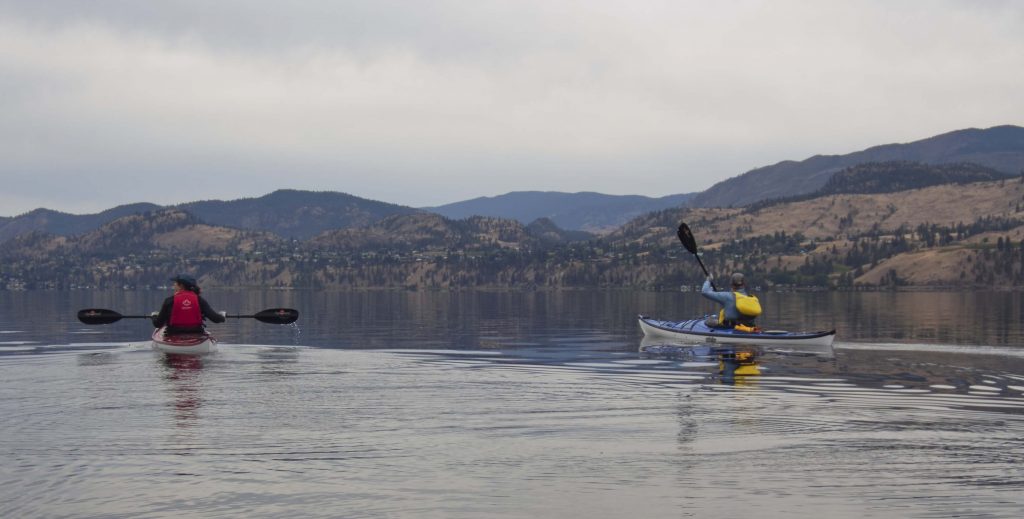
The afternoon is for paddling. We ply the shoreline for a few kms and return by the same route. The water is glassy and the sun is warm.
September 9, 2020
The morning is chilly but not cold. The plan for today is a longer paddle. The wind is suppose to pick up as the day progresses, so we pack a lunch and are off early. We can see a red boat house far in the distance and D thinks it is Killeney Beach Park. We paddle (11 km round trip) to the beach for lunch. As it turns out the wind was in the morning and was calm for our return trip.
Okanagan Lake
The sun is shining so we opt for a quick dip in Okanagan Lake. It may be our last chance to get wet before our kayak tour.
After supper, we tote our lawn chairs down to the water’s edge and watch the sky turn orange as the sun sets. Tomorrow is a long drive, so we crash early.
It’s the Monday of the September long weekend and we vacate our voluntary prison and head for the coast. That’s the Pacific Ocean coast in British Columbia and to all Albertans, it’s “the coast”.
The highway is crowded in both directions. More folks driving toward Edmonton, as school has started, than away, but we are not alone heading west. The traffic didn’t thin out until Valemount, then it was fairly sparse until we stop just south of Clearwater.
There was a big snowfall on the eastern part of the Rockies. Not the regular summer snow that dusts the trees, but an accumulation in the alpine and it covers well below the barren rock. The mountains look stunning with the white highlights. As we get further into the heart of the Rockies, the snow disappears. By the time we reach the Jasper townsite, the mountains are donning their summer apparel again, green tree shoulders capped with grey stone.
Debbie and I have good luck viewing Mt Robson. I would call it the Canadian Rockies’ highest easily accessible peak. Not that it is easy to climb, but it is easy to get to various spots to view it. As it is so high (3,954 m), it spends a good portion of the year in cloud cover. We have often driven by and the peak is clear. Today we can add another view of the snowy mountain top to our collection of sightings as it is blue sky right to the top.
It is 6 C when we back out of our driveway in Edmonton and turned the car west. We notice the leaves on the river valley trees are already turning to fall colours. It seems the farther west we drive, the farther back to summer we go. The car blower goes from “heat” to “air conditioning” as we drive west through Jasper (13 C), Blue River (20 C) and Clearwater (27 C). As we enter BC, the forest gets thicker and lines the road. The trees are not yet yellow or orange but multiple shades of green that become more saturated when the sun shines through the needles and leaves.
We spend the night at the North Thompson River Provincial Park Campground. The campground is on the North Thompson River and is quite idyllic except for the train tracks on the other side of the river. We cook supper, clean up and retire into the tent as it cools off quickly as soon as the sun disappears behind the hills.
It is not that going on a kayak trip is really much different than any other adventure. Maybe closer to a backpacking trip to anything else. But are we ever out of practice. We usually pack a week or so ahead of time just so we can walk by the pile and take stuff, we have added because we might need it, out. This time we are packing early because we can’t remember what we need.
Debbie has about 4 different lists, from the one supplied by Footprint BC to our regular ‘we are leaving the house’ list. Our basement is set up in four piles. Kayaking stuff, camping stuff, clothes specifically for the kayak camping trip on Desolation Sound and clothes for camping to and from the coast. Each pile is at least knee deep. After all we are car camping so we can take as much as we want, except on the tour. The big restriction is living out of the car, we have to make sure we have access to all we need. We can bury things but only what will not be needed except at a specific time. There are a couple of other piles upstairs as well, a food pile that still has to be topped up and the ubiquitous electronics, mostly a modern day nuisance but unfortunately a requirement, even for me.
Up until we were sequestered we could pack with our eyes closed but this 6 month social distancing from our travel bags has caused a disconnect. I’m hoping in time we can again pack without humming and hawing but we may never again achieve the efficiency we had only a short time ago.