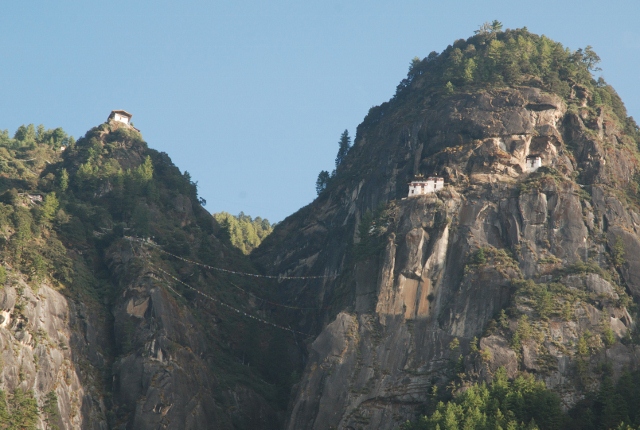
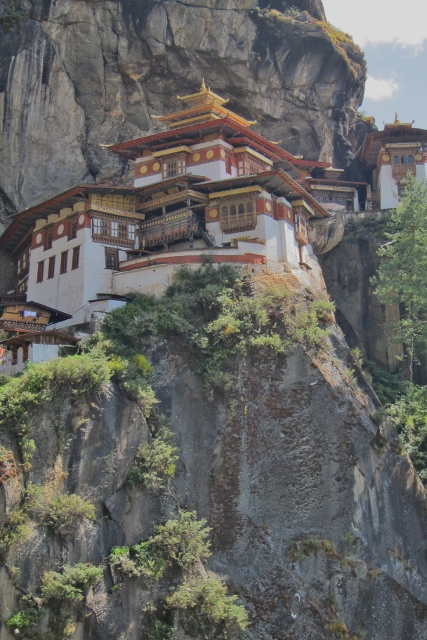
The Icon of Bhutan……Tiger’s Nest

Our first glimpse of the Tiger's Nest

We start our hike

View from the observation point

Taking a break

View from the opposite side of the gorge

Getting closer

Crossing a bridge over a waterfall. One last climb to the Tiger's Nest.

Murray is just behind Debbie!

Our cameras had to be handed in at the top, so there are no pictures from the Tiger’s Nest.

Heading back down

Getting farther and farther away

Trail sure was dusty!

Done!


Posted in Bhutan and India | Tagged , , , | Leave a comment

Stories and Other Thoughts

Debbie writes:

The Goddess of Compassion would reach down into hell and lift people up to heaven. She did this continuously.  Each time she lifted people up and then turned around, there were more people in hell to lift up.  She lifted and lifted and lifted and suddenly became so despaired about not being able to keep up that she collapsed.  She shed 1,000 tears. The God of Infinite Wisdom saw her pain and gave her an eye for each tear that she shed and 1,000 arms to aid in her quest.  He also gave her 10 more heads. With 1,000 arms and 11 heads The Goddess of Compassion was able to lift people continuously from hell to heaven and not despair.

Murray writes:

I’ve read about butter tea. What I have read has not been all that complimentary. Basically the accounts have said don’t bother trying it, you won’t like it. Yesterday, I had the chance to try it. Tashi was talking to the monks, again, and getting us into places we should not be. We were standing in the monastery kitchen staring at 21st century cooking equipment in a 15th century building and all of a sudden Tashi asks us if we want to try butter tea. One of the monks had some tea brewing and was perfectly willing to share. Debbie could not imbibe as butter is not on her list of acceptable foodstuffs, but L, R and I said OK. The monk washed 3 mugs in steaming hot water and poured 3 completely full cups of tea. I was hesitant and only took small sips. Which was a good thing as it was the hottest tea I have been served in Bhutan. The taste was unusual. Not terrible, but unusual. It was kind of like a cup of melted butter. I could not taste the tea at all. It was very rich. I could appreciate how such a hot, rich, and fatty drink would be of substantial benefit on a cold winter night. It would go a long way to keeping you warm in a house with no insulation and only a wood stove for heat. Butter tea is definitely an acquired taste and I don’t think that I personally will take it up as one of my staples, but it is definitely not as bad as the written word would have one believe.

Debbie writes:

The forests in Bhutan are old. The trees look like they are first growth trees, ancient, primal, primitive, Ent like. There are trees that are gnarled and reach for the sky.  Whole forests without any human habitation in them – trees so thick there is no undergrowth. Forests that reach to the mountain tops and run along the ridges casting eerie silhouettes on the skyline.

Murray writes:

I cannot believe how quiet Bhutan is. There is sound, people, cars, animals, rushing water, wind, but it is minimal. We have spent nights in remote valleys, and in the capital city of Thimpu and the quiet is eerie. When we hike in the mountains at home we can park our car on the highway and hike up the mountain.  We can be several kms away and several hundred meters above the road and you can still hear the cars swish by. You have to be over the range and into the next valley before you get anything close to silence. Here the vehicles do not travel fast and there are not very many of them, so the distance required to find quiet is quite small.

We have been staying in remote places and very small cities or towns and the noise at night has been non existent. Occasionally, the feral dogs will bark but unlike in India the Bhutan dogs seem to have a sense of decorum and do not bark endlessly into the night.

We arrived for a two day stay in Thimpu and our hotel was in the center of town. I expected that, with windows that do not seal very well, we would not get a peaceful sleep. We stayed two nights. Both nights the noise in the alley outside our window, including the barking dogs, shut down at 10 pm. The first morning the city began to awake around 6 am and on the second morning, a holiday because of the royal wedding, we had checked out of the hotel at 8:30 and the city noise was non existent.

Debbie writes:

A cow, a dog and a deer all took at shared taxi.  When the taxi got to the cow’s destination, the cow paid his fare of 50 rupees and got out of the taxi. The taxi then drove further and stopped at the dog’s destination.  The dog got out, gave the taxi driver 100 rupees and before he could get his change, the taxi driver sped away. When the taxi driver got to the deer’s destination, the deer jumped out of the taxi and leaped away before he paid for his fare.  And that is the story of why cows stand in the middle of the road blocking the passage of vehicles, they think they own it; why dogs chase vehicles on the road, as they feel they are owed change; and why you never see any deer near the road, they don’t want to get caught for skipping out on their payment.

Murray writes:

We were leaving Thimpu this morning and I expressed my gratitude to the head waiter at the restaurant at the Phuntsho Pelri Hotel for all the help he was to Debbie (food issues) and R (upset stomach). The fellow then offered a bit of a philosophical analogy for our departure. He likened our meeting and then leaving to the five fingers on one’s hand. The four fingers being L, R, Debbie and me and the thumb being himself.  Sometimes, we are together, when a hand is closed, and sometimes we are apart, when a hand is opened up. So, people, like fingers on a hand, will come together and part and he hopes that we will come together and visit Bhutan again.  Or something like that – it sounded much better when he said it.

Posted in Bhutan and India | Tagged , | Leave a comment

Traveling with Murray

I admit it.  I take advantage of Murray.  You see, Murray will talk to anyone. He is interested in what everyone is doing and what they have to say. I just tag along and absorb the experience.

Yesterday, at the Lungchutse Temple, he helped a monk saw a board.  The monk was surprised at the offer of help. I sat, watched, grinned and took pictures.Today, we went to the School of Arts and Crafts. Woodcarving, sculpture, painting, weaving and embroidery are taught there. Tourists are welcome to wander into the classrooms and talk to the students.  When we were in one of the painting classrooms, Murray had a conversation with a few of the students about the drawings they were doing, the proportions used, whether they had sketchbooks and if they could create their own non standard artwork. I listened, looked and absorbed the conversation.

Sketch book of a student studying painting

We hiked up to a temple this morning and Murray tried the butter tea offered to him. He said it tasted like hot butter with a touch of tea. When offered a slice of bread to dip in the tea and eat, he kindly accepted it. A friendly dog became his friend when Murray dropped some bread on the ground. The dog then got the rest of the bread that Murray didn’t want to eat. I watched Murray’s face as he drank and thanked my lucky stars that I am allergic to butter.

So you see how I take advantage of Murray? He is terrific to travel with and causes me to experience all sorts of things that I am too shy to experience on my own.  I am so lucky.

I have to tell you about the strangest animal we saw today.  I thought I had seen pictures of all the animals in the world, but I have never seen a takin.  The story is this.  The Devine Madman was in a village, and the village people cooked a cow and a goat for him to eat.  He ate everything right down to the bones.  When we was done, he put the cow head on the goat bones and miraculously the creature came alive.  And that is how the takin came into being.

Takin

This takin lives in a sanctuary that was created for injured and sick animals, basically a mini-zoo. It had been decided that this facility was not in keeping with Bhutan’s environmental and religious convictions so the animals were released into the wild, but the takins stayed around Thimphu looking for food, and so they were put back into captivity.

Posted in Bhutan and India | Tagged , , , , | Leave a comment

Feral Cows

Cows! There are, what at first glance, feral cows everywhere. I expected that in India but hadn’t really thought about their presence in Bhutan. There they are, on the side of the road, in the middle of the road, climbing the steep slopes adjacent to the road. I’m told they do belong to someone and every once in a while we see a person herding 4 or 5 cows, headed for who knows where. But, I have questions. Hindus can’t eat beef, so why do they keep cows? There is milk of course, but I haven’t noticed any milk for sale in the ‘general stores’ we’ve been in. Then there are the Buddhists that can eat the meat, but they cannot kill the cows. So why do they keep cows? I really do find this a bit of a puzzle.

I have to take back some of what I said about the food in Bhutan. Since I wrote the blog about the food being bland and boring it has steadily improved. The food at the hotels has been quite good of late. Most of the food we are being served is the Bhutanese interpretation of what tourist types might eat. For the most part it is good, but I do think that us tourists could stand to try some food that is native to Bhutan. I do not think it would kill us.

Most of the interior floors in the dzongs and the monasteries are made of wood. They are extremely well kept and polished constantly by the barefooted monks shuffling thick cloths along the floor as they walk through. Yesterday I slipped on one of these highly polished floors and managed to (I think) break my toe as it slammed into the adjacent board. (For those of you who might care, I have taped it to the adjacent toe as a splint, we hiked today and I did not have any pain.)

As we were standing in front of one of the Buddha altars, R noticed that there was an imprint of 2 feet and all the toes worn into the 12″ wood planks that make up the floor. These foot prints have been worn in over time by the monks standing in the same spot and prostrating themselves repeatedly believing that by doing so they are absolving themselves of sins.

The other day L made a crucial traveler’s error. She fell in love with a carpet that was hanging on the wall before she knew the price that the vendor was asking. We were in a shop that displayed locally woven products and there it was. There is not supposed to be any bargaining in Bhutan but after obtaining the ‘list price’ R asked for the sale price. There of course was a ‘sale’ on at the time and now R has to figure out how to cart a very heavy 3’X6′ carpet back to Canada.

Our trusty hiking friend

Today,we hiked from the Dochula Pass at 3,100 m to the Lungchutse Temple, up at 3,569 m. The hike was a 369 m gain over 3.5 km. It was a strenuous hike in parts but we were rewarded with great panoramic views at the top.  Saw a few cows on the way and had a trusty local dog follow us up and down.  Tashi and Karma (our driver) heroically carried up a 5 dish lunch for the hungry hikers. The dog, of course, was well fed at the top, eating what we could not finish.

Clouds rolling in at the temple

Bhutan is abuzz with the Royal Wedding. On Oct. 13, K5 will marry a commoner and the entire country is gripped with wedding mania. (Sound familiar to all those in touch with the British monarchy?) Although it has caused some disruption with our tour itinerary we are being compensated by being able to watch as a country sets up for a very auspicious day.

Yesterday we tried to visit the premier dzong in Bhutan and as I explained we were not allowed in as that is where the wedding is to take place and all visitation had been curtailed. Today we attempted to visit the offices of the King. Although normally open to visitors, for the next few days they have been closed. There was a bombing at the Bhutan border today and the security  has been tightened a little bit more. We can still view the exterior of these sites and because they have been dolled up for the wedding it is worth the time to go visit. The dzong in Thimpu has been decorated with skirting around all of the eaves and there has been some lighting added to the exterior of the building making it a very noteworthy structure. Personally I think they should leave the lighting intact after the festivities are over.

King’s Offices

As for the cows, one way or another the wedding does not seem to affect them. They remain calm cool and collected munching on grass at the side of the road.

Posted in Bhutan and India | Tagged , , , | Leave a comment

Dzonged Out

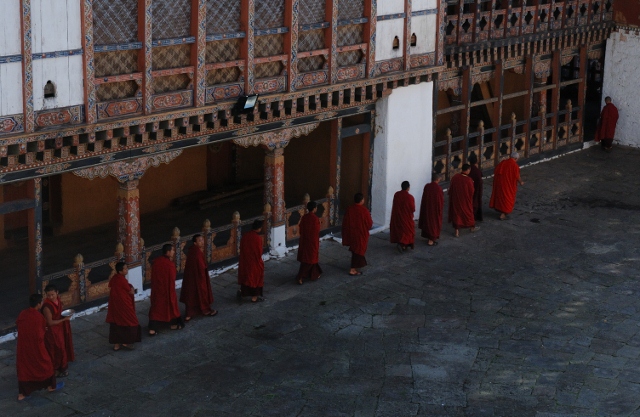
Trongsa Dzong is the second most important dzong in Bhutan.  It is an enormous structure. It took eons to build. Currently, it houses about 300 monks. We arrived at the dzong early, just after 8:00 am. Tashi tells us that this is the dzong that he studied in. Everywhere we went we seemed to run into a monk that knows Tashi. After wandering around for a while, we heard a loud slapping sound we learned is the call to the 9 o’clock prayer.  Two monks are slapping leather “whips” on the stone and it is quite loud.  Monks gather in the courtyard where we are standing.  Once all the monks are there, the head monk comes out and leads them single file to another part of the dzong for prayer time. It was special to be able to watch this procession. Again our guide looks brilliant, as we are going out the crowds are on their way in. Score another point Tashi.

We headed off and drove for 6 hours toward Punakha.

We have spent numerous hours in the car plying the roads of Bhutan. Every single road is hanging on a cliff. Down these cliffs pours water. Every kilometer there is another waterfall with water gushing from it and across the road. Between the streams are weeping walls that sparkle when the sun shines on them. The rainy season is over, it is fall so the snow has long since melted but the water continues to fall.

It is little wonder that Bhutan has chosen to build an infrastructure of hydroelectric facilities and export the electricity.  The country is adjacent to the two most populated nations in the world and both are starving for power. Personally I look at this with mixed emotions. I understand that if Bhutan wishes to increase its economic wealth it has to find ways to do that, but the cost in terms of changing an unspoiled environment is huge. The fast moving river at the bottom of the gorge, which is quite a spectacular sight, will no longer exist. The land as it exists naturally will once again be transformed by human intervention and not necessarily for the better. The choice for change may be the right one but it is very sad to see a nation that had resisted ‘modern life’ for so long give in to follow a way of living that even those that embrace it know is not the proper direction.

In Punakha we quickly checked into our hotel and were on the road again.  We wanted to visit the Punakha Dzong today too.

Punakha Dzong

On October 13, the king (K5) is getting married at the Punakha Dzong. As we approach the dzong we realize it is all decked out in its finery.  The only access road is lined with colorful banners, the dzong itself has banners surrounding it, and all the eaves of the immense building have been completely lined with colorful skirting. It looks like a North American house decked out with Christmas lights. You can tell something big is about to go down by the army and police presence. The dirt parking lot was being paved for the occasion. We arrive at the front gate rife with expectation. We are 8 hours too late. The door was shut to foreign visitors this morning. Not even Tashi’s cache could get us by the guard this time. As with people in general here, even the police in Bhutan are polite and a bit reserved, although adamant we would not get in, the fellow seemed a bit embarrassed about the whole situation.

This dzong is the premier dzong in the country and it is too bad we were not able to breach the security to satisfy our self-centered desire to see the place, and I’m sure we would have loved it, but after the number of dzongs we have visited I think I can image its grandeur and will have to suffice with that.

I’m sure there are a few more monasteries and other places of Buddhist significance on our itinerary but I think we have exhausted the inventory of dzongs in western Bhutan. I can’t say I’m sad about that, I am working on a bit of information overload right now and could probably use some time for the knowledge gained to gel.

Posted in Bhutan and India | Tagged , , , , | Leave a comment

Prayer Flags

The Yotong La Pass, at 3,551 m (11,540 ft), is the highest pass that we drove over on our tour.  When we reached the top, we stopped so we could hang up a string of prayer flags. We bought the prayer flags in Jakar and wrote the names of our dear family and friends on the 10 flags.  So, if you noticed some extra vibrations coming from the east, that is the prayer flags sending their message out. All of you were in our thoughts this morning as we hung the prayer flags.

As we headed out of Jakar this morning, we noticed that the colours of the leaves had started to turn from green to yellow, red and orange.  Three days ago, they were still green.  Winter is approaching at the higher elevations.

Our first stop in Trongsa was at The Museum of Monarchy.  It is Sunday, the museum was closed but Tashi did his magic and we managed to get a personalized tour.  It turned out that when he was a monk he had studied with the monk that helps to run the museum.  Tashi seems to have connections all across Bhutan.

We were really impressed with how the ancient watchtower had been refurbished. It consists of a circular five story tower and 2 lower towers.  The inside was redone in a modern style in complete contrast to anything we have seen so far in Bhutan. The displays were statues, religious paintings and artifacts from the kings of the Wangchuck dynasty. The picture below was taken from the courtyard of the main tower looking over the Trongsa Dzong into the valley the towers once guarded.

Trongsa Dzong

We then drove to the neighbouring valley to a palace where “K2” lived, and is now home to monks.  In Bhutan, the people fondly call all the Wangchuck dynasty kings K1, K2 etc to K5. K4 is the king that introduced democracy to Bhutan. K5 is the king getting married in a couple of days. Anyway, back to the story….This palace was where K2 lived and died.  Tashi again did his magic and convinced the main monk at the palace to let us into K2’s bedroom. In its day, the room would have been magnificent.  The room has bright yellow walls with large flower designs, windows on 3 sides and a painted ceiling.  The story is, that after planning the assignation of one of the local deities, the deity’s protectors had cursed the king with an illness and the king died by the window in this very room.

Two monks at the palace of the K2

Mur’s two bits

I’m from the prairies and when the lightning flashes and the thunder claps, it is a single boom. I lived in the mountains for several years and was quite surprised and impressed the first time I heard the thunder echo down the valley. It was quite an awesome concert. Bhutan is a country of mountains and valleys. When the thunder booms here it echoes, and echoes, and echoes. The local belief is that Druk, the dragon of Bhutan, is running up and down the valley, his footsteps creating each echo.

Druk, the Dragon

Bhutan is full of stories and imagery such as this and it makes for a very colorful society. I think that there is a good number of the population that still, if not truly believe, would like to believe in all of the country’s stories. If the number of prayer flags that are hung up is any indication, the beliefs are still strong and the folklore will continue to be part of the Bhutan fabric for many generations to come. Let’s hope so.

Posted in Bhutan and India | Tagged , , , , , , | Leave a comment

Darts and Mokoli

The staff that have been serving us and helping us at the Mountain Lodge, in Jakar, are absolutely wonderful.  There are two younger fellows and a young lady.  The two fellows are dignified and would do almost anything for us.  And they would do it without a word or a grumble.

I am amazed that they are cooking special food for me due to my dairy, wheat and egg issues.  If carrots with butter are on the buffet table, they will bring me a small bowl of carrots with no butter added.  At breakfast, I am eating Bhutanese porridge, which is rice made into porridge with tomatoes, onions and a bit of meat, instead of eggs and toast. The Mountain Lodge has been over the top accommodating with the meals, and I am impressed.

Murray and I have decided that we are blessed to have such great traveling companions as L&R.  We all get along and they are of the same mind as us when it comes to travel. Conversation at meals is entertaining and quite often our guide has to hurry us along. Four people on a tour works fantastically.

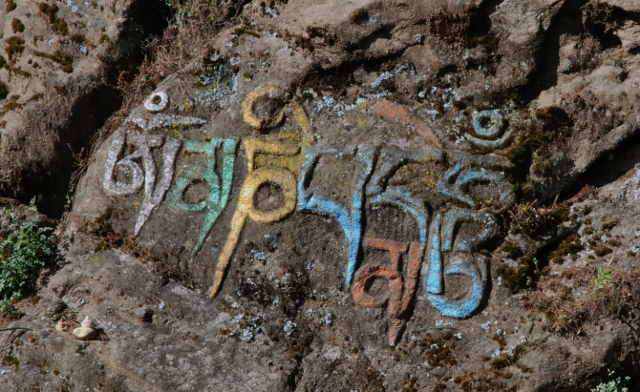
We have been seeing a mantra engraved onto rocks, painted on cliffs and inscribed over doorways.  The mantra is “Om Manee Padmay Hong”.  There is not necessarily a meaning to this mantra, it is just said over and over again while circumnavigating a temple and spinning prayer wheels.

We are getting trained in the courtesies of entering a temple or dzong.  Like the Canadian “No shirt, no shoes, no service” Mur has created “No hat, No shoes, No pictures”. Whenever we have to remove shoes or hat, it means that we cannot take any pictures.

We happened upon some young monks playing darts today.  Tashi, our guide, is always kibitzing with the locals and he got the monks to let us all try throwing a dart.  Our darts did not go where they were supposed to – duh!  As we watched the monks, I wondered how they don’t get frustrated as the target is so small and very hard to hit.  The whole time we watched, we saw only 1 dart hit a target in about 30 throws. To me it looks like an exercise in futility. Of course playing for money, monks or not, lessens the frustration factor.

We learned a new word today.  It is mokoli.  Our guide also learned a new word today.  It is toque.  I hope when we get home, we do not have to put on a mokoli when we go outside.

Tashi used his magic again today and took got us into a monks dorm room. I’m quite sure normal tours do not go there but we did. It’s a small room that 2 monks call home. 2 single beds, a corner for books and maybe an ipod and a corner for a 2 burner propane hot plate. Monks are not supposed to own much so I guess palatial digs are not in the offing.

We have had a good few days here in Jakar.  Tomorrow we are heading back west and our first stop is Trongsa.  See you there.

Posted in Bhutan and India | Tagged , , | Leave a comment

Buddhamania

The altitude here has not been affecting Debbie as much as it did in Tibet.  A slight headache for a day and the adjustment was complete.  Practicing in India was a good idea.  We traveled high then slept low, then high then low and even in Bhutan, we are sleeping lower than our highest travel points.  It seems to be working.

The local festival took up the bulk of our day. The dancing and entertainment, of course, with religious overtones, goes on all day, for days.  Everyone gets dressed in their finest and off to the fair.  All the kids get spending money and buy junk.  Sound familiar? I’m still working on why Buddhist kids get to buy guns.

Most of the people are gathered in the monastery courtyard watching the dances.  They come and go but spend the better part of the day watching the drama these dance portray that is repeated year after year.  The kids haven’t seen them too often but the adults still stand and watch.  I’m not sure if it is a religious obligation. I think it’s more of a social get together on a holiday.

Lunch today was picnic style.  Tashi ordered a picnic lunch from the hotel and we joined the locals and a few cows in a small orchard adjacent to the monastery to eat Bhutan festival style.  Noodles, beef, vegetables, chilies with cheese, potatoes and the customary rice. It was the first time I tried chilies with cheese as a standalone dish.  It wasn’t as scary as the anticipation.  They were hot but my mouth has burned worse after eating other foods.  I justified it by believing at the very least it would be good for the digestive system.  I’m quite sure the chilies and cheese dish will not become one of my staples.

As the Buddhist religion is the center point of life here, it would figure there are a lot of temple type places, monasteries, dzongs, and the like on our agenda.  Tashi, our guide, is making the visits much more interesting than church visits we have done in the past.  He was a monk from the age of 7 to about 15, so he knows the ins and outs of the monastery.  Today’s dzong in Jakar was almost deserted as the majority of the monks were off preforming at a festival in another valley.  Tashi located the big horns the monks use and showed us how to play them.  R and I had a try.  R was pretty good and I managed to get a sound, but nowhere near the deep resonant sound that is typically made by the monks. Tashi does spend time explaining about past Buddha and the reincarnation of the 2nd something or other such things, but for a good part of our visits he acts as a go between, between us and the monks.

There are only 700,000 people in the country and for the most part it is driven by Buddhism.  Whether it be hardcore dedicate your life to the religion, vis a vis become a monk, or if it’s the yearly take a few days off and let your hair down, the people’s lives all revolve around their spiritual beliefs.  The entire country seems to move as one.

Posted in Bhutan and India | Tagged , | Leave a comment

Across Bhutan

So far we’ve been witness to several “cultural” events.  We stopped at an archery tournament, visited a dzong and witnessed a once a year dance to cleanse out evil spirits, attended a yearly festival in Wangdu and happened on a dart match as we passed through a village.

Unlike other countries where such things take place in a controlled environment for tourists, these events were not staged, but were being played out as art of the cultural fabric of the land.  It was as interesting to watch the local spectators as it was to watch the participants.  Especially at the Wangdu festival, the attendees were in a festive mood and thoroughly enjoying their break from the work a day world.

Last night we stayed in the Phobjikha Valley.  An idyllic setting with an abundance of agriculture and the winter home of Black Necked Cranes.  We had been warned that the Hotel Gakiling was a little on the “rustic” side.  It had the atmosphere of a Canadian hostel; basic accommodation with a central dining/meeting hall where the guests met and exchanged travel stories.  Debbie’s and my room was in the main lodge and although basic was large enough to move in.  Our travel mates, L&R, had a room about 3m x 4m with a semi outdoor washroom.  Ouch. The heat in all the rooms was provided by small wood burning stoves that needed to be stoked all through the night. The owners are busy building a new hotel at the back of the property which should make for a much better experience.  On the bright side, the food has started to look up.  The dinner served was the best meal we have had so far in Bhutan.

We started out this morning with a 2 ½ hour walk through the Phobjikha Valley ending at the Gangtey Dzong.  There was a “prayer” session in progress and we were going to view the proceedings.  Of particular interest would be the playing of all the instruments, the drums, horns, cymbals and the gong.  Unfortunately, it was coffee time at the dzong and we had to be on our way.

The clouds here are nothing short of dramatic.  A few days ago Debbie pointed out how huge the clouds were and how tall they build to.  We’re fairly sure they are caused by the severe terrain of the area.  Every evening as the sun disappears from the direct line of sight, it continues to glare on the clouds and make for a most interesting back drop for the surrounding scenery.  I’ve tried to capture the drama with my camera but nothing matches being here and watching it all unfold.

After seven hours on the road, with a 45 minute lunch stop, a couple of pee breaks and a flat tire, we arrive at Jakar and the Mountain Lodge.  Our home for the next while.  The place is upper end, close to heaven, again. Rooms are great, with one oddity – they are heated by a small wood stove, but hey, it’s warm! If supper, our first meal here, is any indication, we’re going to have a wonderful three days.

Mountain Lodge room

Although the people here are aware of the tourists and seem to go out of their way to be accommodating, I don’t feel or believe that any of it is a put on.  The effort put forth is from an honest want to help out and is extremely welcomed from this tourist.

Posted in Bhutan and India | Tagged , , , , | Leave a comment

“Your View is Here”

6 AM…KNOCK KNOCK. Mur’s mind, “ What’s that? We don’t have a wakeup call??” Mur, “Yes?” Young Lady, “Your view is here.” Mur, “Pardon?” Young Lady, “Your view is here.” Mur’s mind, “We didn’t order a view.” Mur’s mind, “ Oh, Ya, our view!” Mur, “Thanks!”

It’s sunrise and the clouds that have been obscuring the Himalayas are now gone and the sun is lighting the snow on the tallest mountains.  They are quite some distance away but they are still spectacular.  We are awestruck. Photos at 6 AM.

Up early, might as well eat breakfast early. Fast shower and downstairs to the dining room.  Buffet breaky as all meals have been in Bhutan. Cornflakes, toast, rice, hard boiled eggs and porridge. Totally boring and bland.  Most of the food has been that way.  I’m afraid of the chili’s that seem to be a staple in Bhutan, but the food we have been getting is beyond mild.

Rice is a Bhutan staple.  White rice or red rice is at every meal, breakfast included.  As it is such an important food stuff, you can imagine how many rice fields populate the country side.  I’ve seen rice before.  While it is growing, it is the most beautiful green colour.  The rice in Bhutan is ripe and just about ready for harvest and the golden colour is just amazing.  The last 3 days, I have taken numerous photos in an effort to catch that colour.  I’m hoping I’ve been successful.

Today’s big event was the festival in Wangdue.  We were a kilometer outside of town and the traffic jam started.  Everybody for miles around comes to these regional festivals and with only one main road in this country, it gets hugely congested.

Everyone comes dressed to the nines and the festive attitude is pervasive.  So much show and so much colour.  The pathway to the dzong is elbow to elbow with market stalls lining the sides.  Inside, the dances occupy the center of the courtyard and the spectators pack the perimeter.  The idea of personal space is no where near what it is in North America.  At lunch, L mentioned that it reminded her of the Calgary Stampede – the whole city gets caught up in the festivities.

The dance has a story.  The details are lost on us foreign folk but the general outline is relatively easy to follow – good spirits fighting off bad spirits – and if nobody explains the real story, your own made up version will suffice.

The main highway in Bhutan gets smaller the further east it goes.  We are not past the busiest tourist area and the road is maybe 4 m wide.  For what reason, I’m not sure, they maintain a centre line.  The condition of the road has deteriorated but overall it is still not as bad as Indian highways.

The drivers here are quite courteous. They don’t race to see who can get farthest along before pulling over to let each other pass.  They just wait.  As things go, everyone is patient and very few people exceed the speed of safety.  Our driver, Mr. Karma, is a saint.  I don’t think I’ve held my breath even once.  He’s very cautious and slows when the road surface is bad, even if we are the only car for miles.

That being said, it is amazing that these roads even exist.  I was on the “cliff” side of the car today and the edge of the road drops straight down, I’m guessing about 500 m or more. I ski and generally do not have a fear of steep slopes, but if these slopes had snow on them, I would think twice about embarking on a slide down them.

At 6 AM this morning, we took in a long distance siting of the Himalayas, but the view of the festival and all the other views along the road today, close or far, were no less spectacular.

Posted in Bhutan and India | Tagged , | Leave a comment