Last Dive Day in Matemwe

Ready! Ok go! I lean back and fall, lifting my legs so I clear the side of the boat. Kersplash! I am in the water, the coolness enveloping me relieving the heat of sitting too long in a wetsuit in the sun.

We go down down down to 17 m. I’m checking that Murray is descending not too far away from me. Saedi (Sa-ee-dee) is ahead and is descending too. On this last dive we are going to drift down a channel and see what we can find. The guys hope to see a shark, or a turtle, or something else big.  I will settle for anything but a shark. Not my favorite marine critter.

The current is slow but noticeable. We drift and watch the movie play below and around us. Saedi uses his pointer to coax a leopard eel to stick its head out of its hole. I spot a juvenile Oriental Sweetlips and marvel at the brilliant yellows, oranges and blacks on its body. We find a shrimp of some sort in a hard coral, but because of the current cannot stick around to take a close look.

Saedi waves us over and nudges what looks like a piece of corral. It starts to move and morphs into an octopus! The octopus travels effortlessly a few feet and morphs back into its surroundings. We are all amazed at the octopus’ ability to disguise itself.

I glance over at Murray and he seems to have picked up two clown fish. He must have swum too close to their anemone and they are swimming around his face. These two are not the Nemo sized clown fish but are about 8 cm long, with black, white and orange stripes. They decide they have scared him away and swim back home. I thought he had made some fish friends!

Saedi is pointing madly to the left. I see a rather large octopus gliding over the sand around some coral. It looks to have its legs tucked under him as I cannot see the full tentacle. He glides about 7 m and stops and does his disguise trick.  I have never seen an octopus moving in the open like that.

Before we know it, we are doing our safety stop and then ascending to the surface. The bright sunlight waits us to warm us up and welcome us to the boat.

Walking to school along the beach

Posted in Tanzania and Botswana | Tagged , , | Leave a comment

November 29 – Safari

Murray and I have been talking about the differences between the safari in Tanzania and the one in Botswana. The areas are very diverse with Tanzania being mostly arid, desert like in the Serengeti and Ngorongoro Crater with areas of grasses and trees. Botawana, as we get closer to the Okavango Delta, has water and is green with trees, shrubs and grasses. There are marshes with large pools of water.

Ngorongoro Crater is abundant in game and visitors. It is easy to find the various animals and finding them is made easier by the number of guides in vehicles who radio and talk of where to find the lion or the cheetah. In the Serenget,i the animals were a little more spread around, but were still quite easy to locate. Patience pays off at an animal sighting to watch behavior. Although the animal sightings are numerous and easy, the number of vehicles is also numerous. At one leopard sighting, I counted 23 trucks parked watching a hard to see leopard in a tree.

In Savuti, Khwai and Moremi, in Botswana, the animals were more difficult to locate. But we do locate them and are able to watch some extraordinary behavior. The trucks can only communicate, via radio, with other trucks from the same company, there is no common channel. So in low season, we are the only Letaka truck in the area which makes it harder yet to locate the elusive game. Guides do talk whenever we meet another truck, but again, in low season these encounters are few. The game in Moremi is more abundant than in the other two areas. This is due to the lack of rain in Savuti and Khwai and the poor vegetation. Moremi, located in the Okavango Delta, has lush elephant and giraffe fodder and green grasses for the impala, zebras, buffalos and the antelope family of animals. Unlike Tanzania, the number of vehicles we encounter is a minimum.

The guides have different approaches to accommodate the areas and numbers of animals. In Tanzania it is easy to spot animals from the road so we do some “fishing”, go to Pascal’s favorite fishing holes and see what we can see.

In Botswana, we notice right away that Pat tracks animals. He has to. How else do we find a cat or a wild dog on our own? The animals routinely ply the dirt roads, so the tracks are visible. When we do locate an animal we stay and watch its behavior, sometimes sitting for an hour. This pays off as we see remarkable happenings – lions killing an elephant, wild dogs hunting two impala, a baby leopard eating an impala high up in a tree, an old elephant making the peace between two young elephants. Pat is extremely knowledgeable about birds, trees, flowers, insects, reptiles, not just mammals. When the sightings of mammals and birds (his passion) are few, we start to learn about insects, grasses, landscape and the geological history of the area.

Pascal paced the safari very well; I presume he has learned this over time. When we started out he knew it was our first time in Africa and we stopped at every animal. They are all new to us and he understood. We have just arrived at the gates of the Tarengire National Park, right inside the gate are a few Thompsons Gazelles, Pascal stops and we click away on madly taking an inordinate amount of pictures. We sit and ogle the tiny antelope and marvel at their beautiful coats. Over time Pascal knows that we spend less and less time with the Gazelles until by the last day we drive right by and will only stop for cats, elephants, giraffe and the like. The last day we only spend a good amount of time at unusual sightings like a male lion feasting on a wildebeest.  Pascal, in Tanzania, has the knowledge, but he does not pass it on so readily as Pat. I am quite sure that most people on their first safari experience information overload and will not retain the details even if told. So our more mature guide picks and chooses the information he releases and if we ask he expounds upon the base he has provided.

The safari we spend with Pat has a slightly different pace. He knows we will see so many impala that they will become commonplace so we stop but not for very long. Just as Pascal knows, Pat know the value of patience when we do come upon a promising situation, we wait and wait and sometimes wait longer, or maybe leave the site to return later, but with a little persistence we have been there at the events that are mentioned above.

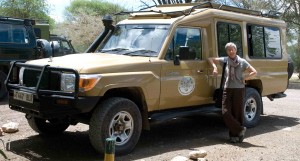
In Tanzania, we use a Toyota Landcruiser that is enclosed. Windows and doors, perhaps to protect us from the dust that is everywhere on the roads. The vehicle has a pop up roof with a sun shade so we can stand to take unobstructed photos.  In Botswana, the Landcruiser is completely open. If it rains, we don rain gear, if a lion is close, we don’t stand up – we become one with the vehicle. It was quite scary being 3 meters away from a male lion with nothing but air between him and us.

Both Tanzania and Botswana are unique destinations with their own personalities, just like the safari guides, one not better than the, other just different

Posted in Tanzania and Botswana | Tagged , , , | 1 Comment

Zanzibar

So this is Zanzibar. I imagine it is quite a bit different than it was 50 years ago when I first learned of its existence while I was collecting stamps. It has been on my list of places to visit since that time even though I had yet to develop a travel lust at the age of 9. But, here I am sitting on a beach that could well have been pictured on one of those stamps.

Zanzibar it quite a big island and it is able to maintain areas with distinctly different characters. We have stopped at one place so we can only talk first hand of it, Matemwe, but the reports of other areas come from fellow travelers and each sounds different.

Matemwe is a quiet east coast village with a reasonably nice beach.  The beach is being more and more developed so I do not expect it will be quiet for long. The local folks fish a bit, farm seaweed, and work in the lodges. Everyone is friendly, both tourists and locals.

There are two main traffic thoroughfares here. There is a small dirt road that is dusty and because it is 50M from the water and sheltered from the sea breeze it is very hot to travel on. The other, the beach, is huge; I’m guessing it is 3km long and anywhere from 5M to 30M wide depending on the tide.

I have worn shoes only once, the day we walked along the dirt road and immediately removed them to walk the return route along the beach. It is the longest period of time in my life , I think, I have gone without something on my feet. Four days without donning footwear other than flip flops and I only wear those to walk on the gravelly roads and to get into or out of the water where there are rocks. Debbie and I walk the beach every day and we walk in bare feet. The sand is white, white and does not retain the heat so the walking is easy.

You can swim at high tide but it is a bit shallow at low tide and you have to be careful about stepping on a sea urchin.

Most of our last couple of days has been spent in our bathing suits with a t-shirt, then dress for dinner. Most restaurants here don’t really care and we are keeping our clean clothes for the city.

The big disadvantage to this place is the lack of snow which would preclude any chance of skiing.

We went diving yesterday and return to the underwater world today. The diving is good and we see a lot of different types of fish.  Our first dive is at a spot called the aquarium and it is the first time Debbie and I see a frog fish.  It never rains, it pours and the dive master finds 2, one green and one red. I guess it looks somewhat like I imagined after seeing some pictures in this book or that but they are so big. Debbie will say I am exaggerating but I think they are about 30cm across. They are so camouflaged, both are tucked up against coral and have all the same lumps and bumps of their inanimate hosts and the colour is an exact match. They do have eyes and fins which of course give them away but only when you know they are there.

The last two days we have been diving with an older French couple. Older than us if you can imagine that. They have lived up to the international reputation of French people and they are quite rude. Both have underwater cameras and when the dive master points out something of interest they literally use their elbows to get to the front of the line to see and take pictures. There are only 4 of us in the group so it would not take long to hang back and wait a turn. For the most part after visiting France I did not find the people to live up to their reputation. I think this is the case in most countries but it only takes a couple of incidents and a sweeping generalization can be established. Even if queuing was not their strong point they are quite nice and we did seem to meld into a good dive group after the first couple of dives.

There are people from all over the world staying in Zanzibar. On the dive boat today there are three ladies from Holland, two young people from South Africa, one from Australia, two Brits, two French folks, two from the U.S., and two from Canada. That seems to be the way everywhere we run into a group of tourists.

I do not know how the people choose to come here but I can see why one might come back. I do know how we chose to travel here. Some months ago Debbie asked me; “If we only had one other place to go and then we did not travel again where would it be?” Reflecting back to my stamp collecting days and remembering the exotic places that I learned about because of the philatelic activity I had a very strong desire to visit Zanzibar and here we are.

Posted in Tanzania and Botswana | Tagged , , , | Leave a comment

Wish I Had My Underwater Camera Housing


Early morning on the beach

We go scuba diving today – scuba safari. Nerves, of course, but still excited to be in the ocean.

One Ocean has a couple of boats and today we are 14 divers and snorkelers on the big boat. Our dive group has four divers and Marine, our dive master. The crew is very efficient and the ship deck is organized and run well. We gear up and PLONK! into the water.

Eels. Marina said there are lots of eels on the first dive, and there are. Right away we notice the difference between these eels and the eels we see in the Caribbean. There are whitish ones and orangish ones here.

Nudibranches are frequently spotted. White with black and blue with black ones. They are large – 4 cm long.

We see fish that we know the shape but the colouring is different.  We see our favs – clown triggerfish, clownfish and butterfly fish.

Marina finds two octopi and one is quite large. They are hiding in holes so are only partially visible. It would have been cool to see them outside their holes, but we would have had to wait until dark.

I remember why I love diving so much and rue that fact that I did not bring the underwater housing for my camera.

Posted in Tanzania and Botswana | Tagged , , | Leave a comment

December 1, 2 and 3 – Money

Yesterday was an eventful travel day. Get on a plane, get off a plane, get on a plane, get off a plane, go to a hotel. So we didn’t even attempt to write a blog.

Today however was far more exciting. Get on a plane, get off a plane, get in a taxi, get out of a taxi, go to a hotel. We could hardly contain our enthusiasm.

We are in paradise. Matemwe, on the east coast of Zanzibar. Miles of beach to walk, water to swim and scuba dive in. A breeze to keep us cool in the heat.

We go on a walk through the village and realize right away that we are not in Botswana any more. Hawkers approach us asking if we want to go snorkeling. We get a shock when the little children say Jambo! and then ask for money, which brings Murray to write the following………

Which brings me to today’s topic, money. Not money per say but the word. It is one of the few English words that kids around the world know. Hi Mister. Money. I always answer, Hi. No. I cannot understand why the kids ask for money. Is that what they are taught by their parents? I do not believe so, I think it is because some *$@&$# tourists actually give them money. I do not care how cute or how poor the kid is there is absolutely no excuse to give anyone cash just for the asking. What the hell is that going to teach them except that they can get something for nothing and that maybe that tourists are truly stupid.

I was talking with the waiter on our safari in Botswana and he passed on a story about a fellow Canadian. This fellow was a pilot from Toronto. He must have thought himself a very important person because he made the waiter feel very small. The conversation went something like this: Tourist; How much money do you make? Waiter; I make 900 pula/month (about $120 US). Tourist: I make that much in one day. Why on earth would this pilot want to say that to a person he knows could not possibly make that kind of money at any time in his life time. It is not so much he was bragging about HOW much money he made but it is that he spent no time what so ever supplying a context within which that wage is made. How much rent is in Toronto. How much a mango cost at the grocery store. That in most places in North America it is imperative that one own an automobile. None of this was explained only that he made an extraordinary amount of cash and because he did he could live a life that this poor waiter will never live. I spent the better part of 2 hours trying to undo the harm that this fellow Canadian had managed to inflict on my now friend. I can only hope that he feels a little better about his job and himself. The people in the developing nations for some reason look towards the western nations as a goal to strive towards. I know I am not the only one that believes we of the western world do not have all the answers. There are a lot of really good things about our ways but along with the good comes the bad, we know what most of the bad things are yet we pass on our way of life lock, stock and barrel without any regard for the impact it might have on the peoples on the receiving end. Please take into account who you are talking to and consider what information you are passing on and at the very least put it in context. No matter how wonderful you think your life is, the person you are talking to has a good life as well and I do not think it is fair to belittle their world. I travel to many developing nations and what I see is many happy people, they do not have all the junk we have but they are laughing and smiling and enjoying their neighbors. I see no reason to burst their bubble.

Three days in one what a bonus. Today we were suppose to dive but there is not enough room on the boat so we got bumped. It is an akunamatata day. It’s early and we walk out the front door and walk directly into the water for a short swim. Breakfast is on the deck with a beach view of the Indian Ocean. You cannot believe how hard this is to take. A walk though the village with more requests for money, out to the beach for the return walk. Our lunch stop is at a hotel with an upper deck on the restaurant overlooking the beach. You must be getting the picture by now.

Yesterday at about 5pm the tide came in and we went for a short swim. The tide was out most of the day and the water in the tidal pool was heated. I have never ever swam in such warm water. I would swim a bit and then pop up when I put my head back in the water to swim again it felt like a hot, not warm, hot bath. This morning the hot water had time to mix with the cooler water and the water was only warm. It is now 4pm and we are headed for another ‘bath.’ Tomorrow we will find out what this part of the world’s ocean has to offer in terms of adventure.

Posted in Tanzania and Botswana | Tagged , , | Leave a comment

Safari Goodbyes

I wake up hoping to see an elephant today. I know, I am not supposed to hope for things. But I do anyway.

Dunega, Pula, Pat, Mosh with Murray and Debbie in front

Dunga, Pula, Pat, Mosh with Murray and Debbie in front

After saying goodbye and thank you to Pula, Mosh and Dunga, we three head off for our last game drive.

The game drive starts as every other day. Impala, landscape, impala, fish eagle, impala, cape buffalo, impala. A whole herd of impala gathers closely, very closely together. So close that it is worth a stop of a photo. Click, click, then the impala froze and every one of them faced attentively to stage left.

Just behind the impala there is a panic and impala running exit stage right and then across the opening a white flash. Pat says, CHEETAH! Man is it fast! About 30 seconds later the cheetah returns from where it came with a baby impala in its mouth.

The impala have an M shaped marking on their butt. Pat says the cats see that as “McDonalds” and dine there regularly. Debbie and I have been amazed at the number of baby impala there are in each herd and have come to the conclusion the reason is because the babies serve as cat fodder.

The rest of the drive is slow without any other big animal sightings. The next installment is Botswana by air. We say goodbye to Pat and board the elusive white bellied cessena, which can be found in varied habitat through the world, and watch out the window observing the delta from the skies. We see a few animals but they are really tiny. It is interesting to see the landscape from a bird’s view.

The plane ride ends but our day is just about to begin anew. We arrive chilled (mentally) from 10 days of pampered isolation, the hotel shuttle is not at the airport but that is solved with one phone call. We arrive at the hotel and our room is not ready. No problem, we have all day, the internet is good by the pool so we find a table and sit. Our intention is to check emails and post one of the stored blogs. Debbie digs into her email to see what’s up. Nothing earthshaking.  My turn. There is a weird titled one from Air Botswana about “important flight information – The flight you were booked on from Maun to Johannesburg has been cancelled and you have been confirmed on a flight 4 hours later.”  ALARM!!!

Nice of the folks to rebook us free of charge and all but the new flight arrives in J’Burg 15 minutes AFTER our connecting flight to Dar es Salaam takes off. Today’s flight to J’Burg has already left, we are at the hotel we have paid for and we are behind the eight ball.

We try to raise the Air Botswana office by phone but there is no answer. So we grab all our bags, hand in the room key, explain that we may not be back if we can grab another flight today that will eventually get us to J’Burg by noon tomorrow.

The lady at the Air Botswana office is helpful although it was our suggested routing that she followed up on. We eventually got a flight to Gabarone (the capital of Botswana and closer to J’Burg) at 8 pm, and another flight from Gabs to J’Burg tomorrow morning landing in time to catch our connection.

The lady at Air Botswana also called the Maun Lodge and managed to get us a 50% refund on our hotel payment. Catch was we had to return to the hotel to collect it in cash. So, back to the hotel we go. The front desk lady offered to book a hotel in Gaberone for us. Awesome customer service at the Maun Lodge. If you are in Maun, stay there.

Flight rebooked, hotel booked, onward flight rebooked and a day of reintroducing ourselves to civilization, catching up and resting turns into stress, panic and a short night’s sleep.

“Travel Mode” says Debbie. She means ooooommmmm. I fell out of travel mode for a while today, whereas Debbie seemed to stay in it. It is important to maintain travel mode no matter what happens, after all, travel is all about adapting to changes and handling whatever is thrown at us with calm and humour.

This morning where she mentioned that she hoped to see an elephant, I said “Don’t get your hopes up as we haven’t seen many elephants in Moremi”. Today our last day on safari we searched hard for that elephant and didn’t see one and the day went downhill from there. Here we sit on an airplane to a city not on our itinerary and I should be showered and asleep in a real bed for the first time in 10 days.

Posted in Tanzania and Botswana | Tagged , , | Leave a comment

Birders

Pat is turning us into birders. He is been teaching us the names of all the birds that we see and hear. Unfortunately, we only remember a fraction of them.

I only remember the ones I like. Like the Yellow Billed Hornbill. Big brightly coloured bill and black and white plumage…and they are everywhere! The LBR – Lilac Breasted Roller – is also everywhere and is very noticeable with its bright blue wings and lilac breast. The Copper Tailed Coucal has brilliant coppery tail feathers and shines in the sunlight.  The Saddle Bill Stork with its long legs, red bill with a black “saddle” on it.

Saddle Billed Stork

Saddle Billed Stork

Today Pat spots a Pel’s Fishing Owl high up in a tree and gets very excited. We watch and take pictures of this elusive owl. He radios another Letaka Safari guide who is touring actual real birders to inform them of our location and the fellow says they will head our way as this owl was a rare sight not to be missed. We wait and watch the owl turn his head to look in all directions. He is dressed in brown tones, head a lighter shade and body a combination of light and darker browns. He opens his eyes occasionally and checks up on our location. Yup, we are still here!

Pel's Fishing Owl

Pel’s Fishing Owl

I have trouble differentiating between a heron, egret, stork and ibis. They all have longish legs, longish necks, longish bodies and longish bills and are all found near water.

There’s the Great White Egret and Little Egret and Open Billed Stork and Saddled-Billed Stork and Grey Heron and the African Scared Ibis and and and…..

Great White Egret

Great White Egret

Grey Heron

Grey Heron

There are so many little brown birds that they have been lumped together into one category called LBJ – Little Brown Jobs. I do not even try to differentiate between them all. To me, they are all LBJs.

When we see a giraffe or a zebra or a larger mammal, they often have a Yellow-Billed Oxpecker riding on them. These birds pick the tics off the animals and enjoy a meal. Pat says a giraffe can have up to 800 tics on it, so these birds can be well fed. We saw a giraffe with 8 birds on its neck. It is of mutual benefit for both bird and animal.

There are also all the raptors, kites, eagles, hawks and falcons. Of which again we can only identify a couple. The African Fish Eagle is very big, dark in colour, with a white head, the Tawny Eagle has beautiful tawny feathers (surprise) and a very sleekly built. The one I have intimate knowledge of and my favorite; the Yellow Billed Kite has dark plumage, a yellow bill and very adept at dive bombing chicken (MY CHICKEN!!).

I do not think we will ever become true birders, even with Pat’s diligent instruction, but we now can spot various birds and enjoy the finding of them.

Posted in Tanzania and Botswana | Tagged , | Leave a comment

Khwai Village

Today we move to the Moremi Game Reserve, our last stop. We drive by the location of the wild dogs but they are not visible. It is extremely quiet and we see almost no wild life except impala.

We stop at the Khwai Village where about 300 people reside. We have asked Pat if we could walk through the village, if for nothing else to stretch our legs.

You see, we feel we are held captive while we have been on safari here. Our walking distances are either 20 steps from our tent to the dining tent, or 15 steps from our tent to the vehicle. Once we walked maybe 200 steps to see where an elephant slept. That has been the extent of our exercise for the last week. Those of you who know us well will understand that will be hard to take for Murray and me.

Anyway, we park at one end of the village, chat with some ladies and then walk down the road through it. We meet a fellow who works for the Khwai Village Trust and he is supervising the construction of a house for a poor woman and her children. The Trust has a program that provides employment for people who cannot find work by hiring them to build this house. The workers are fed breakfast and lunch and are paid a small wage. He did say that sometimes the workers are not motivated to work (as witnessed) and he has to keep them progressing on the house.

The houses in the village are mostly block and plaster with thatched roofs. The technique of using termite hill sand for the blocks and plaster is slowly being replaced by cement and cocrete blocks.

After we pass through the gates of Moremi Game Reserve, we see more game in an hour than we have seen in days in Khwai. Hopefully this will continue for our last 2 days in the wilds of Botswana.

Posted in Tanzania and Botswana | Tagged , | Leave a comment

Weather

Temperature

After relatively nice temperatures in Tanzania we arrive to sweltering temperatures in Botswana. Kasane, a small town in the north, our safari starting point is 35C and rising.  There is no breeze and the heat is suffocating. We walk all morning at a slow pace and there is no shade. Back at the hotel it is all we can do to remain upright while we waste away the afternoon in the shade.

We leave early in the morning to avoid the heat of the day. It is maybe only 30C when we start. As we travel on the highway in our no sides, no windows, safari vehicle the temperature rises quickly. The hot air that blows by us only exasperates the problem. We try to drink because it is not only the heat but the wind that sucks us dry.

In the afternoon it rains a bit and the temperature moderates. The next couple of days in Chobe National Park are again hot with small amounts of afternoon rain to keep things livable.

Heading south-west to Khwai Conservation Area and the clouds roll in. It is nice to be protected from the glaring sun and the cover keeps the temperatures nice enough for a t-shirt and we do not sweat too much.  We get to camp around noon and the thunder starts.

By the 4pm game drive it is pouring. Debbie dons an extra layer, I put on my jacket, we both hunker under our rain ponchos and for 3 hours the rain comes down in buckets. The temperature drops to about 20C and with the nature’s wind and the breeze of being in an open moving vehicle is it chilly. We are again officially warm weather wiennies.

Thunder

We run into the first rain that amounts to anything in Botswana. The thunder is a low throated rolling rumble. Unlike the prairies where there is a sudden very loud clap, loud enough to knock you out of your chair. The noise here is more like you hear on the shoreline of an ocean. It’s loud enough but it starts with a low grumbly kind of boom, gets louder and then rolls across the landscape, the sound decaying over quite a long span of time. Thunder is another interesting aspect of the constant audio sound track that is being played out constantly as the safari movie plays on.

Clouds

The clouds here provide another sort of visual drama. For the most part, they are similar to the clouds that form across our prairies, but they provide the backdrop for spectacular sunsets almost every evening, orange, red, yellow, purple, with the sun streaking through like a bible picture. They are of every shape and colour and we wish our photos could capture their drama. The colours are not quite so vivid with the sunrises but the clouds help with the drama there too and they are worth a stop in the routine for a look. We are starting to read the clouds, from which direction they come and which ones bring rain.


Posted in Tanzania and Botswana | Tagged , | Leave a comment

African Wild Dogs

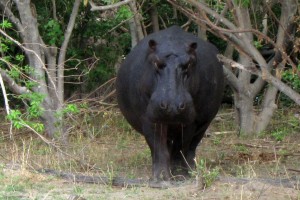
The weather this morn, chilly. I have to wear a jacket to stay warm while we ply the trails looking for whatever the wilderness will cough up. Since there is not the abundance of animals we have been use to, here in Khwai, our guide has resorted to tracking. Debbie sits on the same side of the Toyota as the guide and she has been learning to identify the different tracks and to tell how recently they have been made. She has got quite good at finding hippo tracks and we think maybe she could open her own guide shop specializing in all things hippo. I’m sure there is a market for such just waiting to be tapped.

Today our pray is the African Wild Dog. There is a pack of these creatures that roams these parts and we set out to find them. African Wild Dogs are very rare and to see them is akin to spotting a Yeti, yet Pat thinks we can find them so we try. Luck is with us, there are tracks and they were made last night. We are able to follow them for a ways because often the animals use the car paths to move about and the dogs are no different in that respect. We come upon an area where the dogs have ‘played’ for a while. There are 4 adults and 6 pups in this pack so there is a lot of rough and tumble being acted out. It is hard to find which direction the dogs went from there but Pat feels they would go north, a fisherman’s instinct, so we head north. We drive aimlessly, left on this road and right on that one. A few impala here and there, suddenly, with the words ‘honey badger’ emerging from Pat’s mouth, he again jumps into action, we are chasing alongside a very fast and agile honey badger. The whole time we were in Tanzania with L&R, L wanted to run into a honey badger, but they are for the most part nocturnal and we did not find one. Today we see one during the daylight hours. He is very fast and good at keeping distance and the thickets between us and him. The pictures I tried to take consist mostly of blurred leaves and branches. So L will just have to believe that we saw, however briefly, a honey badger.

Pat is sure the wild dogs are near so via radio he commandeers Pula, our cook, into assisting with the hunt. Pula talks to a self-drive tourist who spotted the dogs a while before but lost the trail. He did provide Pula with the location of where he had seen the dogs.  Pula plies that area, soon we get a call stating he has found a kill and the vultures are having a feast. The dogs had hunted and killed an impala, feasted and left the rest for the scavengers. When we arrived there were a dozen or so vultures squabbling and eating the carrion. These birds have absolutely no table manners. They fight and squawk and push their way to the front of the food line with absolutely no regard for the others.

After watching the birds pick everything but the bones, this took only about 20 mins. emphasizing what pigs they are, we head out to continue our search. Changing our tactic we go west but stay in the north part of the conservation area. As we pause by the river to photo some grazing reed bucks another vehicle passes by and as always the guide stops to exchange the day’s news. One of the vehicles from his company has located the dogs. They are sleeping about 500 meters from where we were searching earlier. Zoom! We are on our way. Spotting the ubiquitous gathering of 4WD’s at any sighting, we knew we had found our morning’s prey. Unlike most of the animal kingdom we were only there to steal images. The dogs, which are usually skittish, are just lying there with full bellies. An animal’s life here can be cruel but most of the time it does not appear to be overly stressful.

Our first stop in the late afternoon was a return visit to the wild dogs. As it has been the case for this part of our journey, we are the only vehicle there. We watch for a short time and the adult dogs appear to be restless. Soon, one by one, in single file they saunter off north towards the river. The pups follow the adults. Pat says let’s follow them, they may be going for a drink of water. We are using the 4WD for what it is meant for – we are off road now. It’s hard to follow the dogs through the thicket, but we manage to track them to the river. On the opposite bank of the river there is a troupe of baboons intently observing the movement of the dogs. On our side of the river, the adult dogs are not fearful, but the puppies keep their distance as baboons can be dangerous to them. The puppies depart on their own, soon followed by the adults, all without taking a drink. We loose track of the dogs in the thicket. The puppies return to the spot where we initially found them.

There is commotion in the trees and the adults are on the hunt. Impala are running and leaping every which way. One of the adults returns to the puppies with a piece of meat which they greedily devour. They understand that they are supposed to follow the adult back to the kill site. We dutifully join the end of the line. As we are watching the puppies eat the remainder of a baby impala, there is another disturbance in the trees. Two impala fly by at top speed with two wild dogs chasing. We are on the move too. In no time, one impala is brought down and the feasting begins anew. These dogs are fast. The adults had eaten most of the first kill, so they leave the second one for the pups. The impala is quickly consumed.

We are on a “night game drive”, so we stay out past sundown. Once it turns dark, Pat uses a flashlight to locate the eyes of the animals. We are looking for red or orange eyes of cats and predators. Blue eyes are impala (day time creatures) and we do not focus on those as we do not want to show the predators where they are.

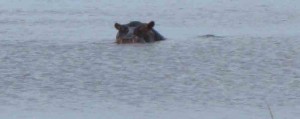
We see hippos, their great grey bulk shining in the flashlight beam, munching grass close to the water channel. When we are almost back to camp we spot a python gliding over the ground. It doesn’t oscillate as it moves forward but travels in a straight line.

The day, which started off cool, heated up and has cooled off again. We are back in our jackets as we dine in the outdoors.

Posted in Tanzania and Botswana | Tagged , | Leave a comment