Kasane to Savuti

We meet Pat at breakfast and we all realize that he has been staying at the Old House, in Kasane, for the last two nights just as we have been. After breakfast and checking out, we all hop in the Landcruise and drive 30M down the road to where we are going on a Chobe River Cruise. Shoulda walked!

The Chobe River is the boundary between Namibia and Botswana. Dan, our river guide, motors us southwest on the river towards a 1.7 square kilometer island in the middle of the river. It is cooler on the river with the breeze created by the moving boat. Many animals brave the river and its crocs to feed on the vegetation on the island as it is very fertile. Buffalo, elephants, red lechwe are munching away. Yes, I did say crocs and we see two males sunning themselves on the sand bank. I take a quick look and look away – I DON’T LIKE THEM! Hippos are sleeping in bunches all through the channel, we keep our distance.

After we dock, Pat, Murray and I travel south towards Savuti and our campsite for the next 3 nights. It is a long drive, hot with a hot wind blowing at us in the open vehicle. In Botswana the safari vehicles are open sided. As long we stay sitting a cat or elephant will see us as one big object. Pat says if we stand up, they will notice us. We see the occasional elephant, giraffe, kudu. We notice that the creatures are not like Tanzanian ones here – the zebras’ stripes are oriented differently, the elephants seem to have longer legs.

We enter Chobe National Park after driving for about three hours on asphalt and the next 70km is dirt “forestry” road.  After a short distance we come across the first dead elephant. Pat says that too many elephants have come into Chobe and with the very dry season and no rain, there is not enough vegetation to sustain their numbers.  Each day elephants are dying. We come across another soon after. It makes us sad.

All of a sudden it starts to rain. We have held off the rain so far on our trip. Murray, dubbed the Witch Doctor by L, is feeling bad for the elephants, and so he caused the rain. We quickly don our rain ponchos and sit it out watching a lone elephant walk towards us. He gets very close to us before turning down a side track.

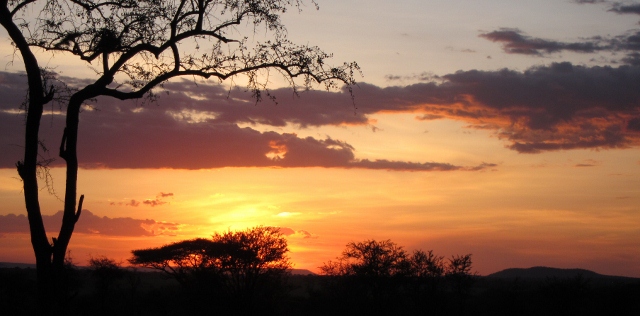
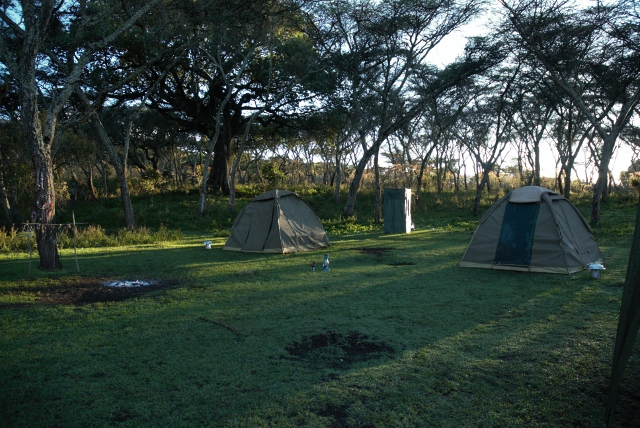
We arrive at our camp and it is a tad more rustic than we thought it would be, but we camp in the Rocky Mountains with fewer accoutrements, so we adapt. The trick is figuring out how to live and move around in our little tent with two cots taking up most of the space leaving little space for our two bags. The sunset is incredible with fuscias, purples and dramatic clouds and I manage to capture a lone elephant in the shot. A good end to the day that started in Kasane.

Posted in Tanzania and Botswana | Tagged , | Leave a comment

Kasane, Botswana or Close Encounters of the Warthog Kind

We have a day in Kasane so we head out for a walk to see the town. The first thing we notice is how HOT it is. It is only about 8:30 and it is already searing.

We wander the streets and the children wave and call “o-aa” to us. We think it means Hi or Hello or Goodmorning, but it actually means “white person”! It is not meant to be derogatory, just a saying.

Urban Warthog

Urban Warthog

Down a lane we come across a warthog also out for a stroll. Two dogs spy him and come to investigate. The warthog doesn’t need investigating so he chases them away, all the while Murray and I are trying to get around the trio without become casualties. We are disappointed we didn’t get to see him run away with his tail straight up in the air, Pumba style.

The wild animals, mostly warthogs and sometimes elephants, wander through the village here, from what we can understand, on a regular basis. Much like they do in our Banff or Jasper. No one seems too concerned and as long as we keep a reasonable distance the animals seem OK with it too. Much different from the motherly approach to taking care of tourists in Arusha.

We stop by the Police Station to look at a couple of enormous Baobab trees.

As the tree gets very old, it hollows out in the center, like most trees. These hollows were used as poachers hideouts, prisons, mail drops – all sorts of uses!

The flowers on the tree are large and look like something we should find underwater.

As we walk we notice that there seems to be a middle class in Kasane. There are the small wooden houses with no windows (poorer) and then there are concrete block houses with windows and A/C and TV satellite dishes. We didn’t notice a middle class in Arusha, but most of the houses were behind high security walls, so there could have been. Botswana is a well off country due to its diamond mines. Kasane has a prosperous feel to it, even walking the back streets. Clean, organized, well constructed houses.

Kasane lies beside the Chobe River. On the other side of the river is Namibia. Hippos and Crocodiles live in the river, but we haven’t spotted any yet.

Chobe River

Chobe River

We are starting our 10 day safari to Chobe National Park and the Okavango Delta tomorrow. It is a moving tented camp, so we do not think there will be WIFI. We will post as soon as we are back in WIFI territory. Cheers until then!

Posted in Tanzania and Botswana | Tagged , | 1 Comment

Dar es Salaam to Kasane

Up at 3:53 (overslept) and out the door at 4:00 to catch our flight from Dar es Salaam to Johannesburg.

I have seen a few sunrises in my day. When I was younger they were usually from the day before end, lately I have seen more from the get up early end. Some of them especially from an airplane have been worth staring at but today sitting in the Dar airport I looked out the window and saw the ball of the sun sliding up over the horizon there is a few thin clouds and mist at ground level and you could look right at the sun. I have seen sunsets like this before but never a sunrise.

Three and a half hours in the airport and we are flying over the city which extends as far as we can see in all directions. OR Tembo Airport is modern and large. We maneuver the corridors and find our gate. The Air Botswana flight to Kasane is delayed about 1 hour due to mechanical issues. We board a small prop and are on our way to our next adventure

As we prepare to land there is a herd of elephants wandering below us. Only been in Africa a couple of weeks and already we are wildlife spotters. The plane lands on its right wheels and flops down to even out, the second shaky landing in a day, must be co-pilots practice day on the tarmac or something.

Arrive in Kasane (ka-sa-nee) to 34 C. Matthew, the Assistant Manager of The Old House, meets us at the airport. A nice surprise as I thought we were getting to the hotel on our own. He makes a stop in town so we can change some $$ into Botswana Pula.

The Old House

The Old House

The Old House is a charming hotel complete with Momma Warthog and Babies in the yard. (Wild animals roam freely in the town. GULP!) I love our room which has a painting of an elephant on the headboard. And it has A/C!!!

Tomorrow we will explore Kasane and hopefully buy me a new watch as mine died the other night and I absolutely cannot travel without a watch. I am driving Murray crazy asking him what time it is.

Posted in Tanzania and Botswana | Tagged , | Leave a comment

Hurry Up and Wait

It’s time to say good bye to Northern Tanzania. I like the place, felt at home here. There are a couple of things that are annoying. First being the tag along self imposed tour guides. They are literally a pain in the ass. The second being the amount of money we the rich tourists are charged for things like taxi fare. Fare to the airport from our hotel was set out by the hotel owner, Andy, at $20US. I managed to get a ride for 20,000 TSH, about $12.50 US, and it is still way too much. You can ride the dala dala for about 600 TSH, about $.40 US and a short walk. But hey we all have lots of money don’t we. The lady we talked to yesterday pays 60,000 TSH/month, $38 US rent for a two room flat so the cost of living here is not that much and one airport fair would pay for 1/2 a months rent. The equivalent of charging say $600 for a trip from Edmonton to the International airport.

The Arusha airport is a domestic airport and it is very small. The line up at each of the airlines check-in counters blocks the entire entry way to the waiting lounge, so it is step over this bag and around that bag to get to the counter we are looking for. We arrive  at the Precision Air desk and we are asked to leave our bags in the line to keep our place and find a seat. The computer has broken down and the boarding passes cannot be made. When is the last time you could abandon your bag in a airport and not have it blown up. The other worry being you are constantly reminded to not loose sight of your things while in Africa as they may have a tendency to disappear. The lady chosen to organize the line is great, she takes complete charge, makes light of the situation, and keeps a smile on everybody’s face. Finally the computers are working and the line organizer starts to find the owners of the bags as they are lined up. She approaches each bag owner, collects their ticket and passport and returns with their boarding pass in hand. Now that is customer service. Air Canada could learn a thing or two.

Arusha Airport

Arusha Airport

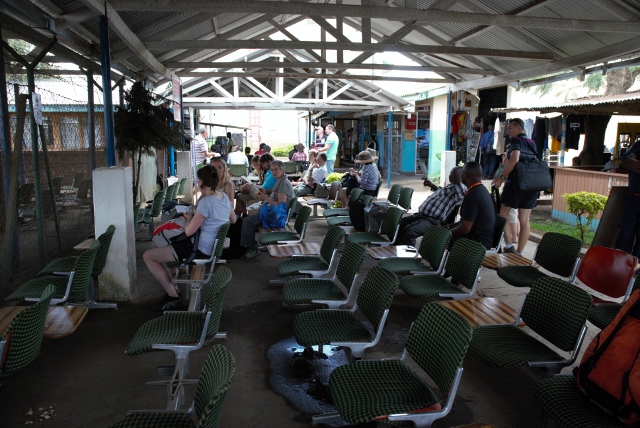
The waiting lounge is quite the place. The area before the boarding lounge is accessible to anyone but there is a chainlink fence between the wait room and the access to the airplanes. All the chairs face the runway and there is not a lot of action to see but that is the view. Once through security you end up on the tarmac side of the chainlink fence and there are no facilities what so ever. You are out of luck if nature calls or you get an overwhelming desire for something to eat. But, it works we all get on the plane we are suppose to and arrive in Dar es Salaam at more or less the time we are itinerary indicates.

It seems that the formality of checking in at passport control is exactly that, a formality. We arrive on the domestic side of the airport and we both are looking for a washroom. There does not appear to be any in the vicinity. So, I ask. We are directed against the flow at the customs desk, passed the incoming international flight luggage carrousels and backwards through the farthest line of passport control to the washrooms on the arrival side of the international airport. We use the facilities and gather our bags and walk right back the way we came past the passport guys, beyond the luggage carrousels, and through customs. Not a peep from anyone???? I’m sure that would happen in a Canadian airport. We were, after all legit, we have had our passports stamped and we are here legally but if you tried that at home even if you were legit some one would have a conniption.

We are staying at the Transit Hotel Airport. Basic is the only word that will fit this place. It is clean enough and the girls working here are great. They have answered all of my long list of questions and been more that pleasant about it.

We knew we would arrive mid afternoon so yesterday we email the hotel and asked if is OK to walk from the airport, would it be safe. Dar es Salaam has a rep for not being so nice. Their response? Yes, it is safe and they gave us directions as to the hotel’s whereabouts. From the airport doors to the front gate is about 2 mins. walk and when we reach the main road we realize that the corner we are looking for, the one that leads to the hotel is directly across the street. Not what Google Maps shows but for the most part those maps are not that accurate anyway. As we cross the highway and start down a shopping street in the Dar suburb a well dressed man in a car drives up beside us and asks if we are lost. We tell him we are on our way to the Transit Hotel. He informs us it is ahead just after the railroad tracks. Another 100M and we pass through the hotel gates. The well dressed man is at the hotel, he had followed us to make sure we were not accosted while we traveled through this alien land. To be frank there are many, many people about and I do not think that if we were held up the honest people on the road side would stand by and watch but I only guess this to be the case and do not know for sure, so that may be the way of things here. It would be sad if it is.

Here we sit in a one star hotel and we are quite leery of leaving the safe confines of the hotel room. It’s OK because we only intended to use this place as a spot of transit  and it will work out to be exactly that. Here we wait until 4am tomorrow morning when we will jump in a cab and spend $5 US to get a 500M cab ride.

Posted in Tanzania and Botswana | Tagged , , | Leave a comment

Back to Arusha

I wake up anxious. It is a day of change. Change from quiet rural settings to urban commotion. Change from traveling with L&R as a foursome to being Murray and Debbie again. Change from being coddled by a wonderful safari guide to fending for ourselves.

Debbie, Pascal, Murray, L, R

Debbie, Pascal, Murray, L, R

We say our goodbyes to L&R at the Arusha Airstrip before they fly off to Zanzibar. Pascal obliges us and stops in town so we may buy some material called a Kitenge. It is a 4 m long piece of colourful fabric that the ladies tie around themselves as a skirt or dress. It will be a tablecloth once it gets home. Murray does his best bargaining and we get the price dropped from 25,000 TSh (about $17) to 8,500 TSh (about $6).

We spend the afternoon in the garden of the Toumani Cottage checking flights, catching up on the blog and reading the cycling news.

As we sit we hear music. It sounds interesting. It continues. We finally get up and follow the sound. We walk down the lane that leads to our hotel and the singing gets louder. We round one more bend and on the other side of a courtyard is church and inside the church is a choir practicing. Not a choir like we might know but a full blown sing at the top of your lungs, dancing, electric band musical extravaganza. We peek our noses in the door and soon we are invited in. It is tremendous. We have not heard music in almost two weeks and listening helps to put the mind and body at ease.

On our way back to the hotel Murray stops to talk to a women that has a window to her sewing shop in the wall of a compound. She is very nice and invites us in to her home to sit and chat. She has no alternate motive other than to be nice. We enjoy each others company for 15 mins. or so. I was taken back by the ‘kindness’ shown by this woman. One for the good people.

Tomorrow is Dar es Salaam.

The anxiety abates as change occurs and we adjust to traveling on our own once again.

Posted in Tanzania and Botswana | Tagged , , | Leave a comment

Gibbs Farm

We rise just before 7:00 when coffee and tea are served on our porch. The four of us sit, sip and enjoy the view of the fertile valley below.

It is a leisure day at Gibbs Farm, a guest house and organic coffee plantation that also grows organic vegetables, herbs and fruit.

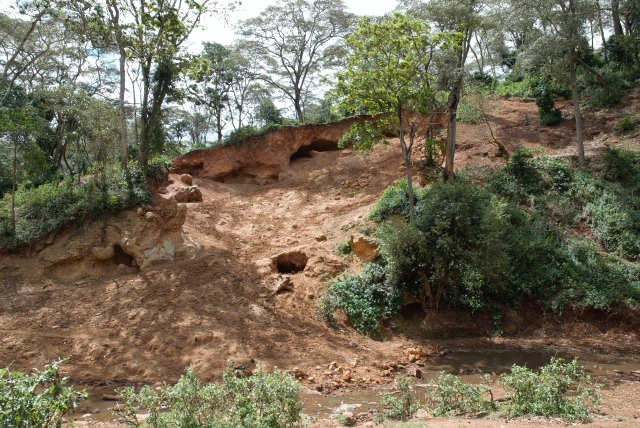
At 10:00 we meet up with Honest our guide for a hike to the elephant caves and waterfall. It is a short 2 hour hike on well-trodden paths. Quite unlike the Mt Makarot hike. We reach the caves, which aren’t really caves but are the banks of a creek. The elephants “mine” for minerals (calcium and sodium) using their tusks to loosen the rock and soil so that they may eat the rock.

We stop at a waterfall, a trickle right now but it grows in size as the rains come. We all peer over the edge looking 30M to the bottom.

We arrive back at the farm in time for the buffet lunch. The choices are endless – chicken, salads, samosas, rice, beef, noodles and breads. All delicious, except we have been in Tanzania for about 10 days and have not eaten any true Tanzanian fare.  The lodges are geared to the tastes of the North American and European tourists.

The afternoon is spent as each one of us wants. Murray walks outside the farm gates, L&R walk the vegetable garden and I lounge on the porch and then take pictures of the flora.

We end the day again on the porch watching the darkening sky over the valley.

Posted in Tanzania and Botswana | Tagged , | Leave a comment

Back to our Roots

Last night we arrived at the camp early, our dinner mates arrived late with tales of a mother leopard and two cubs within ½ kilometer of our camp and a huge herd of wildebeest even closer. Early this morning, 5 am or so, there is a lot of commotion in the herd and the noise is audible where we stay.

Today is a sad day, we are to leave the animals behind and spend a day or two lounging about. We have a long way to go so it we don’t loll too much. The Toyota is loaded and we are on the move. We round the first corner out of the camp and next to the side of the road is a male lion with his head completely concealed within the carcass of a wildebeest. One other Landcruiser is present and the 8 of us tourist types are completely enwrapped by the spectacle. I take my day’s quota of pictures in the first ½ hour of the our adventure.

The lion works very hard to eat what is remaining of its prey. Not particularly interested in appearances he had blood all over his face and mane but doesn’t seem to care, even though he is  continually photographed. He soon stands up, bites into the scruff of the dead animal’s neck and drags it a ways.  Again the cameras are recording every step. A sight that we were not sure we would be able to watch but we do and it is fascinating.

Twenty meters beyond 3 jackals are having their breakfast feasting on the remains of another wildebeest that did not make the natural selection long straw. Behind us close enough for pictures are a female and another male lion. With the spectacle in front of us neither of these other two photo ops are garnering any attention from any of the tourists.

As Pascal puts the 4WD into gear and we start to drive away we realize that the word has gone over the CB radio, there is a stream of vehicles heading to watch a lion eat a fairly protein rich breakfast. We had a semi private showing; luck plays such a big part of what we see on safari and we have had it in spades.

We have a dead line of 11am to be out of the park so our drive is mostly that, a drive. We do make a couple of stops to take pictures of gazelles and zebras much to the surprise of Pascal who comments “What are you guys – new comers?” Most of the tourists are Zebraed out by the third or fourth day and do not request a stop to see more, but R, L, Debbie and I are not most and we see the opportunity to ogle the beasts one more time, for when we return home we will only have pictures and memories.

Impala

Impala

Leaving the gate is sad. We had a good time it is amazing to be here and see live what we had seen on Walt Disney and other such TV programs when we were kids.

Oldupai Gorge

Oldupai Gorge

Next stop is the birth place of man, the Oldupai Gorge. First part of the lesson, the German fellow that first came to the area was an entomologist not an archeologist and although he knew he had stumbled on something big his interpretation of what he found was somewhat off the mark. First he didn’t quite get the name of the area correct and published it as the Olduvai Gorge. Since ancient times the Maasai have called it Oldupai Gorge, after a plant that grows in the area, and with the slip of one letter the world came to know the place as vai not pai. There has been an attempt to make the correction but it has not caught on and the world still lives with the slip of the pen made 100 years ago.

A slight deviation from the main road and we are on the door step of the Oldupai Gorge Museum. A small place but just the right size to keep up one’s interest. Most impressive to me was the casts of the foot prints made in the soil 3.6 million years ago. They look like what you yourself might make in the wet sand on the beach.

There is a short lecture that goes with the museum entrance fee. The presenter tell us of the various layers of sediment found in the gorge, what time they were formed and what was discovered in each layer. Giving us a short history lesson on when mankind started to make tools, when they vacated the region for a while because the environment became inhospitable and when they returned being able to walk upright all the time.

I do not feel nostalgic while I stand adjacent to the area where my ancient relatives once roamed but it is interesting to know that our roots run so deep.


Posted in Tanzania and Botswana | Tagged , , | 2 Comments

Random Thoughts

Birds

There are so many birds here. Bland black and white ones with a 6 song repertoire, colorful orange and blue one, big ones, small ones, fast ones, slow ones, ground bound ones and ones that soar with the clouds. Some even try to steal Debbie’s chicken right out of her hands. They all, of course, have their individual calls, and they are so different from the ones we know. Some of the calls are very complicated, quite long with a wide variety of notes. They start singing at 5 am as soon as the light breaks the horizon and are quiet by 6 pm when the sun sets.

Heat

It is hot here in the Serengeti. Hot, every day. 30 C or more, but we are actually quite comfortable. The air is quite dry so the heat is similar to the prairies. There is also a fairly constant breeze which has a great cooling effect. Again, similar to home. Today the breeze abated and the heat was much more noticeable, but still bearable.

Garbage

The national parks and conservation areas are spotless. I have seen 1, exactly ONE, plastic bottle on the road. No garbage in the ditch and nothing at any of the picnic sites. Even in Arusha, a small city, there is not much garbage on the streets. If all of Tanzania is like this, it is an impressive accomplishment.

Bugs

OMG. There are bugs here. Imagine any bug and you can find it here. This morning, I played with a mini grasshopper about the size of a dime. I touch its back knee and it jumps across the breakfast table. I couldn’t begin to describe the kinds of bugs we have run into but spiders, tse tse flies, flies, beetles, flying bugs, crawling bugs and maybe THREE mosquitos are but a few. Malaria? I’m sure the numbers of mosquitos can be bad, but right now I do not know why we spent hundreds of dollars on malaria meds. My cynical self wonders how much input the drug companies have in recommending what areas require prophylactics and what areas don’t. The ordinary house flies here are terrible. They get worse as the migration brings more animals to the area. A sweep of the hand does not seem to be a threat to them. They pester and pester and pester. Flies here need to take lessons from their North American cousins.

Facilities

The facilities here are world class. There have been a couple of questionable washrooms but that is the case anywhere in the world. The tourist info centers, although simple, are well constructed, maintained and informative. The lodges and camps are well located yet unobtrusive and are not visible until you are upon them. All but the fussiest people can travel here and feel comfortable.

Sounds

Africa is a whole new symphony to our ears. The cars in the city do not use their horns incessantly as they do in Asia. Except for the sounds of the auto, the city is quite quiet.

The wilderness is a whole different world. I can ski up to the top of a mountain in Banff National Park and still hear the sounds of the highway thousands of meters below. Here when our Landcruisers engine is shut off there is no noise but the wind. In the day the animals are quiet, even the birds stop tweeting. We have heard grunting sounds from the elephants. Within a gigantic herd of wildebeests, we listen to snorts.

The hippos blow bubbles while breathing and grumble about this or that.

But most of the time the animals are silent. Mornings and evenings, the birds sing and the landscape comes alive with sound. Quite peaceful, really.

Sun

We are near the equator so the sun is intense. We climb to 3,000M on Mt. Makarot and even though I am quite tanned, my arms are pink. Debbie has sunscreen on but her nose, cheeks and throat have a slight glow.

People

I cannot get over the people here. I know I am a tourist and by default a guest (wanted or unwanted) but everyone is polite, helpful and happy. There are bad people everywhere and I hope I am not being lulled into a sense of security, but the folks here are great. The four of us have come to a consensus that the Tanzanians are kind. It is the best word we can come up with, but it is an accurate one.

Migration

Four animals take part in the great migration – wildebeests, elands, zebras and Thompson Gazelles.

It starts moving south during the short rains (Nov, Dec) and goes north after the long rains in June. Today (Nov 14) we drive though a herd of wildebeests and zebra. It is massive, there are animals 50 deep and a kilometer long. This group is the leading edge of the migration and is small. Parked mid herd listening to the snorting and baying with the ground all around us moving with the animals is something to remember.

Kopje

Kopjes are outcroppings of solidified lava. The molten rock bubbled up during times of volcanic activity. The entire area was covered with ash and soil over time. The soft layers eroded away leaving the flat Serengeti landscape dotted with little bumps, kopje.

Flora

For all the fauna we see and learn about, the flora side of the scale is a little lacking in the Serengeti. We now know about the acacia tree. You would call it an umbrella tree. There are 13 types of acacia trees and 7 types of acacia bushes. I think it is a symbol of Tanzania, if not Africa. Every so often we spot a flower sitting alone on the plain. It is called a crinum lily and is my favorite.

Posted in Tanzania and Botswana | Tagged , , | Leave a comment

Serengeti

We sit on our low balcony at the Olduvai Lodge looking out over the Serengeti and it is peaceful and beautiful. Two Thompson Gazelles wander within binocular range, they are a joy to watch. Petite, light on their feet and playful.We leave the Olduvai Lodge reluctantly but excited to go further into the Serengeti.

The Serengeti is dry and dusty. Whenever we cross paths with another vehicle, I call out “Truck!” and we all close our windows. The dust gets everywhere regardless.

After passing through the official gate, Pascal takes us to a known watering hole and we find five lionesses lolling by the water trying to sleep and stay cool. They are aware of each vehicle that arrives, but are not too bothered by them. We watch one and how heavily she is panting in order to stay cool. Lions sometimes go 7 days between killing and eating, the time spent mostly just laying around.

We spot two cheetahs in the low brush. Brothers. Male cheetahs are usually solitary, but two brothers will choose to stay together after they become adults. The wildebeests nearby are nervous and eventually move away.

It is a day for cats as we come across a tree that contains a leopard and the two gazelles that she has recently killed. Leopards will kill 2, 3 or maybe even 4 animals and only eat 1. They kill to kill, a hunter’s instinct. The leopard is hard to see high up in the tree but with binoculars we all find her and watch and wait. She stays in the tree and we eventually move on.

Soon after watching the leopard R realizes that one of the tires, the same one that went flat the other day, is flat again. Pascal hops out to check and confirms that it is flat, the tire fix he got apparently is not a very good one. We drive to a level spot slightly off the road and Pascal starts to change the tire. We are told to stay in the truck. Unfortunately, the jack will not lift the vehicle up with all of us and our luggage in it, so we climb out with strict instructions to stay right beside the vehicle. I think to myself, here we are standing in the Serengeti with a leopard not that far away looking down upon us! We should try not to look too tasty. Pascal gets the tire changed, we hop back in and are on our way.

We see more than just cats and are still enamored with mongoose, warthogs and all living beings on the Serengeti.

We end the day at the Kati Kati tented camp. More rustic than last night but charming in its own way with metal bed frames, wooden furniture, a campfire and delicious food.

Posted in Tanzania and Botswana | Tagged , , | 1 Comment

Mt. Makarot

It is 6:30am and a rap on the side of the dome tent we are sleeping in is our wake up call. We must get an early start in case (1) it rains, we want to get as far as possible before it does or (2) we are slow going up or down.

Breakfast is a real camping breakfast, only with a cook in a white chef’s coat. Eggs, croissants, PB, jam, fruit. We sort through the packed lunch and discard what we won’t eat, no use lugging it up the mountain and down again.

The local crew doesn’t seem to panic about time yet today our hiking guide and Pascel, our safari guide want us to jump to so we get more time to walk in the cool morning.

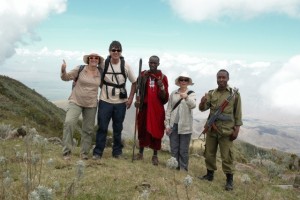
Up we go. Pole, Pole. Quite a steep climb. The pace is good. Sumati, our Maasai hiking guide leads. He stops every 500 meters or so for everyone to bunch up. Toumani, our ranger with a semi-automatic rifle, brings up the rear. We parade up the mountain single file high stepping to avoid the cow poop.

We all chat as we ascend; we learn about the ways of the Maasai and Chunga (Toumani’s people) and they about Canada and Canadians. Cresting what appears from the bottom to be the peak, we see the real peak not far but still up. Between us and our goal is a stretch of forest. Sumati says to be quiet as there are many animals here. So now the column is silent.

There are no trails except the cow tracks in the grassy areas and wild animal trails in the forests. That’s what we follow. All along the path are signs of cape buffalo having just passed by. Runny poop, some of it steaming.

Sumati spots a buffalo or two a few meters (like 100M) away. We watch them stumble through the forest. He hears several more go romping into the dense trees. They must have sensed us and got spooked. Toumani jumps into action. Unlocks his gun and walks on alert between us and where we spotted the beasts. He is all about caution and maybe a bit of drama as I do not think the animals are much of a threat.
On the peak of Mt Makarot

On the peak of Mt Makarot

This hike we are on is 15 km, a long way at the best of time but this walk is really taking its toll. The first 2 km is up and quite steep, the next 3 are down and also quite steep, then comes the hard part, 10 km of undulating terrain with negative elevation gain, a good portion of which is on fist size rolling rocks. Foot placement is all important. Debbie and L are having a difficult time of it.

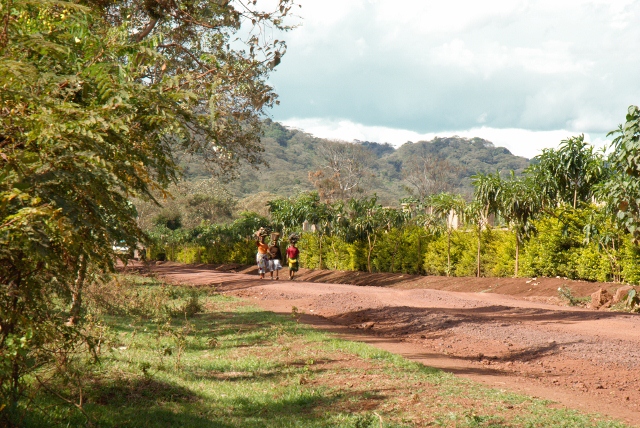
At the foot of the mountain we connect to “The Road of Cows” (I think this is a generic name not specific to the road on which we trod). The road leads us to a cluster of Maasai villages.

Each enclosure is a “village”. It houses a family unit. It would be more like an acreage or yard to us westerners. The cluster of villages are the homes of relatives and others, and would be more like what in the west would be considered a village.

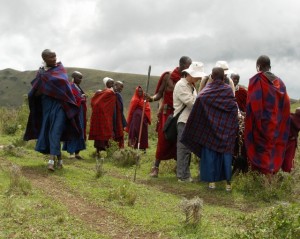
As we arrive at each village we are greeted by the inhabitants. Mostly women, the men are off tending the animals, and a few children, the ones not in school. They show us handicrafts they have been making to adorn themselves and family and to sell to the occasional tourist that happens by this area.

Debbie and L commit to purchasing a trinket or 2 from one the villages. We stop and are immediately surrounded by women selling their beaded goods. L and Debbie choose a couple of items each, bargain a little and walk away with beads on their wrist. The sales technique is somewhat different here. Only one or two of the women do the selling. The merchandise is provided by all in the village. Money made is communal funds and is put towards beads and supplies to create more jewellery.
Shopping at the Maasai village

Shopping at the Maasai village

The men and boys of the villages spend the days tending livestock – cows, sheep, goats and donkeys. Each day the animals are taken from the stockade to graze nearby and each evening they are gathered and ushered home to the protection of the village corral. The livestock is not only the source of food for the Maasai (the Maasai do not hunt nor eat wild meat) but are a form of currency, used to purchase fruit, vegetables and grains and for such things are dowry.

Passing through this area I feel it is a unique part of Africa that most tourists do not get to see. It maintains a traditional lifestyle not affected a great deal by modern life.

With 8 of the 15 km remaining, we leave the villages behind and start a long descending trail to the plains on the Serengeti. The going is tough with the rolling rocks. Fatigue is setting in and concentration is not as sharp as it was 4 hrs. ago. We are not as careful about avoiding the animal dung as we were when we started out.

We are all fatigued, R, L and Debbie are showing signs of a long day, but I am managing to hide them. Toumani must be impressed; he asks me if I am a soldier. I’m puzzled and say no and ask why? He says I am still looking strong and we have come a long way.

Getting on to 9.5 hrs. since we started out, we reach the rendezvous with Pascel and our ride to the next hotel. Before we climb in to the Landcruiser I locate my stash of pop and offer all the walkers a can. Coca Cola for everyone!

The Olduvai Lodge is our destination. NICE place, very NICE. Located in a small caldera and not another place in sight. It is remote. It is also the nicest place we have stayed. It is a tented lodge which means the rooms are surveyors’ tents, but this one is luxury, high class beds and furnishings with an open air ensuite at the rear that is sculpted from concrete and sheltered by a thatched roof.
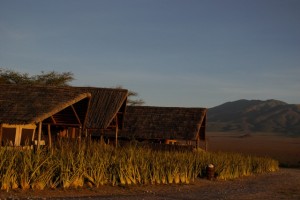
Olduvai Lodge

Olduvai Lodge

It only took 15 km to go from roughing it in the wilderness to settling in in the lap of luxury.


Posted in Tanzania and Botswana | Tagged , , , | Leave a comment