It’s pouring rain when we get up. The forecast says it should stop around 9:00 or 10:00. By the time we are ready to go, it has miraculously stopped raining. The heavy duty rain gear stays in the pannier. We manage to stay dry and warm all day long.
Leaving the hotel vicinity is easy. We are using Komoot as a navigation app. The female voice instructs us to turn right here and left there. We have to get used to her instructions and how the bike paths work as a couple of times her saying turn right here, then left then right, confuses Murray (who is leading), and we have to stop, turn around and try again. By the end of the day’s ride, he has it figured out with a combo of voice instruction, blue line on the map and bike path reality.
The bike paths are mostly red in colour. The pedestrian path is pavement colour so there is a separation. There is usually a hedge or curb separating the road, and cars, and the bike path. Occasionally the bike path is a shoulder of the road with a dashed line as the separator.
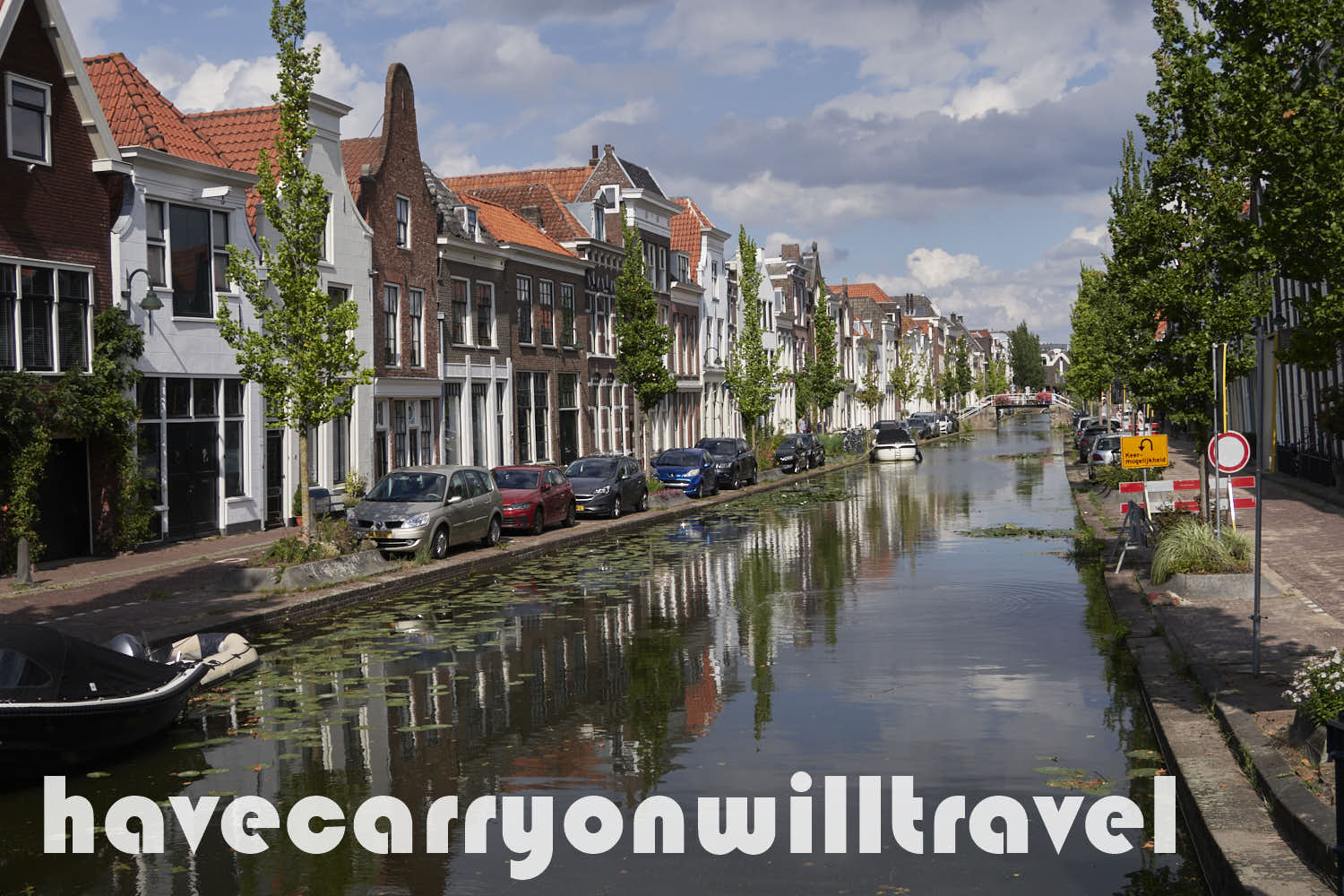
We wiggle waggle through residential, light industrial and farm areas. There are canals everywhere. Sometimes with ducks or geese, a few swans and one heron(!) floating on or standing in the water. A town called Woerden is our lunch stop. We park ourselves on a bench next to what happens to be a church. Next thing we know we are chatting with a local woman, then her kids and then her husband. The best kind of lunch stop.
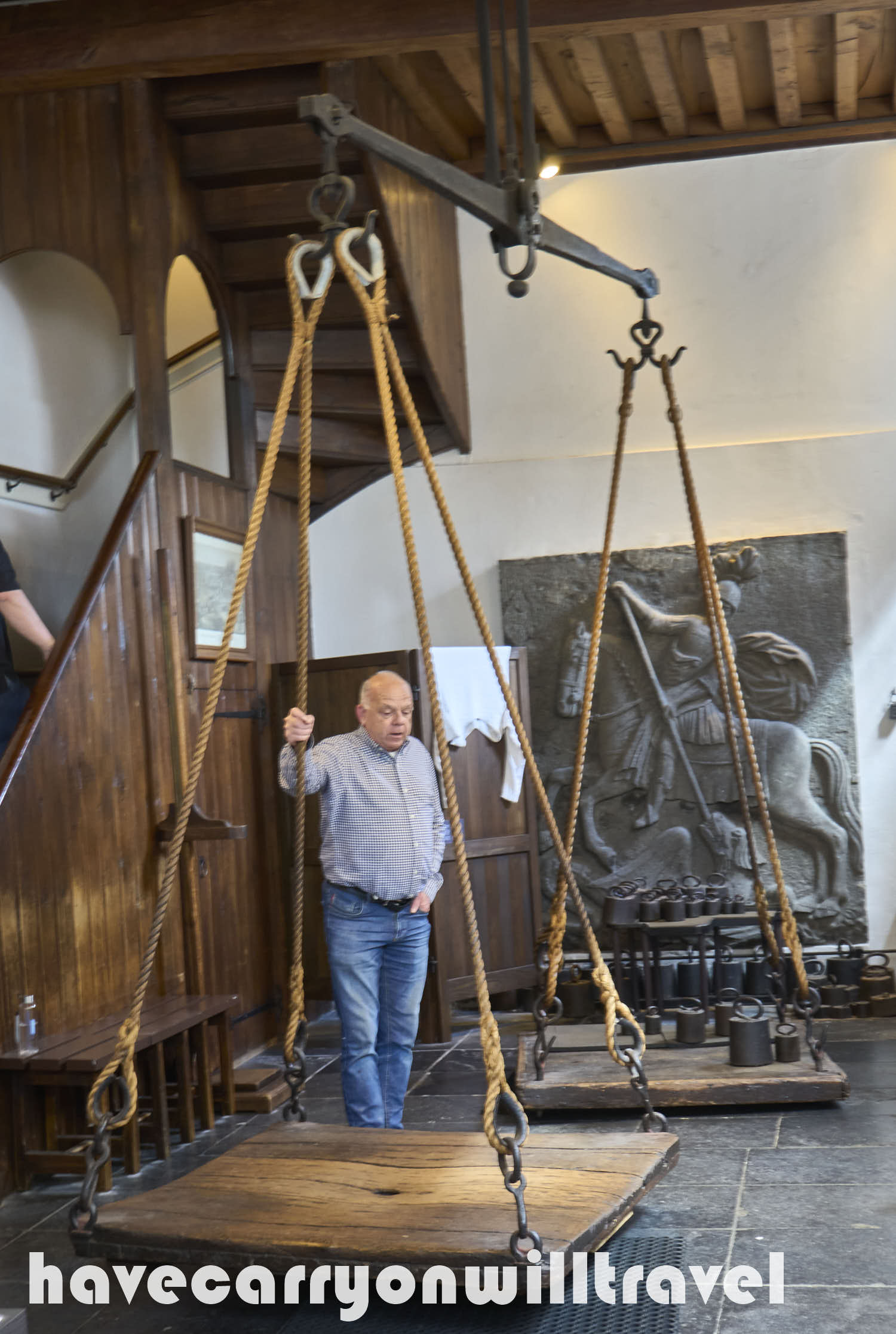
Our next stop is Oudewater where there is a witch weighing museum. Apparently, if you were accused of being a witch, you could get weighed and if your weight was within a “normal” range, you were declared not a witch. Luckily, neither Murray or I are witches, and I have a certificate to prove it!
Witch weigh scale
From Oudewater to Gouda is only 15 km. Lesson learned today…..make sure Murray’s phone is 100% charged in the morning. We pulled up to the hotel with only 3% battery left on his phone. Phew!
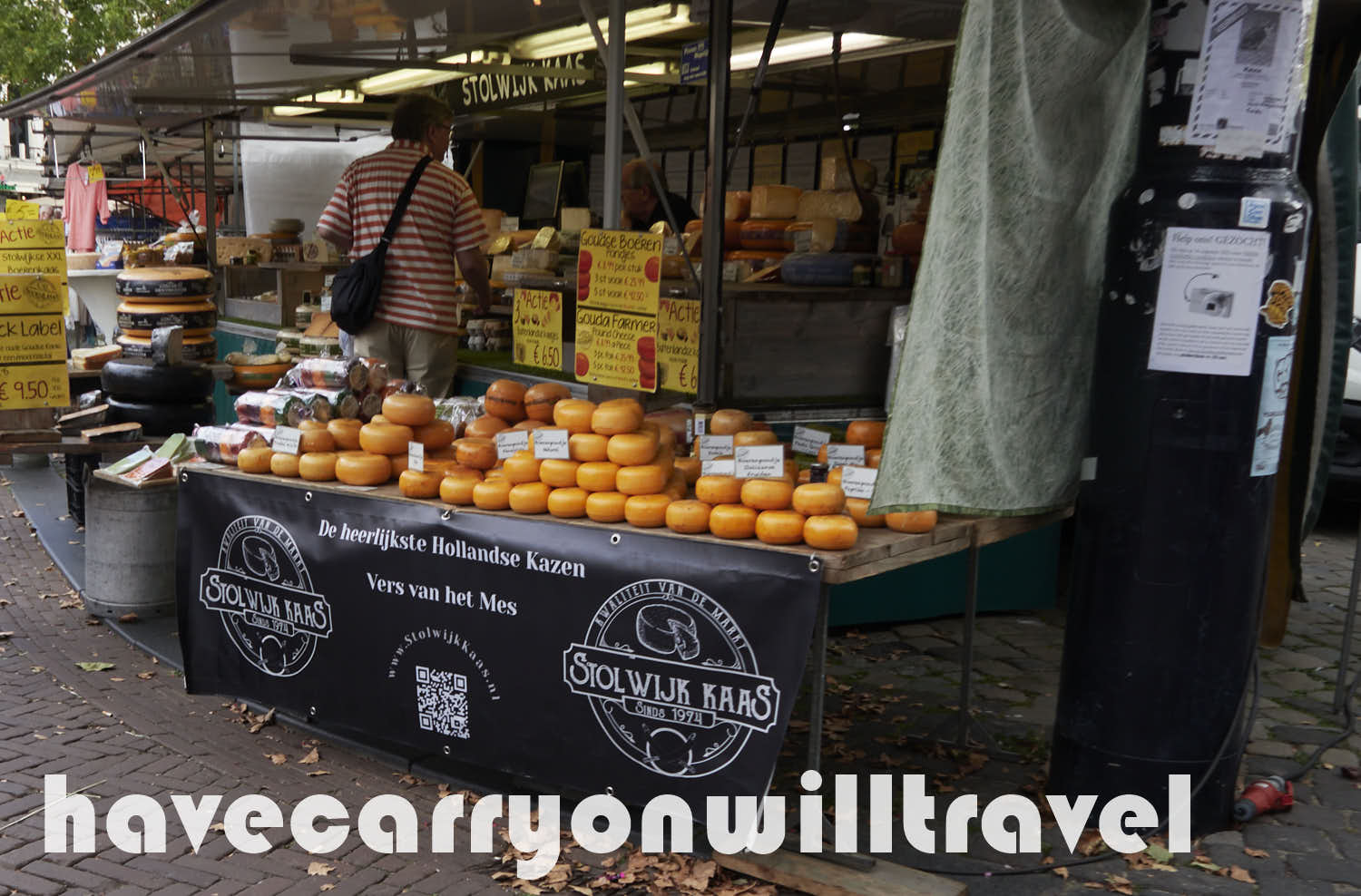
After checking into our hotel, parking and locking the bikes and showering, we go for a walk in Gouda. It is Saturday, the market is in full swing and there are people everywhere. The market sells fruits, veggies, meats, purses, clothes and, yes, cheese!
Gouda’s Saturday Market
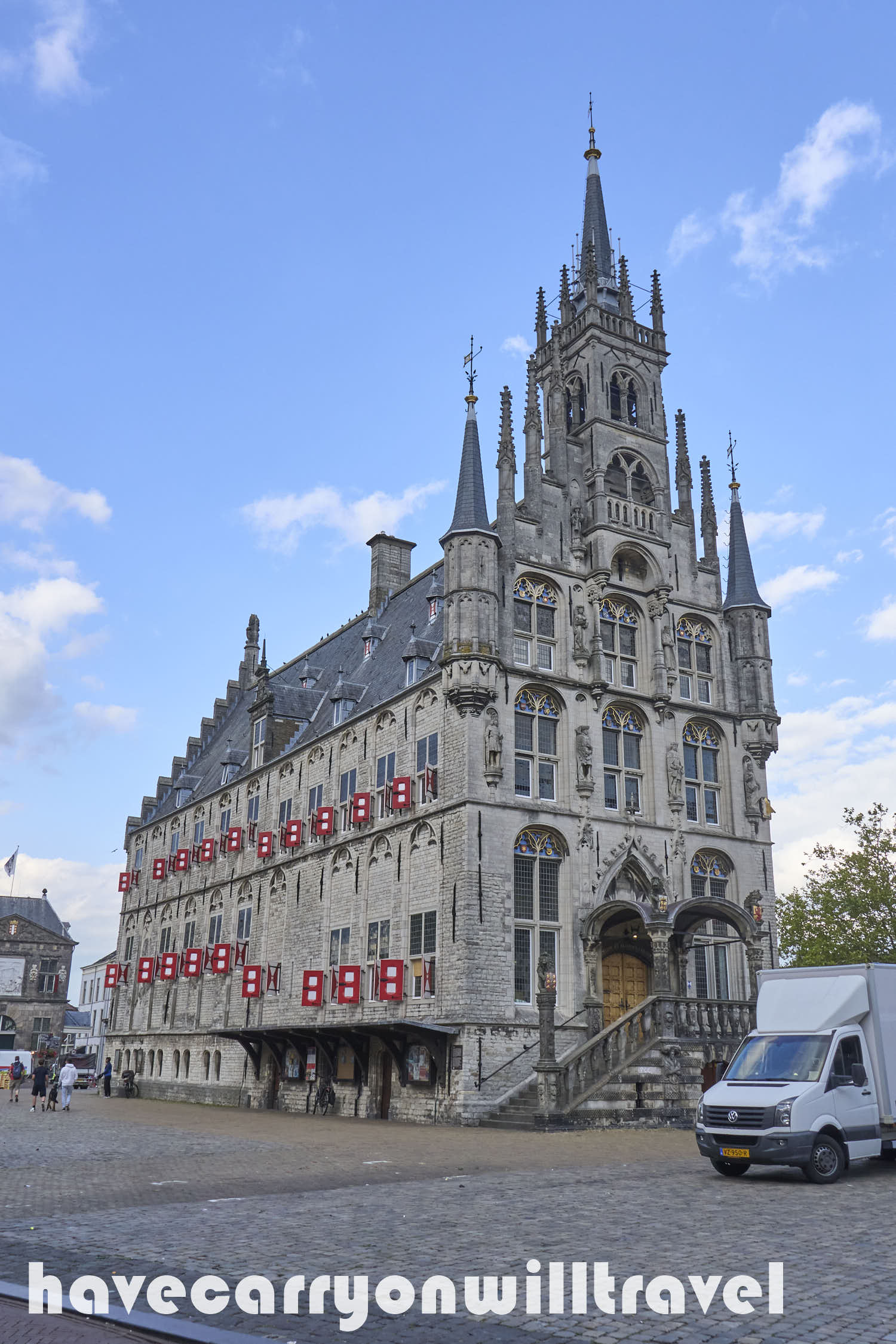
Every larger town has a Stadhuis, or town hall. Gouda’s is quite impressive.
Stadhuis in Gouda
Supper is Thai. By the time we exit the restaurant, the market is shut down and the streets are quiet. Gouda is a lovely town full of unique shops and sights.
We arrived in Amsterdam yesterday morning, shuttled to the hotel, put bikes together, unpacked two suitcases into our numerous pannier piles, ate supper and collapsed.
Slept in this morning as our internal clocks are still in MDT. We have chores to do today so we force ourselves out of bed and get to it.
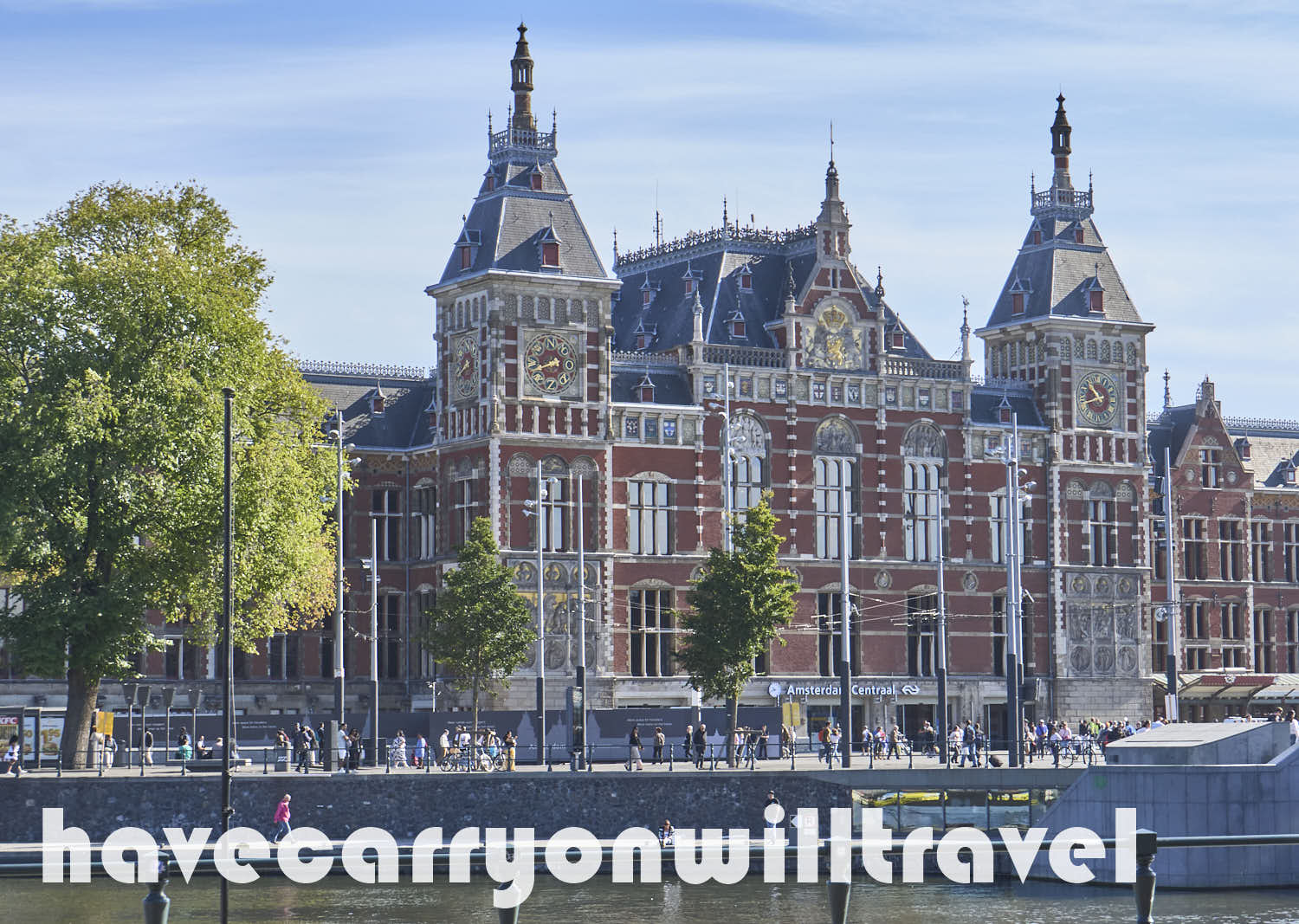
Amsterdam Central Station
A shuttle ride and then a train ride takes us to the Amsterdam Central Train Station. We walk down Rokin Street looking for a Vodofone shop, to buy SIM cards, and a Geldmaat ATM to get some cash. After a some blocks and a few wrong turns we find both.
We line our panniers with plastic bags in case of torrential rain. I inadvertently only brought four bags instead of eight, so our third chore is to find a super market large enough to sell plastic garbage bags. This is the hardest chore to accomplish. We have 7-Eleven stores at home. In Amsterdam there are Albert Heijn stores, selling mostly quick prep meals or ready to eat items. It reminded me of the stores in Japan that sold similar items. We finally are directed to a larger Albert Heijn shop and find what we need.
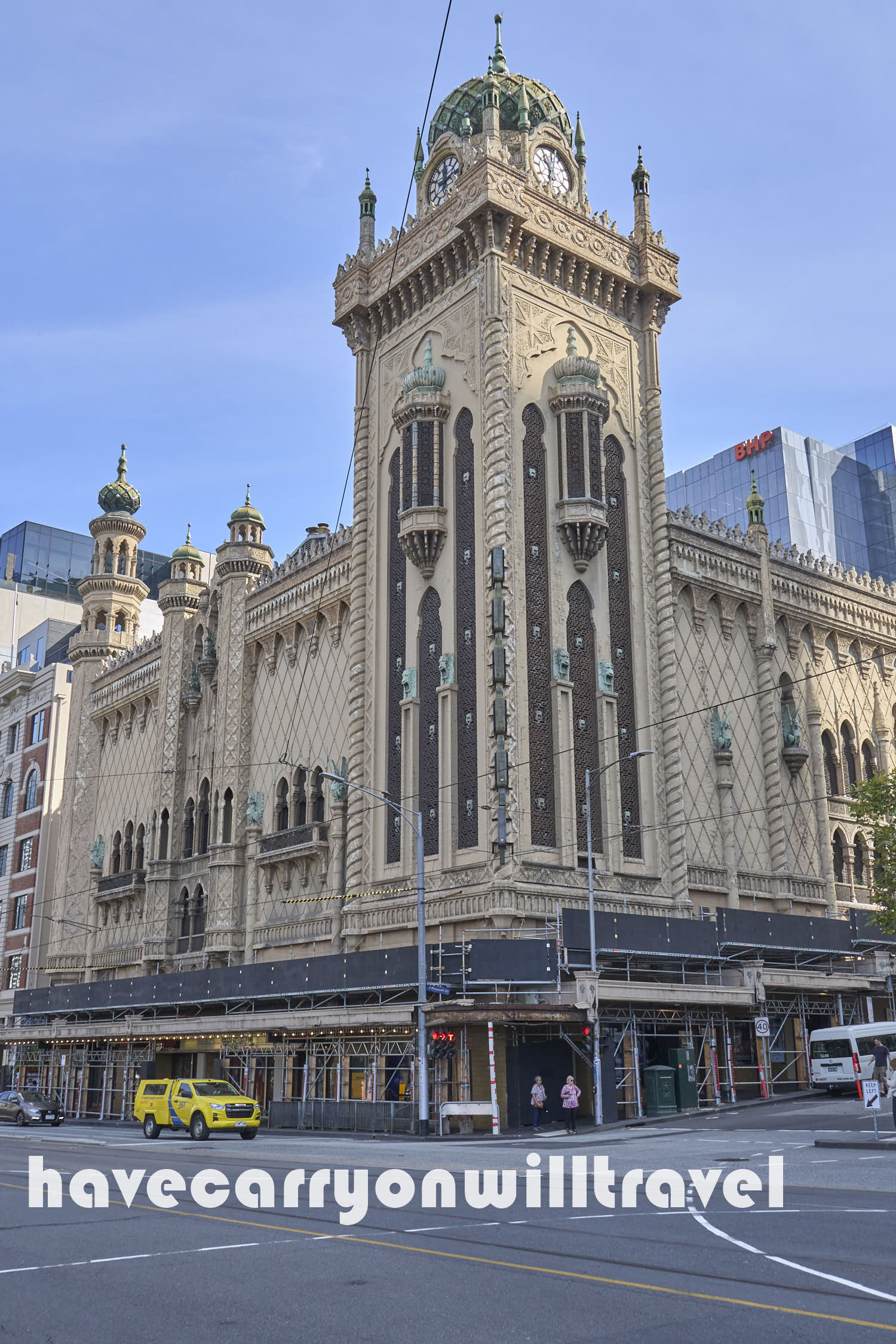
Tushinski Theatre in Art Deco
With our chores done, we can now play tourist. We wander past an art deco theatre, stroll along canals and end up at the Stedelijk Museum, a contemporary art and design museum. I like the “old” stuff – Picasso, Mondrian, Kandinsky. The “new” stuff sometimes makes me want to discuss “What exactly is art?”
We were warned about the bicycles and to watch out for them. They are everywhere, and don’t always follow the rules, so we look both ways before crossing a bike path or road. They seem to go very fast in congested areas. All sorts ride bikes – young women in short skirts and high boots, guys in wide jeans and sneakers, old people, young people. The bikes are not fancy, mostly dark colours, sit up straight kinda bikes.
An Amsterdam Canal
Fries are very popular here. NOT French fries, just fries. Served in a paper cone with a large dollop of sauce (ketchup for me) on the top. We sample this staple and enjoy every bite. Another popular food item is waffles. Decorated, iced, served over tea. We haven’t sampled waffles yet, but it is on the list!
We are now back at the hotel, listening to it pour rain outside. We will pack the panniers tonight as tomorrow, we hop on the bikes and head to Gouda.
On this day in 2018 we were riding our bikes through Denmark. I have been rereading our posts from the Denmark bike trip as, in a few days, we are heading to The Netherlands and Belgium with our bikes. Definitely NOT Have Carry On Will Travel.
Murray has always wanted to go to Bruges, Belgium and finally decided it was time to go. “Oh, let’s ride our bikes there!” We are flying into Amsterdam, putting our bikes back together and riding on a route from Amsterdam to Gouda to Antwerp to Brussels to Ghent to Bruges to The Hague and back to Amsterdam. There are stops in small towns along the way. Our longest ride is about 64 km, our shortest is about 35 km. The most number of days of riding in a row, so far, is four. We do have some slush days to move things around, so we have some leeway.
Our first big stop is in Antwerp where we are meeting our German friend I. We will spend two full days exploring Antwerp and catching up with her. We are also spending extra days in Brussels, Bruges and The Hague. Our list of sites to see includes many art museums, as we love the old masters and modern art.
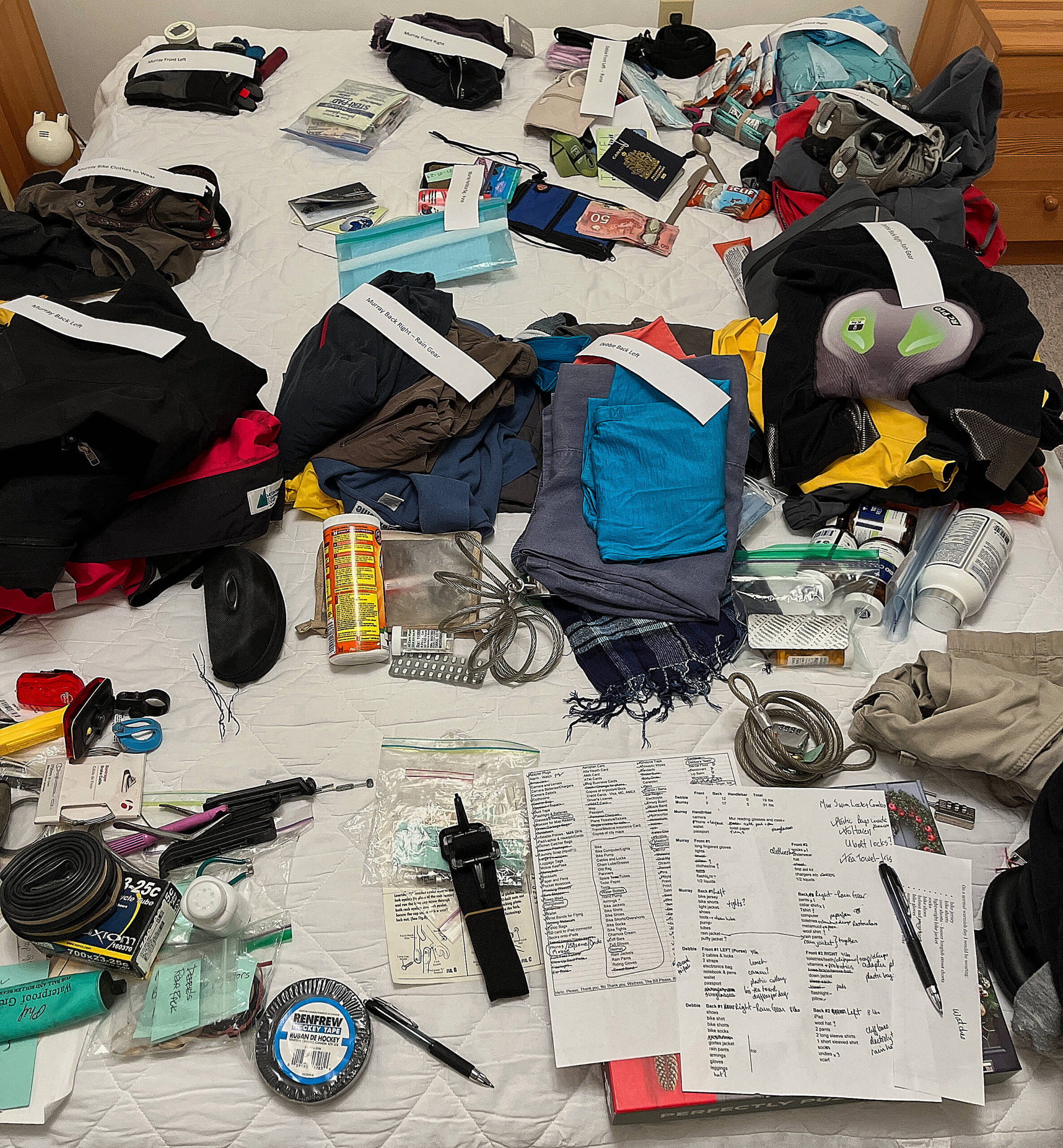
I have used the packing lists from our Denmark trip to organize for this trip. We have 7 piles downstairs, all labelled – 4 for the panniers, 1 for Murray’s handlebar bag and two piles for bikes clothes we will be wearing. Oh, and another one for airplane stuff and bike tools that will stay in Amsterdam.
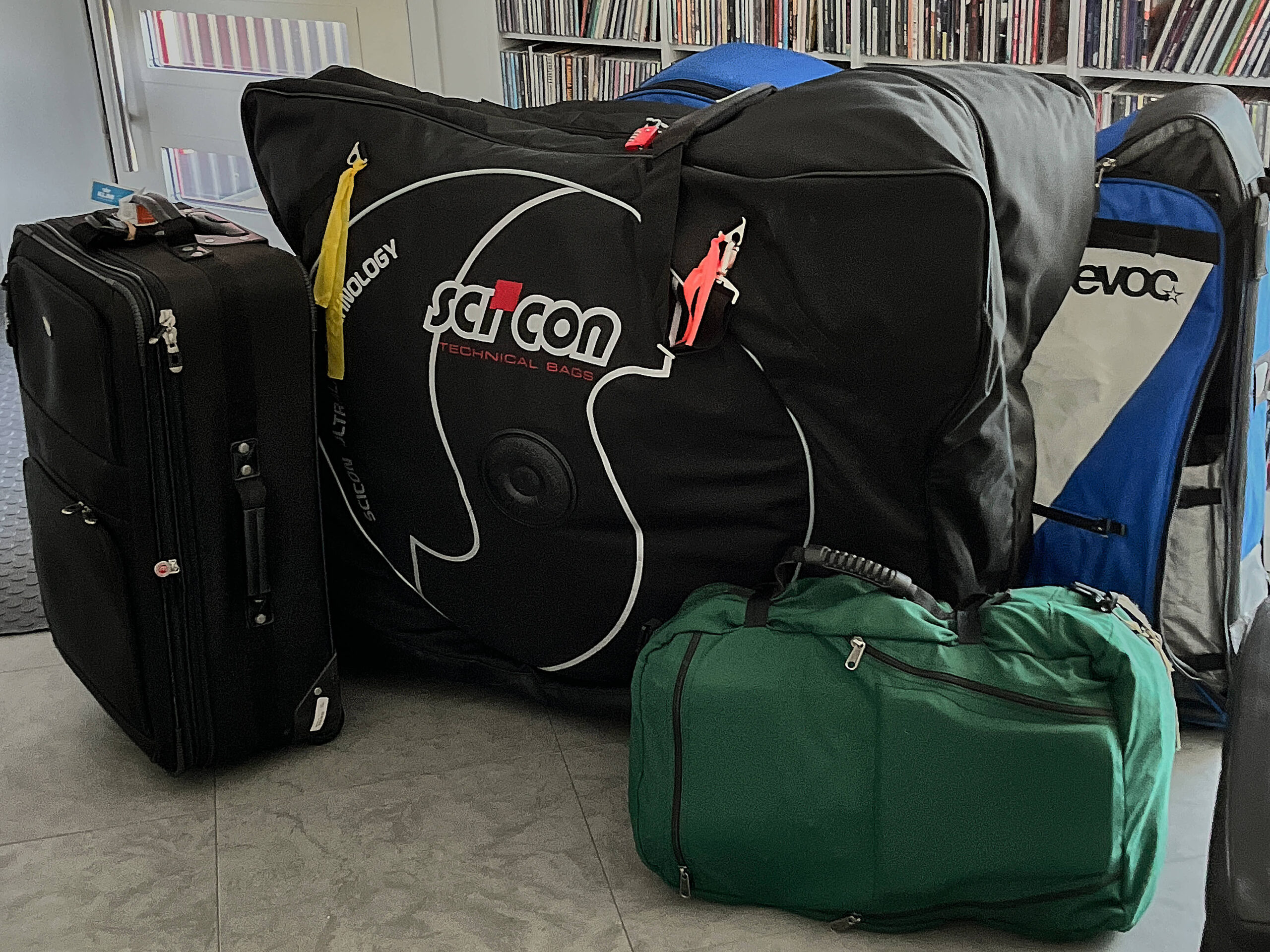
We have calculated how much weight both should be carrying and the split between front and back panniers. We test load up the panniers, weigh them, redistribute and then create a final packing list sorted by pannier. I will use this list to sort clothes and gear after we arrive in Amsterdam. It saves so much time and mental capacity. Once the list is made, we unpack everything and repack it into our suitcases, which will also carry the panniers and the bike racks.
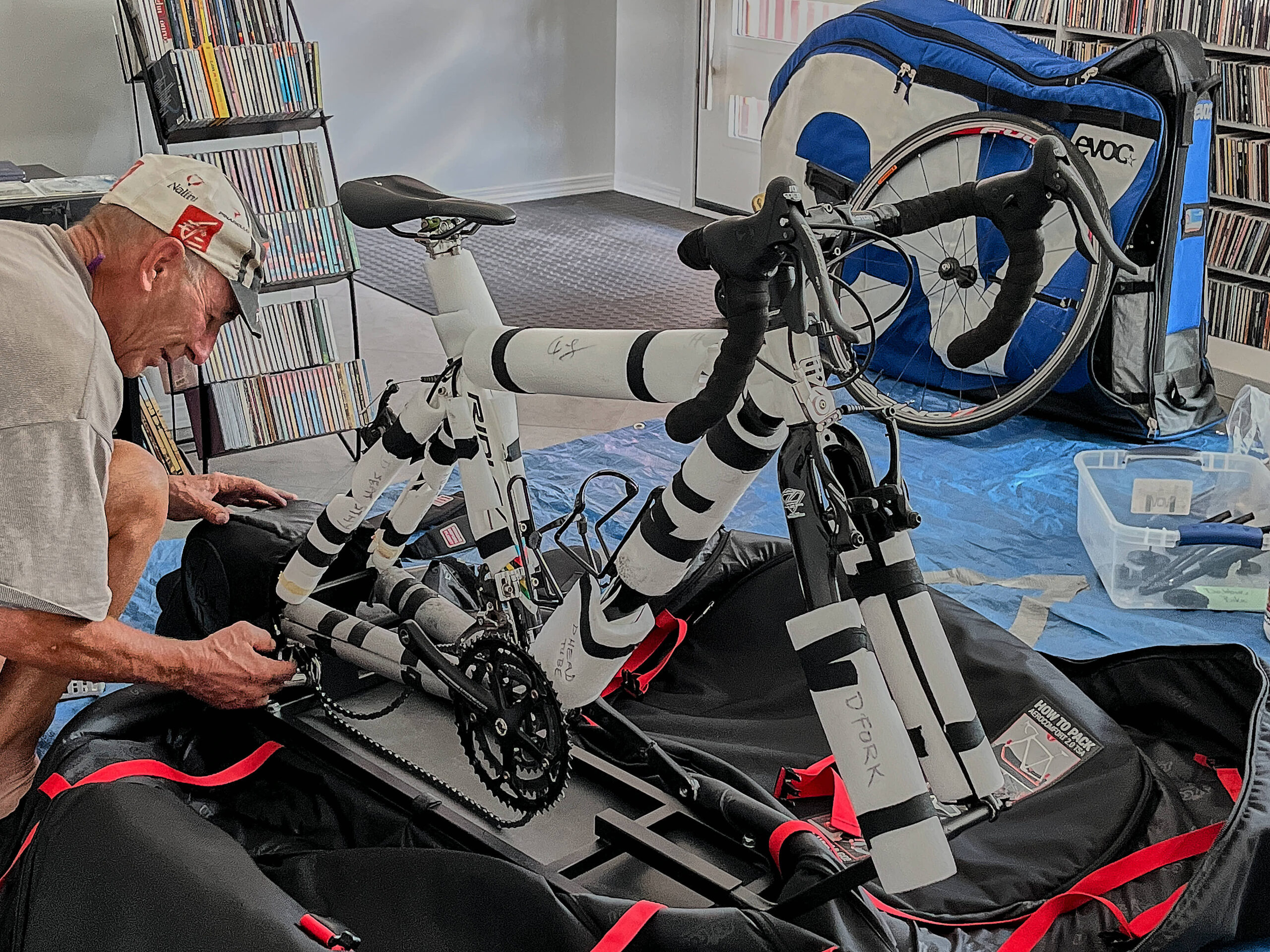
We spend an afternoon tuning, cleaning and packing the bikes.
We have packed the suitcases and are basically ready to go. Next stop….Amsterdam.
I love the Gold Coast. The weather, the vibe, the ocean and especially the beach.
Just before we left Edmonton, Gold Coast got hit by the edge of Cyclone Alfred. Our son, M, kept in touch and was preparing the house for the storm. Cleared the rain gutters, put away all the deck furniture and toys, put the garbage bins inside and caulked the windows. The authorities had requested that all residents shelter in place, so M worked from home and D and V stayed home.
When the storm hit, the winds were up to about 110 kph. The wind alternated with rain. The area around M’s house received about 600 mm of rain. Their house is on a canal and has a highish bank from the house level to the canal. The water level was up over the 4’ fence at the bottom of the hill and had crept 1/3 of the way up the hill. That’s a lot of water! Fortunately, the house sustained no damage.
Others were not so fortunate. About 66,000 properties lost power. Numerous trees that came down on property, causing damage. City parks had trees down everywhere. M told us city crews were driving around picking up garbage bins that had blown away of blown into the canals. The clean up is almost done now.
The new narrower beach
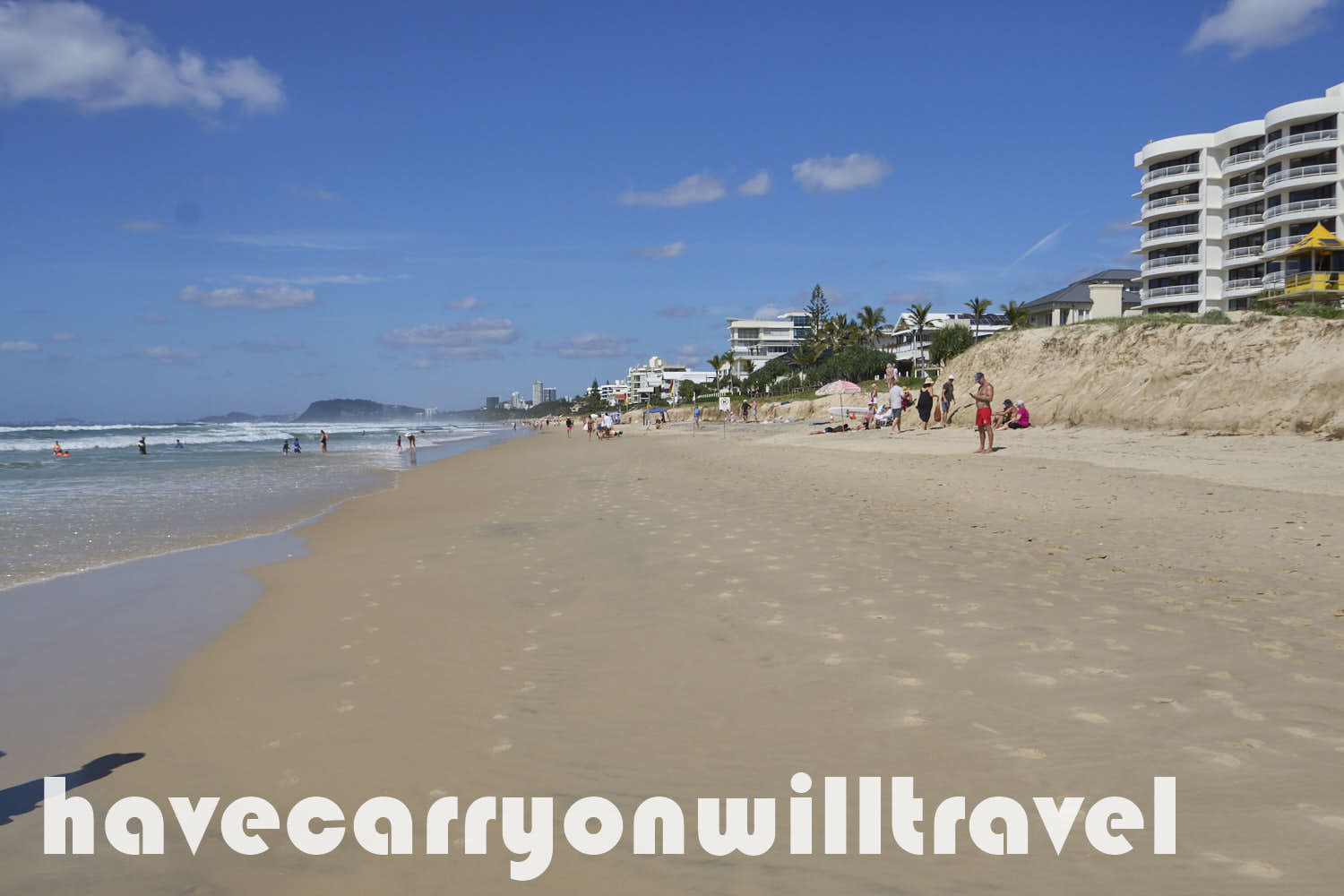
The biggest area affected by the cyclone is the beautiful beach along the coast. Before the storm, there was a headwall (dune if you like) above the beach with sand ramps down to the beach and the water. This headwall got hammered and in some spots, the drop down to the beach was 20 feet. The ramps disappeared and sand on the beach also disappeared into the ocean. It is estimated that 4.0 million cubic meters of sand was lost along the whole Gold Coast beach. What was a nice wide beach is now a narrow beach about half the width. M says the sand is sitting just off the beach, making for great waves that the surfers are enjoying. The sand will eventually get pushed back onto the beach by the waves and tides, but it will take years. A dredging company has been hired for a 6 month contract to dredge as much sand up as possible. In that time they will only be able to gather a fraction of what was displaced. Bulldozers have replaced the ramps and Gold Coasters are once again enjoying their beach lifestyle and I am able to walk the beach that I love.
The last time I was in Melbourne was in 1998. At the time I thought it had more of a ‘British’ influence than the other big cities in Australia. My impression now is it is a lot more, say, cosmopolitan. It is still an ‘arty’ city, there is just that kind of awareness.
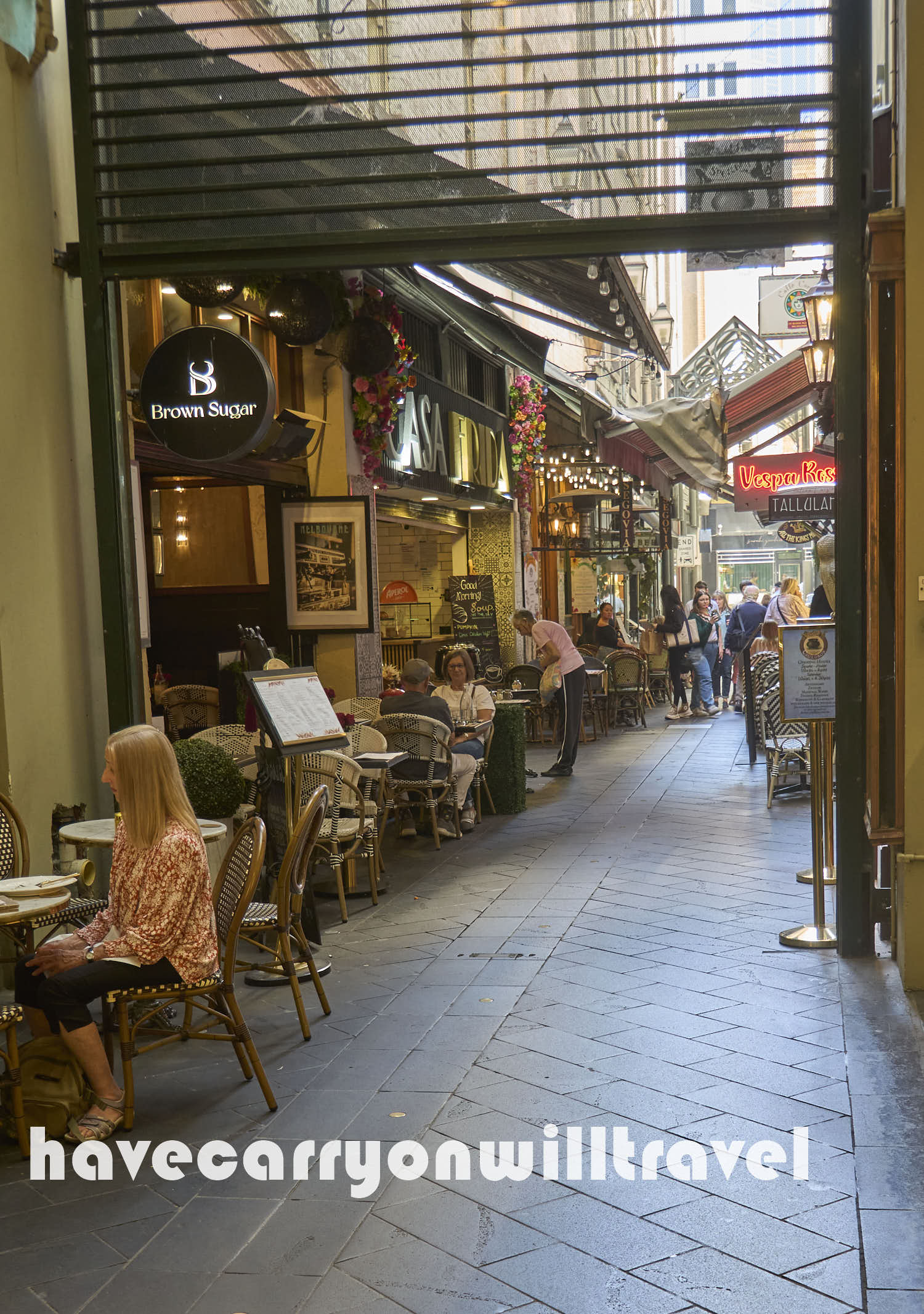
Downtown Melbourne has more than its share of restaurants. Most are tucked in an alley or on a quieter street and all have outdoor seating. Like in Europe, hosts stand where the pedestrians pass and try to lure you into their establishment. The majority of these eating establishments have a good number of folks in their seats so are at least making ends meet.
Considering its size, the traffic in Melbourne is not too bad. It seems to move and we have seen no traffic jams. For the most part the drivers obey the red lights and are polite to pedestrians. Pedestrians are in turn polite to the drivers. Generally, the people only cross at intersections and wait patiently at the curb until the little green man walk light appears. On the smaller streets, the ‘lanes’, it is OK to jay walk but on those streets the traffic is extremely light.
The days we were in the city, there were quite a few tourists. I think the fact that it was a school holiday in Victoria was the reason for the Australian tourists. There also were a good number of Asians wandering about in large groups following a guide with an obvious sign on a tall stick. A tip for those who might visit Melbourne; don’t bother with the free on/off downtown tourist tram. It is free which is enticing, but the time we got on it was so crowded we were crammed in like a Japanese train and because we were standing we could not see anything out the windows. We rode it for 2 stops and got off. We didn’t try again.
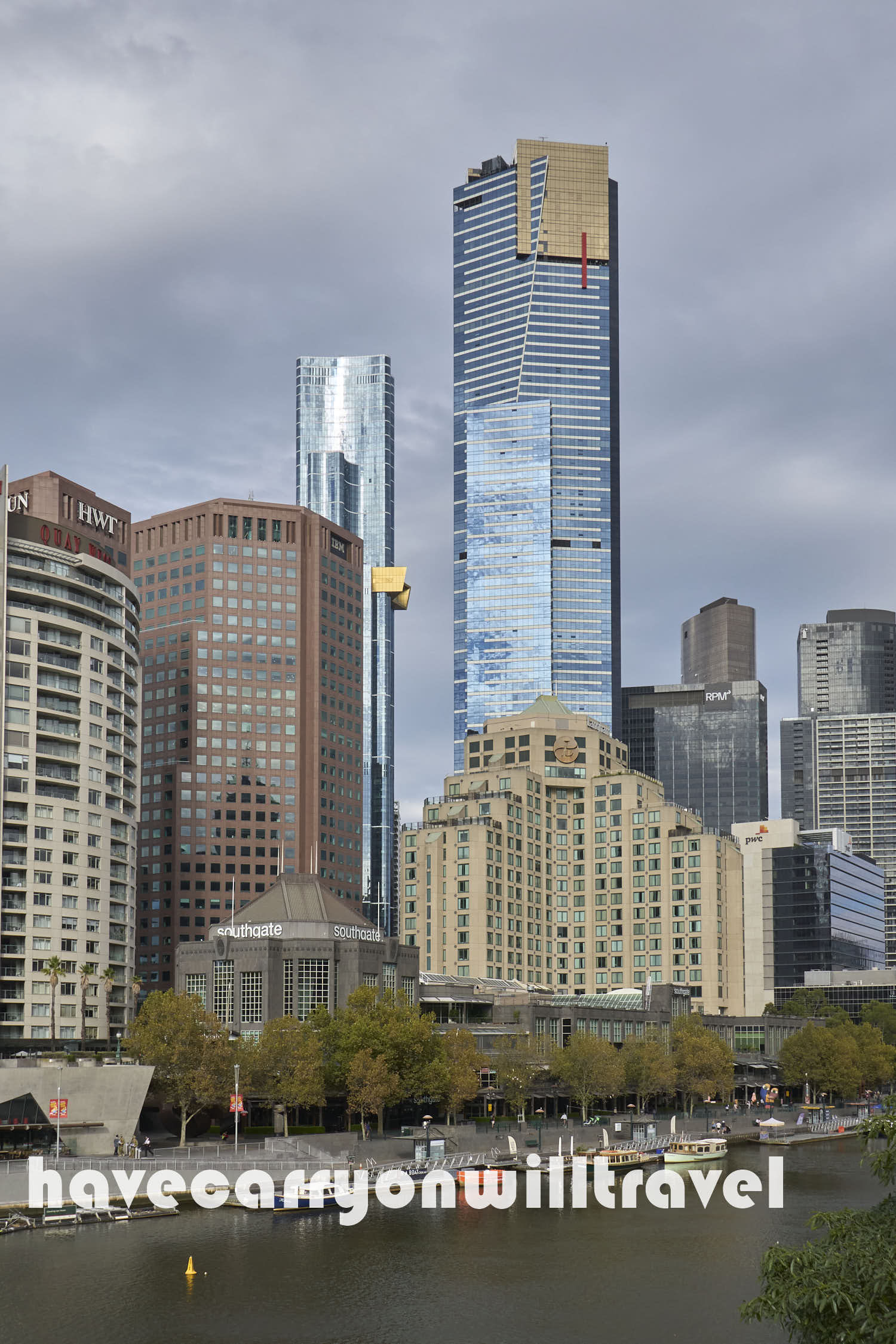
I thought it was just the Gold Coast but after walking around Melbourne I think all of Australia must be booming. There is so much construction. High rise cranes are part of the city’s fabric and visible no matter where you turn your gaze. There are workers dressed in the standard work uniform of a bight yellow jacket on every street we walk down.
Have a cursory look at the landscape and you would think Melbourne is a flat city. Although the elevation gain is not much, Debbie and I walk up and down hills most of the day. The only real flat walk is along the south shore river walk.
I’m not sure where Australians store their garbage when they are out and about, but Melbourne is a very clean city. There is no accumulation of garbage anywhere, not even in vacant lots. The odd thing is there are not many garbage cans around. I would carry an empty Coke bottle for at least 2 blocks before I could get rid of it. Recycle bins are even more rare. Sometimes the garbage buckets were paired with recycle bins but not often.
The din in the city is quite loud. It may be because of the reverb in the canyons created by all the tall buildings. Debbie and I had to use our very load outdoor voices to communicate. The loudest of all the places we encountered was the covered train platforms at the Southern Cross Station. The volume knob was turned so high instead of using the tables provided we went outside and sat on a public stairway to eat our lunch.
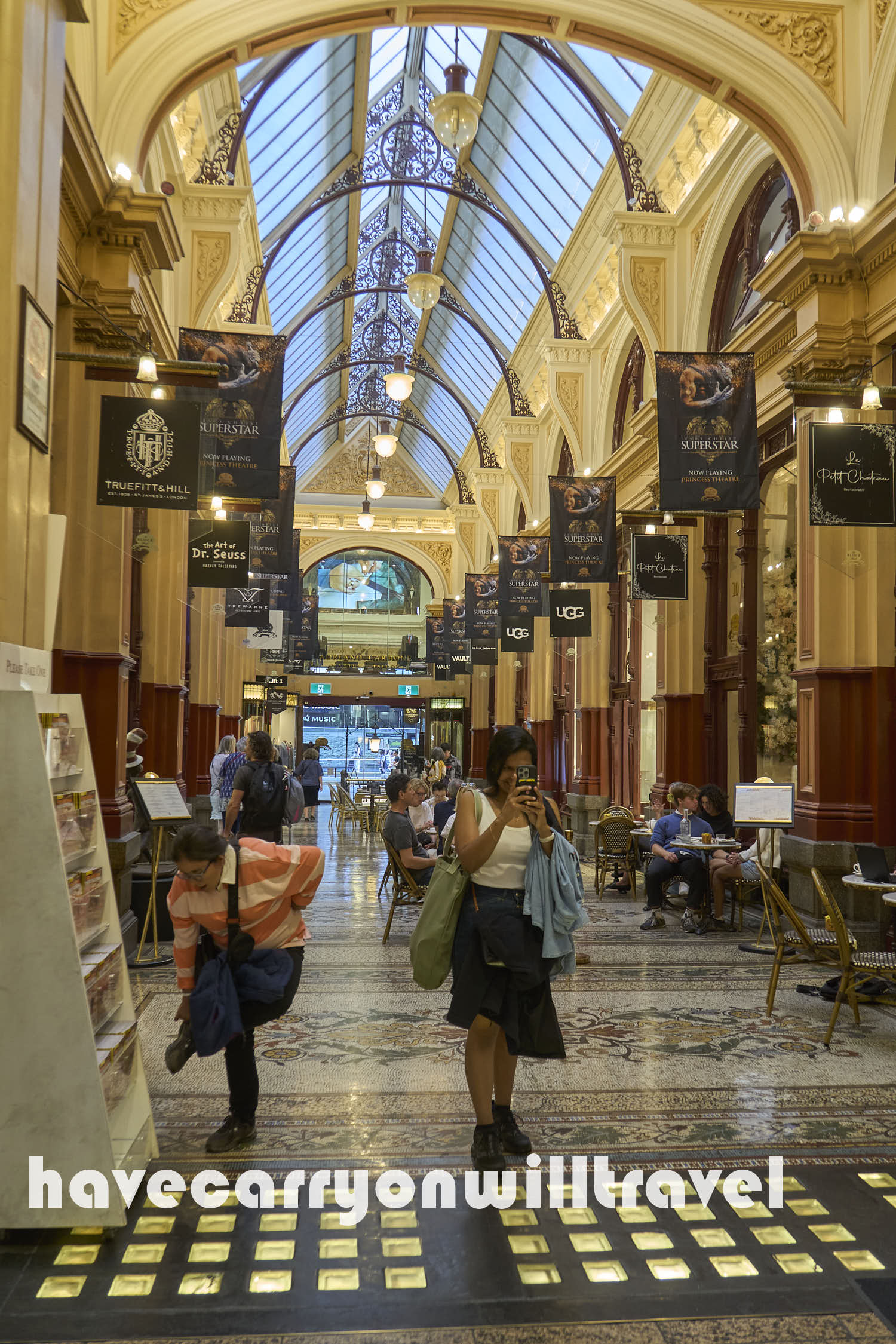
As mentioned before Melbourne respects its history and has kept a good number of its old buildings. This philosophy is also practiced when it comes to the network of streets established as the city grew. The old lanes and alleyways have been turned into boutique type retail and restaurant areas. Again, referencing our city of Edmonton those old buildings are torn down, the alleys are obliterated and the entire block is filled in with high density office and residential buildings that frankly have no character what so ever. The populating of the Melbourne alleys is not only funky but it makes those areas safe to traverse and totally fun to explore.
Melbourne has a network of bike lanes similar to Edmonton’s with dedicated lanes along the side of busy streets and some areas bikes and peds only. This is a city with rideable weather 365 days of the year and still there are not enough riders to justify the amount of city space and money spent given to those bike specific areas. I saw more bikes than at home but, sorry, neither city will become a Copenhagen or Amsterdam.
I don’t wander the downtown streets at home much so it is a little hard to make a proper comparison but there are a lot of smokers in Melbourne. It was not too surprising to see older people standing in the alleys puffing away but what was a little disturbing was the number of young ladies that were headed here or there vaping. I thought the anti smoking campaigns of the last couple of decades were effective, but I guess not.
Melbourne is a big city with all the big city characters. It sure makes for good people watching. A few times each day, Debbie and I sit on one of the street side benches and watch the world go by. Most people are within the realm of ‘normal’. But every 50th person is a bit ‘eccentric’. Some clothing is really out there. Each of the eccentric people have their own style and it is exemplified in the clothing they wear.
I don’t know how far and wide the idea spreads but at least in the South Pacific the measurement of a pizza is different than in North America. Twice on this trip we have asked a server “How big is the pizza?.” This was in two different countries. Both times the answer was 6 pieces. When I use my hands to indicate what is the diameter of the pizza they looked baffled.
Another unusual practice we encountered at the hotel is a $20 food and beverage credit just for leaving the ‘Do not make up the room’ sign on the door. We don’t find the make up of the room every day a necessity and in fact we rarely use the service. It was a nice surprise to find we would receive a rebate.
One last Kusama
I like Melbourne. It has a good vibe. I don’t know what would be the cause of the good feeling but it is there. My spidey sense didn’t tingle once and in fact I felt comfortable where we were. It is a safe and welcoming place, definitely a place to visit when in Australia.
Today is the day we go to the art show that was the underlying reason for us to hop on a plane and head to Melbourne. Yayoi Kusama has a retrospective show of her works at the National Gallery of Victoria (NGV). We think it’s smart to arrive in the morning to avoid the crowds. Approaching the entrance we note there is something special ahead. The trees are all wrapped in polka dot fabric.
Eek! We are in the door before 10am and the place is already crawling. The lobby is buzzing and there are more teasers before you enter the show itself. 1400 mirrored balls are placed in groups on the floor, reflecting the surroundings over and over and over. The line in the exhibit area moves slowly but there are no pauses. Inside it is a constant milling of people. It is busy but we are still able to see every piece hung on the wall and every installation.
Debbie writes…..Yayoi Kusama is in her nineties now. Her art career started in Japan as a young person. She eventually moved to New York and spent about 15 years there before moving back to Japan. It wasn’t until the early 2000s that she became a world wide name. Her pumpkins, with the polka dots, have always been her signature pieces, along with the infinity rooms. One of her quotes said “our earth is only one polka dot among a million stars in the cosmos”, and that really speaks to me.
The dots are of course the highlight. The first infinity room, which was on display at the Venice Biennale, has a mirror box with several pumpkin lanterns in it. A small window allowed visual access. It is the first mind blowing vision. There are several references to pumpkins. Ms Kusama found working with pumpkins therapeutic and used them in her work on and off for her entire career. There are a few more mirror rooms each with its own interest but the first and last one were the most spectacular. The last box has hanging spheres with LED lights that were reflected to infinity. The other highlight was sinuous inflatable yellow tubes with black polka dots spanning the room’s walls, also finished in yellow with black polka dots.
Most of the rest of the day we spent touring other exhibits in the NGV International and the NGV Australia. There is a good show of Impressionism on the second floor of the International gallery. Well worth the visit. There was also a good number of other famous artists display. Salvador Dali’s ‘Marilyn Monroe’s Lips’ might have been the most unusual piece. There are pieces from the Bauhaus, works by Andy Warhol, Manet, Rodin and a whole list of others. The NGV Australia did not have the outstanding pieces the International had but we enjoyed what it had to offer as well. After close to 4 hours of wandering gallery floors we were ready to set a course back to the hotel and rest. It was an anticipated day and I think it lived up to our expectations.
If you get a chance to see Yayoi Kusama’s art, set aside an hour or two and see what she has created. It’s wonderful!
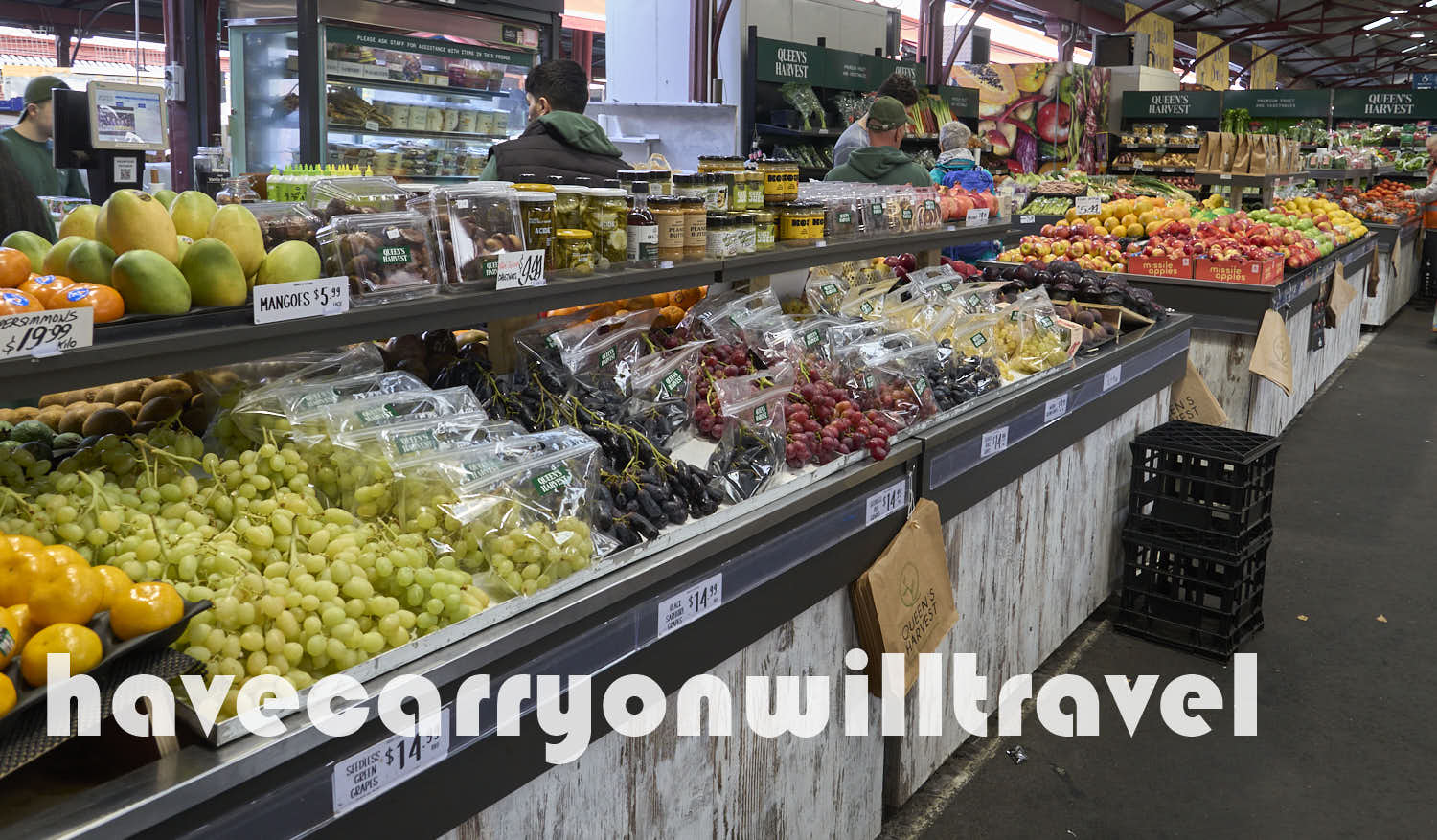
Our first stop on today’s walking tour of Melbourne is the Queen Victoria Market. The market is quite similar to markets in SE Asia. The big difference is the first world orderly layout, presentation and sanitary standards. There are so many stalls, as in SE Asia, how does a vendor make enough money to even pay the rent on the stall, much less make a living. I rarely see anyone buying anything at all. Half the market is an upscale flea market and the other half is fruit and veggies. The fruit looks so delicious! Another building has deli counters, baking, cheeses, fresh fish and butcher meats. We are glad we went early as by the time we are leaving, it is getting busy.
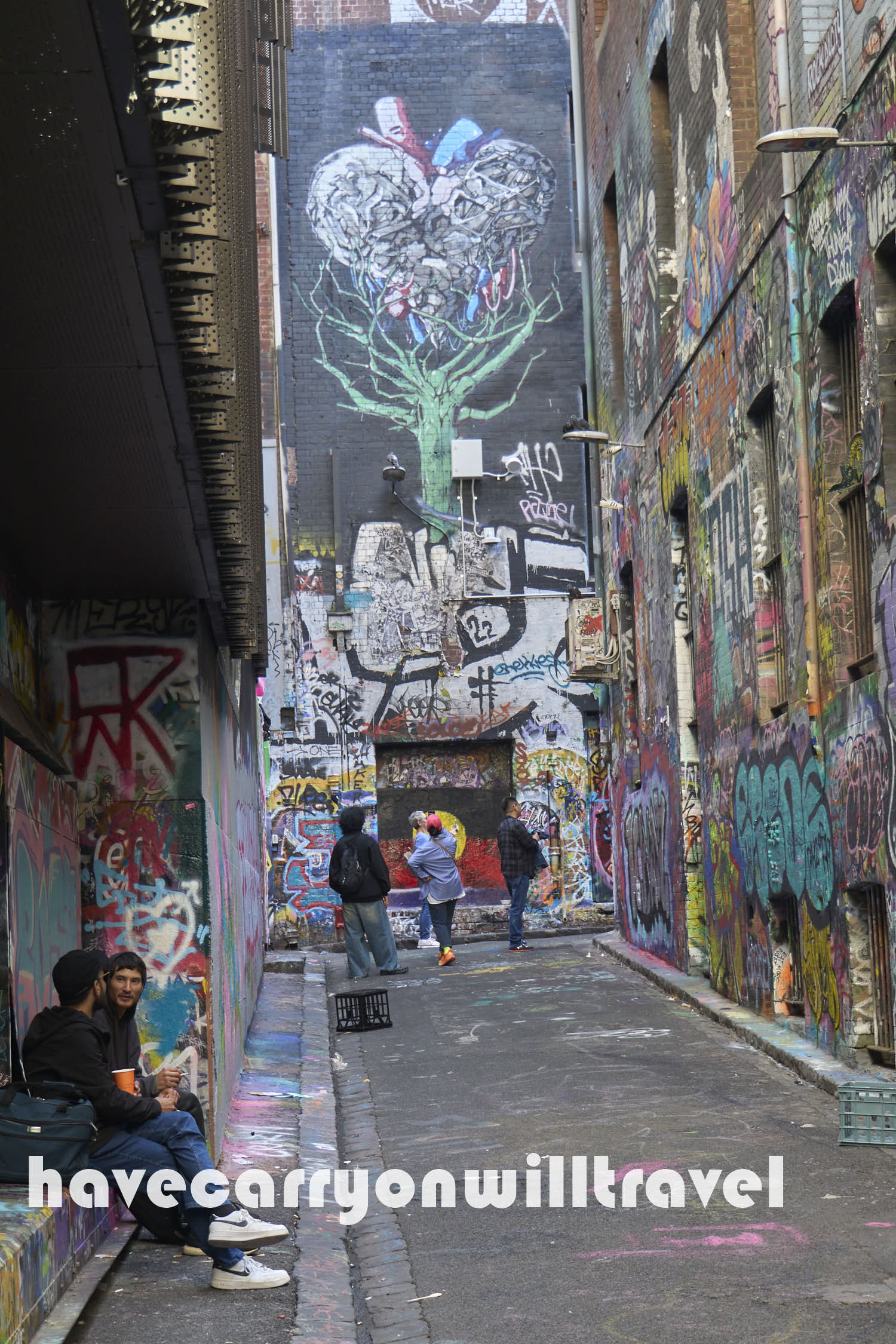
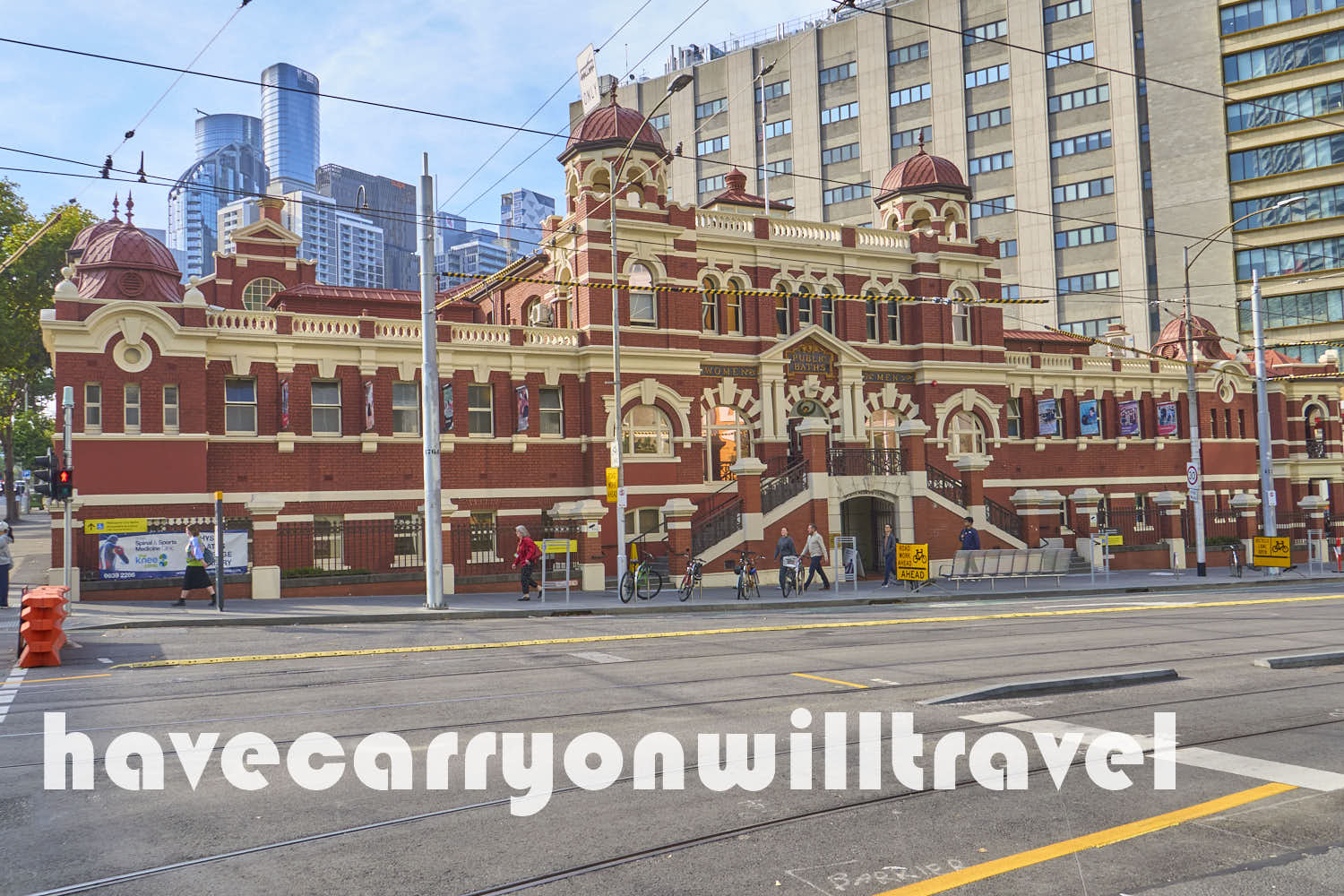
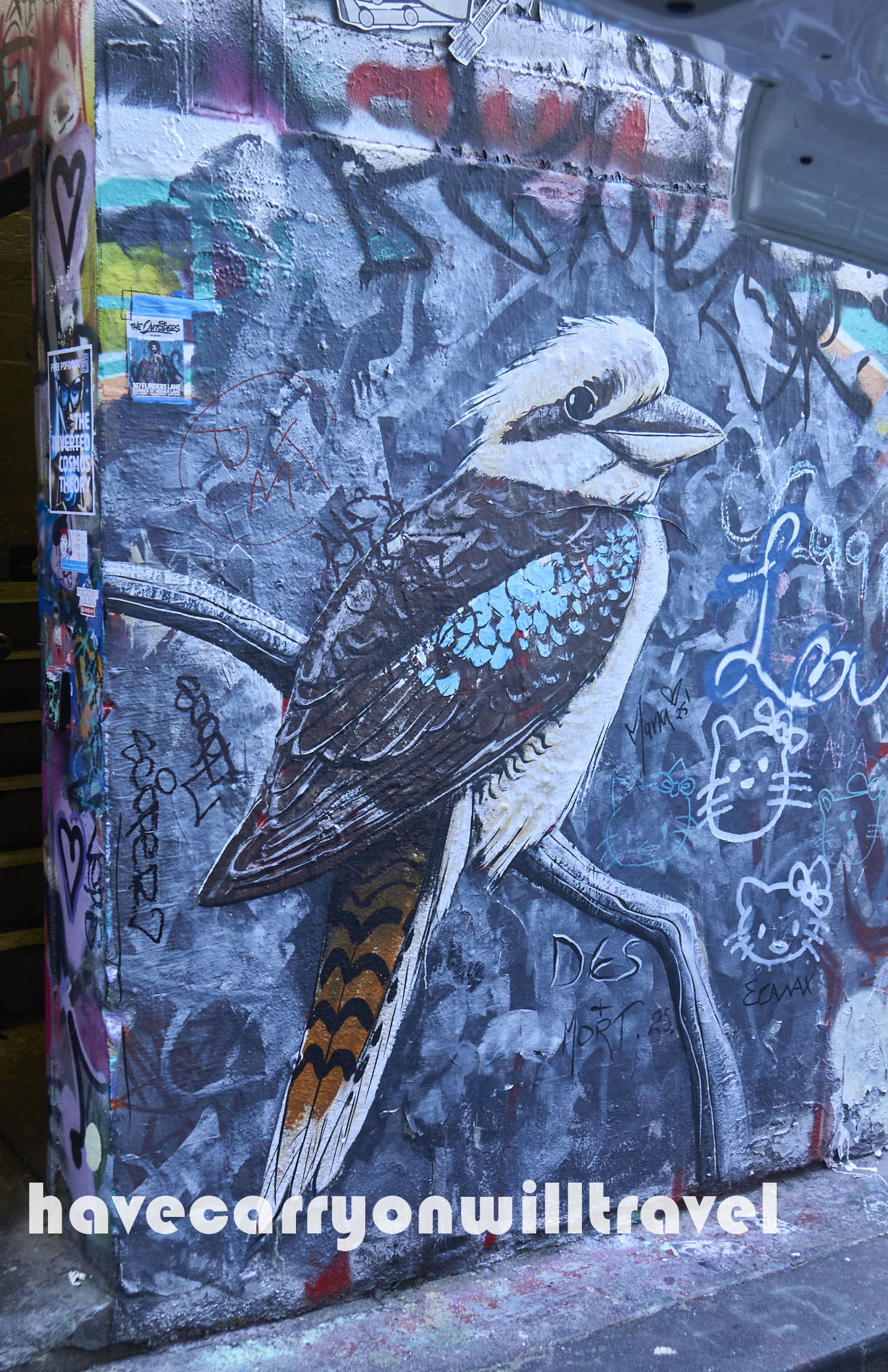
Flinders Lane is a popular spot for viewing graffiti. We run into a number of large Asian tour groups taking photos of the artwork. It is very cool to see all the side lane walls filled with graffiti artwork, both well done and not. There doesn’t seem to a code of conduct involved in the inclusion of artwork. Some artists just spray over existing pieces. Although there is a limited amount of space and this action does provide a constantly changing tapestry, is it bad form and not respectful toward the previous artist?
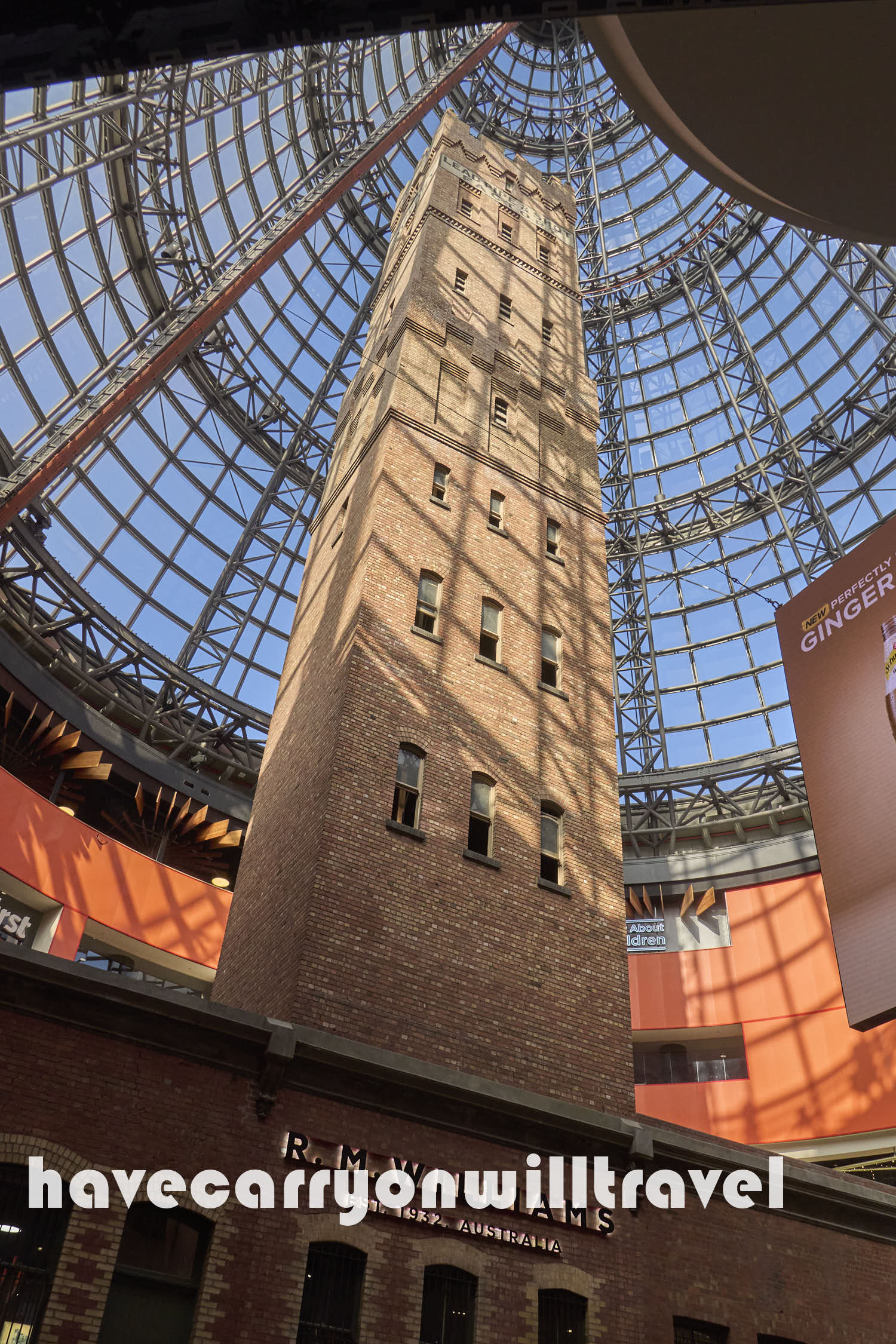
Most of the buildings decorated thus are older brick structures. The streets are a mix of modern and old architecture. This patchwork is everywhere in the city. In our home town of Edmonton the modus operandi is to rip it down and build something new. Here bits of the city’s history are maintained, the character and fabric developed as the city grew remains for the citizens and tourists alike.
Next stop, the ACMI, Australian Center for the Moving Image. We tour the rather large exhibit ‘The Story of the Moving Image.’ It is quite detailed and actually has TV sets from the 1950s, 60s and on ward. We chuckle as we had these antiques at home when we were kids! The exhibit also shows flip books, claymation, old movie techniques, right up to modern times with CGI. A ton of the displays are interactive and the kids as well as the adults are taking part. A super show and worthwhile visit if you are in Melbourne.
ACMI
For a respite we attend a piano concert in The Scots’ Church. Every two weeks the church has a free concert and this week’s was Berta Brozgul playing works by Mozart, Chopin and Scriabin. Murray found the music a bit unobtainable as it was rather disjointed. What it did do was show off the performer’s virtuosity. She is quite talented so the music accomplished that goal. That said it was enjoyable to get out of the hubbub and sit quietly listening to classical music.
Folks in Melbourne love their coffee. A number of coffee places have line ups outside their doors. All day long! We think we should join the line so we too can order a sought after coffee, but alas!, we do not drink coffee.
Murray writes…..We started out early this morning and the temp was cool, 13C. There were only very few people on the street. As 10 or 10.30 rolled around and the stores opened up a few more souls ventured out and there was a bit of sidewalk action. At 11.30 we sat down and had lunch. Out on the street again just after 12 and the crowds had thickened once more. After the hour and a half at the mini concert we step outside at 2.30. The sun had poked through the clouds, it was warm and the streets were crawling with people. Late risers, fair weather people I don’t know. Maybe it is just the regular rhythm of Melbourne.
Today we ticked off a good number of our ‘things to do in Melbourne’ bucket list. We have another full day tomorrow, and with good weather, we should polish off the rest of the list.
A few months ago, I happened on an ad for an art exhibit at the National Gallery of Victoria and I said to Murray that we should go see this. (More about the exhibit in a future post.) He said OK!, so today we flew from the Gold Coast Airport to Melbourne.
To get from the Melbourne airport into downtown, we book tickets on the Sky Bus, which takes us to the Southern Cross Train Station right downtown. The queue for the first bus gets cut off right in front of us, so we have to wait for the next one. A bonus actually, as a double decker bus pulls up so we have our choice of seats and, of course, pick the ones right in front on the top level. We play tourist and sight see on the 30 minute ride into the city. To our dismay the view was mostly of the freeway. 4 lanes wide in both directions for those that might care.
As we walk to our hotel, the Novotel Central, we notice that colour is used as an accent on buildings and there is a definite arty vibe here. The buildings are tall so the streets feel like canyons. The sky is blue but we are in the shade most of the time.
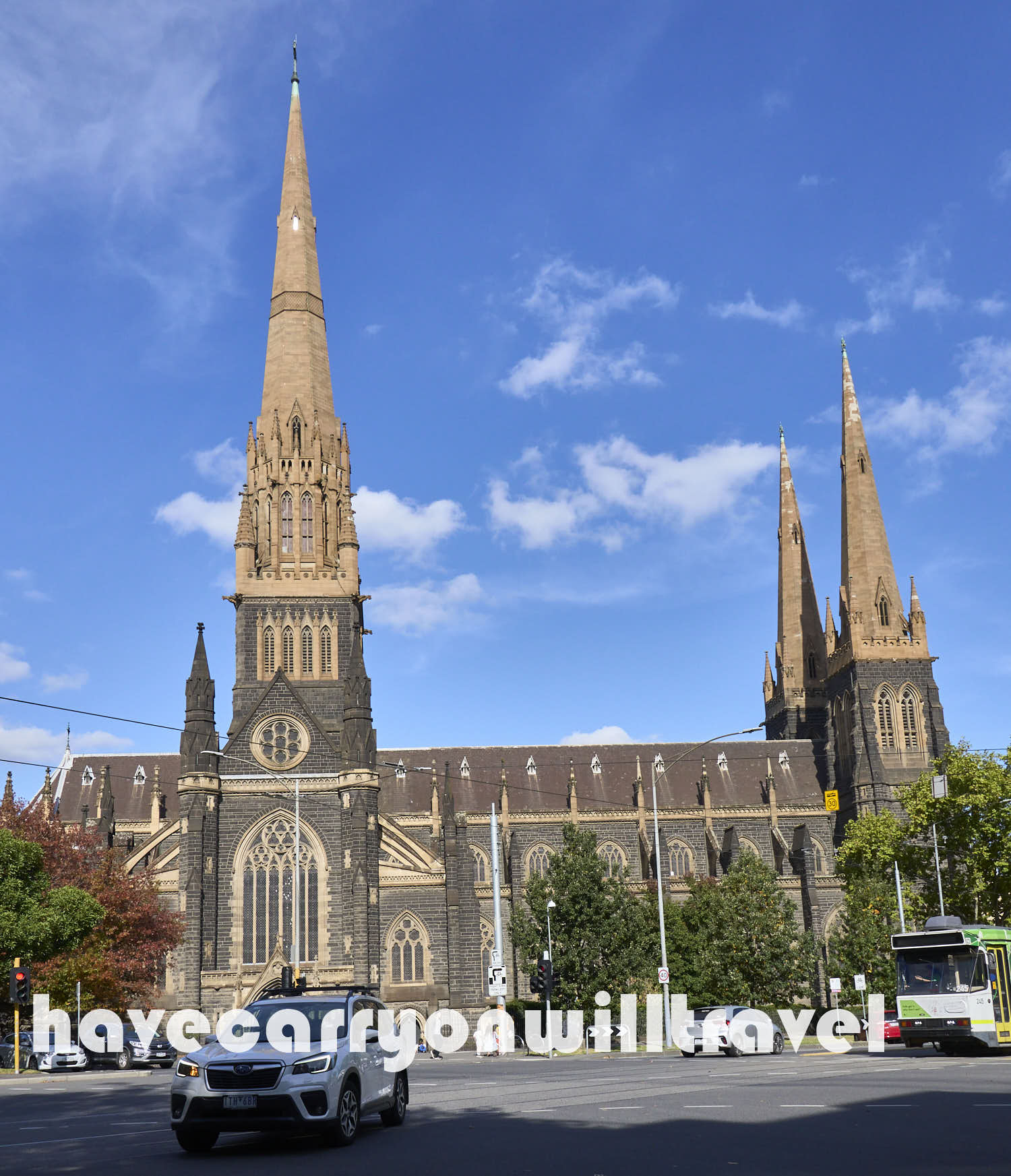
St Patrick’s Cathedral
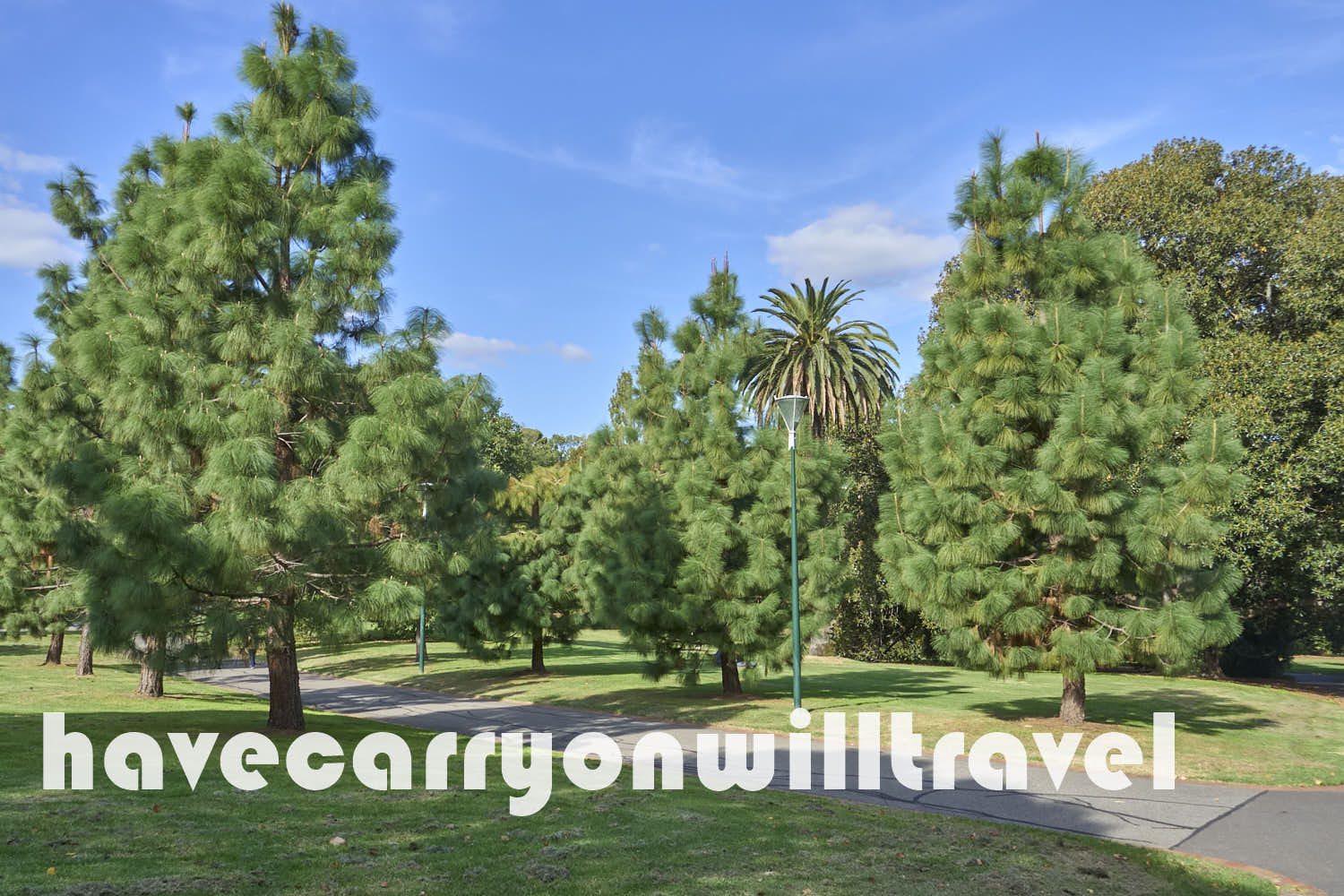
Once organized, we head out on our first exploration. We try riding the free tram – get off after two stops as it is so crowded it is silly. We are standing shoulder to shoulder. With our heads above window level we can’t see what we pass. This is most of the reason for getting on the tram. Best to cut our losses. Using our usual mode of transport we walk to St Patrick’s Cathedral, an impressive church built about 1870, and then through Fitzroy Gardens, a large park also dating from the mid 1800’s.The trees are enormous. It is quite obvious they have been around for almost 200 years.
Fitzroy GardensFitzroy Gardens
We meander through Chinatown and the shopping district before stopping for an early supper of Mexican food on Hardware Lane, a two block long lane filled with restaurants and bars. It is close to the hotel so we will return there for dinner in the next few days.
We didn’t get to see too much of Papua New Guinea. The expats that work there all had warnings about how dangerous it can be. Port Moresby was a definite no go. “Don’t leave the hotel compound.” Normally Debbie and I don’t pay too much attention to warnings like that but the reading I had done previously seemed to tingle my spidey sense so we felt it best to heed the word and sequester ourselves in the hotel.
We checked first but Alotau seemed like a user friendly place and we went into town to see what was up. It is a pretty typical SE Asian town. A little more sparsely built than most but pretty much the same stores, harbour, and produce market. The place is not very crowded with people either. No elbow-to-elbow jostling on the street and no other tourists. First, tourists are a rarity and second, tourists don’t wander around the area freely. The only other white people would be working in Papua and they don’t travel anywhere without security. Thus not much touring. The shuttle driver told us the even the locals don’t venture into the jungle. “Opportunists” lay in wait for any unsuspecting wanderer.
We did see a good number of islands during our sea bound travel. It is estimated the country has 600 islands within its bounds. Some of the ones we passed were very small and probably not counted in that number but they looked like an ideal spot for a mini vacation home.
The sky was quite stunning. The clouds of major interest. Sometimes they towered high in space. Sometimes they lined the edge of some island with perfectly flat bottoms and puffy tops. Sometimes they looked white as snow and like cotton batten. Sometimes they were black as coal and when the wind was right, we knew what was on its way.
All the locals we met on our journey were friendly, happy people. The kids had school holidays so every time we stopped near an island there was a flotilla of dugout canoes paddling out to see what was happening at the big white boat anchored in the bay. They were curious but they also had vegetables, fruit and fish for trade. Bananas and green stuff were traded for packages of itchi ban type noodles, the fish was traded for cash. We ate well.
When we were in KoKoPo, enroute to the airport, we heard that tribes/communities often are in conflict. The road to Rabaul is often closed to traffic due to the conflict between the communities in the area.
Just an aside because I don’t know where to include it, what is know as a ‘Speedo’ in North American is known as a ‘budgie smuggler’ in Australia and from what was mentioned in the safety briefing in Papua as well.
The diving was good but the touring not so much. If you want to go to PNG there are quite a few resorts around so if you want a “don’t go anywhere, relax” type holiday that is an option. You will most likely have to employ a guide to see the environs as they don’t seem to be tourist friendly. There are few dive resorts around so day diving is possible and of course there are two live a boards that ply the waters.
The Masurina Hotel, where we are staying, is uphill from the town center, so we ask the hotel if the van would give us a ride down to town and then pick us up again. It is extremely hot today and we would rather not walk the extra distance.
We start our walk on one end of the main road. There are supermarkets and hardware stores on every block, it seems. As we walk, we smile and say Hello or Goodmorning to folks. Older people respond much better than younger people.
We wander through a couple of markets, one quite small and the other large. The larger one has stalls selling beetle nut, tobacco braids, fresh seaweed, dresses and the usual edibles, such as taro, bananas, peanuts, limes, green beans and various prepared foods.
We cruise the supermarkets comparing prices to what we would pay. A CDN dollar for a small bag of Lays Chips. $600 for a washer/dryer combo. Gas is about the same price we pay in Alberta.
We walk down to the school and fire station and then turn around. School kids are streaming out of the secondary school, wearing coloured shirts since on Wednesday it is colour day and they all wear the colour of their house, or class. Every other day they wear a white shirt.
When we were dropped off, the driver told us to find a Masurina security guard, in a white shirt, at one of the supermarkets and ask him to radio the lodge to pick us up. It takes us three tries to find a guard that has a radio, being helped by each guard in turn. It works and after about 20 minutes, the van pulls up and we are off back to the hotel. Sweaty and hot, but satisfied with our tour.
We were told more than a number of times to be careful, watch out, don’t go! We had absolutely no issues and the people we met were friendly and polite. But, we have done this kind of walk in many cities and towns throughout the world, so know what we are doing, what danger zones and behaviours to look for. Be aware but do go for a walk here.